Reference Material I-2 / I-3 Valve
58 ©Vertical Express
Sequence of Events
(continued)
Up Slowdown and Leveling Speed
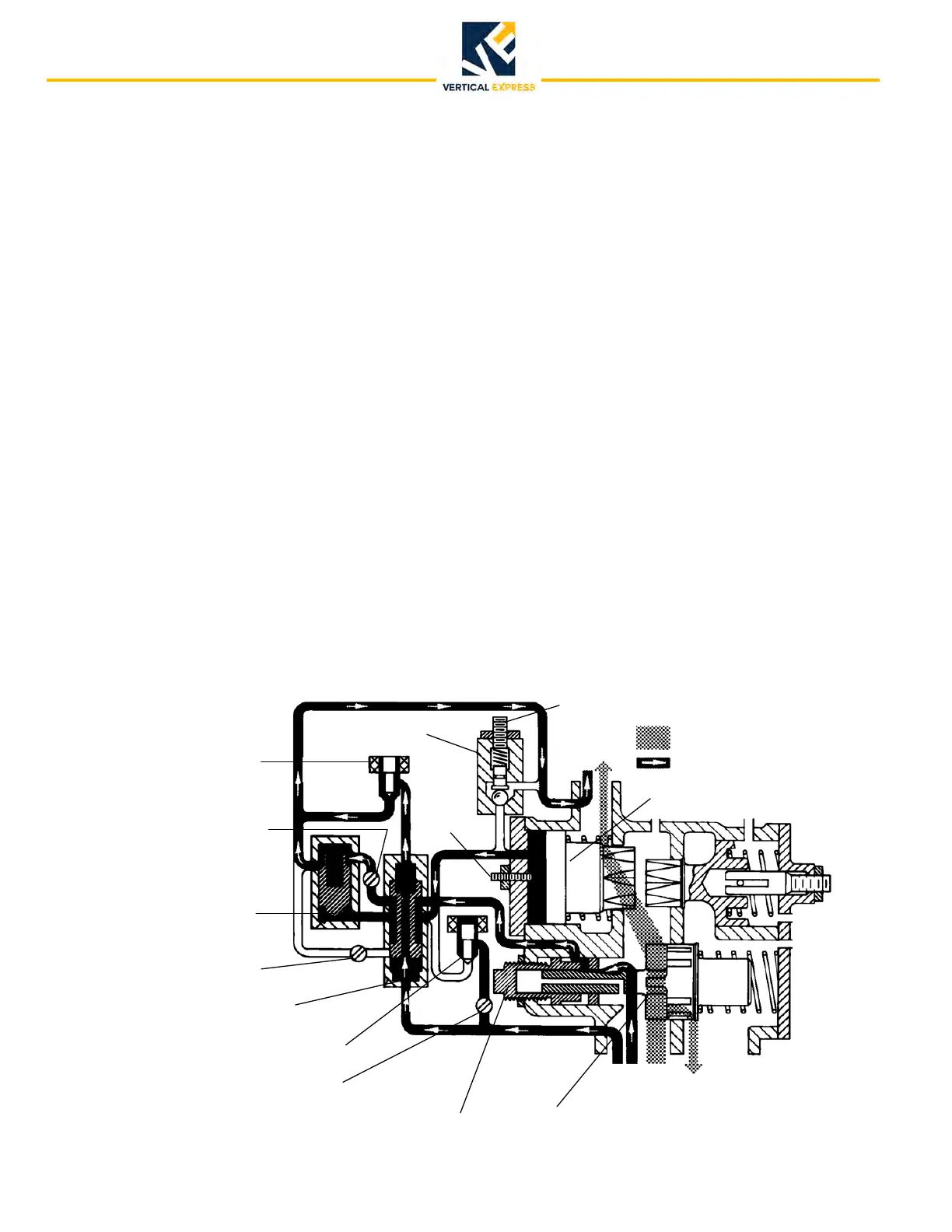
1. From slowdown to leveling speed, the up fast solenoid de-energizes, and the up slow
solenoid energizes. See Figure 9.
2. The pressure on the spring end of the up pilot piston reduces, and the up pilot piston
shifts to the up position.
3. The opening to the up stop adjustment closes, and the opening to the up slowdown
and leveling adjuster opens to the back of the regulator piston.
4. Pressure behind the regulator piston reduces as the oil flows out through the up slow-
down adjuster. The regulator piston starts to open.
5. The opening at the up slowdown adjuster determines the rate of oil flow from the low
pressure adjuster end of the regulator piston back into the tank, which controls the
rate of speed change. The wider the opening, the quicker the slowdown.
6. Valve pressure drops as the regulator piston opens. This action causes the check
valve piston to begin to close.
7. When the slot on the check valve piston reaches the hole in the leveling speed
adjuster, less oil flows from behind the regulator piston.
8. When the slot has opened enough to allow the same amount of oil to flow in the
leveling speed adjuster as the amount that flows out through the up slowdown
adjuster, the system reaches a hydraulic balance, known as leveling speed.
9. The leveling speed is changed by moving the hole in the leveling speed adjuster.
Figure 9 - Up Slowdown and Leveling Speed Diagram
TANK
MAIN FLOW
CONTROL FLOW
Relief Pressure Adjustment Screw
High-pressure
Relief Pilot
Up Slow Solenoid (Open)
Up Slowdown Adjustment
Pressure Control Piston
Up Stop Adjustment
Up Pilot Piston
Up Fast Solenoid (Closed)
Up Start Adjustment
Up Leveling Speed Adjustment Check Valve Piston
PUMP JACK
Regulator Piston
Low
Pressure
Adjustment


 To Next Page