
 Need help?
Do you have a question about the Vertiv NetSure Series and is the answer not in the manual?
 General
| Brand | Vertiv |
|---|---|
| Model | NetSure Series |
| Category | Control Unit |
| Language | English |
Warns of hazards that could result in death, serious, or moderate injury if not avoided.
Alerts reader to actions that must be performed or avoided to prevent damage.
Provides fire safety and general safety information, reminders, or policies.
Outlines essential safety procedures for handling equipment and avoiding hazards.
Details hazards and precautions related to AC, DC, and hazardous voltages.
Provides guidance on handling equipment with static sensitive components.
Instructs on discharging static electricity using wrist straps and proper grounding.
Details how to touch, handle, and place static sensitive components.
Covers storing, shipping, and repairing equipment containing static sensitive components.
Introduces rectifier function, key specs, operating modes, and DC output details.
Describes how input voltage affects rectifier output power and derating.
Explains how ambient temperature impacts rectifier output power and derating.
Details output voltage tolerance, static/dynamic regulation, and response characteristics.
Lists noise filtering compliance and explains automatic output capacitor discharge.
Covers behavior during interruptions, stability criteria, and high voltage tolerance.
Details harmonic content (THD) and inrush current characteristics.
Specifies temperature limits for operation with and without derating, and for storage.
Outlines humidity limits, altitude derating, and temperature coefficient.
Details surge protection, EMI/RFI suppression, ventilation, and safety compliance.
Lists audible noise levels and describes operating modes (Voltage, Power, Current).
Covers fuses, input voltage protection limits, and over-voltage disconnection.
Details overload, current limiting, and high voltage shutdown procedures.
Explains the AC fail alarm triggered by low AC input voltage.
Covers temperature protection, load sharing, hot-swap, alarms, and paralleling capability.
Details fan fault protection and variable fan speed control logic.
Explains the normal start-up sequence and current walk-in features.
Explains handling of communication loss and output current imbalance.
Highlights DSP monitoring and refers to external control/alarm circuit documentation.
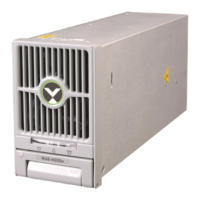
Provides dimensions, weight, and details of rectifier status indicators.
Recommends or requires specific AC input protection devices for the system.
Identifies and explains the functions of indicators on the rectifier's front panel.
Details the procedure for manual restart after a high voltage shutdown.
Provides a table correlating indicator status with possible causes and actions.
Step-by-step instructions for physically installing a rectifier into a mounting shelf.
Illustrates and explains the rectifier's latch mechanism for secure mounting.
Describes how to identify and resolve current sharing imbalances between rectifiers.
Lists fault indicators (LEDs) and refers to a troubleshooting table for causes.
Step-by-step guide for removing an operating rectifier from the shelf.
Details installing a new rectifier and verifying its normal operation.
Step-by-step instructions for replacing a failed rectifier fan.
Emphasizes checking the new fan's airflow direction after installation.





 To Next Page