65
Unsuitable fill and top-up water increases the level of
deposits and corrosion. This can lead to system dam-
age.
Hard water can also cause damage to the instantane-
ous heating water heater in particular.
Observe VDI 2035 regarding quality and amount of
heating water, including fill and top-up water.
■
Flush the heating system thoroughly before filling.
■
Only fill with water of potable quality.
■
Only fill and operate appliances that have an instan-
taneous heating water heater with softened water.
For further information about fill and top-up water: See
technical guide "Heat pump principles".
■
Move the control unit panel into the service position:
See page 86.
■
Open the programming unit:
See page 85.
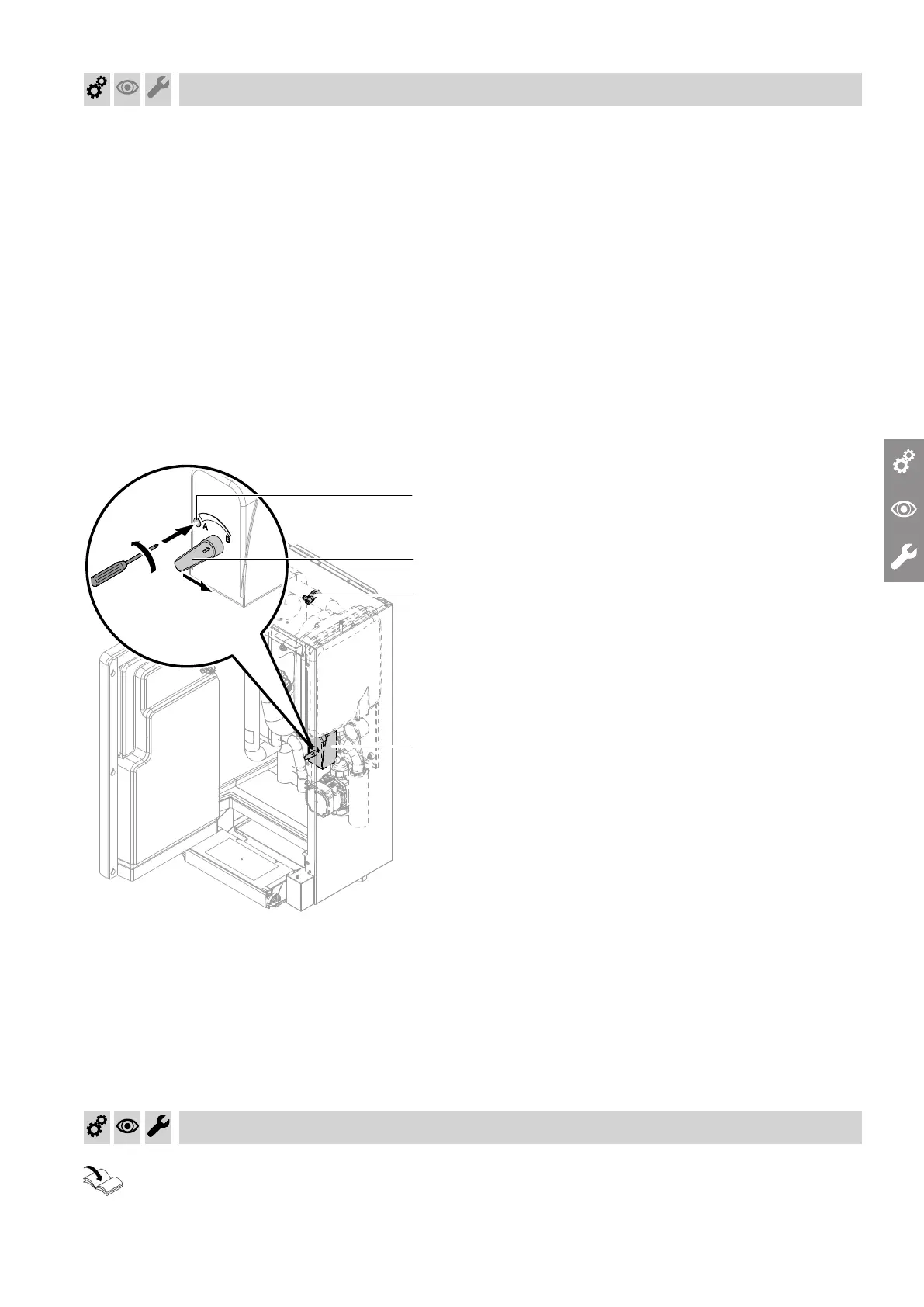
Fig. 60
01. Open any non-return valves installed on site.
02. Check the pre-charge pressure of the expansion
vessel. Adjust pre-charge pressure to system con-
ditions where necessary.
03. Fill (flush) and vent the secondary circuit via an
on-site connection.
!
Please note
Leaking hydraulic connections lead to appli-
ance damage.
■
Check the internal and on-site hydraulic
connections for leaks.
■
In the event of leaks, switch off the appli-
ance immediately. Drain off liquid via the
drain valve. Check the seating of seal
rings. Always replace displaced seal
rings.
04. Check the system pressure at the pressure gauge.
Top up with water if required.
■
Minimum system pressure:
0.8 bar (80 kPa)
■
Permissible operating pressure:
3.0 bar (0.3 MPa)
05. Move the control unit panel into the service posi-
tion.
06. Open the programming unit.
07. Connect the on-site hose to secondary circuit air
vent valve
B
.
!
Please note
Escaping liquids can lead to electrical
defects.
Protect electrical components from escap-
ing liquids.
08.
Open secondary circuit air vent valve
B
.
09.
Turn 3-way diverter valve
A
to central position:
Press
D
. Lock to "MAN" setting by turning to the
left. Move lever
C
to a vertical position.
10.
Close secondary circuit air vent valve
B
.
11. Turn the 3-way diverter valve clockwise to the
"AUTO" position.
Checking the expansion vessel and heating circuit pressure
Observe design information.
Heat pump technical guide
Commissioning, inspection, maintenance
Filling and venting the secondary side
6199585



 To Next Page