EasyManua.ls Logo

Viking 2780 - Page 21

Viking 2780
43 pages
Print Icon
To Next Page IconTo Next Page
To Previous Page IconTo Previous Page
Loading...
Assembling
garments
For
assembling
garments,
i.
e.
for joining
pieces
of
fabrics,
the
ordinary
straightstitch
is
no
longer
the
only
choice.
Many
modern
fabncs
require
stronger
and
more
stretchable
stiches
like
the
elastic
straightstitch
or
elastic
overlock.
Here
are
some
suggestions
fcr
obtaining
attractive
seams:
With
straightstitch:
3
is
the
normal
stitchlength,
but
the
structure
and
weave
of
different
fabrics
might
require
different
length
adjustments
so
that
the
stitches
will
blend
attractively
into
the
weave
of
the
fabric.
Use
shorter
stitches
for
thin
fabric,
but
remember
that
excessively
short
stitches
give
a
puckered
seam
and
excessively
long
stiches
a
loose
seam.
With
elastic
straightstitch
=
triple
safety-seam:
Use
a
rather
fine
thread, preferably
embroidery
cotton or
synthetic
thread.
Helpful
hint:
Baste
the
seams
with
ordinary
straightstitch,
stitchlenght
4
with
thread
of
same
color
as
the
fabric.
When
you
have
tried
on
the
garment,
you
can
fill
in”
the
seams
with
elastic
straight
stitch.
It
will
not
be
necessary
to
remove
the
basting
thread,
if
you
sew
exactly
along
the
basted
seam.
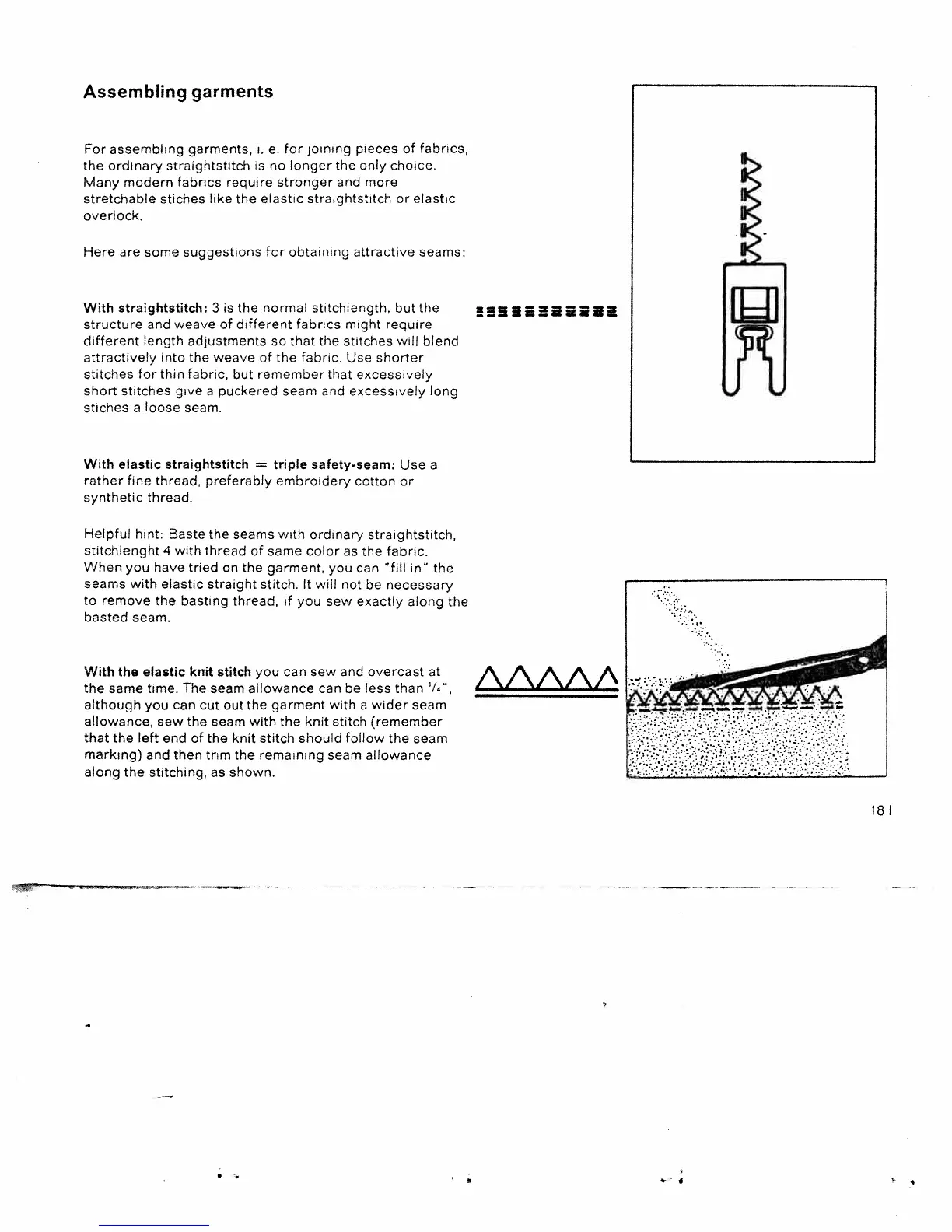
With
the
elastic
knit
stitch you
can
sew
and
overcast
at
the same
time. The
seam
allowance
can
be
less
than
V
4
although
you
can
cut
out
the
garment
with
a
wider
seam
allowance,
sew
the
seam
with
the
knit
stitch
(remember
that
the
left
end
of
the
knit
stitch
should
follow
the
seam
marking)
and
then
trim
the remaining
seam
allowance
along
the
stitching,
as
shown.
AAAA/\
181
d

Related product manuals