EasyManua.ls Logo

Viking 2780 - Page 23

Viking 2780
43 pages
Print Icon
To Next Page IconTo Next Page
To Previous Page IconTo Previous Page
Loading...
Sewing
knit
and
stretch
fabrics
These
types
of
fabric
account
for
well
over
50%
of
all
garments
made.
Common
to
all
of
them
is
that
they
stretch
and
therefore
require
an
elastic
seam,
such
as
the
elastic
straightstitch,
knit
stitch
or
the
elastic
blind
hem,
all
available
on
your
sewing
machine.
The
most
suitable
stitches
to
use
when
assembling
a
knitted
fabric
garment
are
the
elastic
straightstitch
or
the
knit
stitch.
Elastic
straightstitch
is
used
when
you
want
seam
allowances
pressed
open.
The
knit
stitch
sews
the
parts
together
and
finishes
the
seam
allowance
in
one
operation.
Here
a
fine
and
proper
needle
(70—80)
is
needed.
Elastic
straightstitch
Use
fine
thread,
preferable
embroidery
cotton
or
synth.
thread.
After
selecting
the
elastic
straightstitch
it
is
possible
to
make
slight
adjustments
to
the
stitchlengths.
In
case
the
fabric
is
very
elastic,
the
upper
thread
tension
can
be
loosened
somewhat
for
knits
with
a
higher
degree
of
stretch.
-
Helpful
hint:
Baste
the
seams
with
ordinary
straightstitch,
stitchlength
4
and
thread
the
same
color
as
the
fabric.
When
you
have
tried
on
the
garment,
you
can
‘fill
in
the
seams
with
an
elastic
straight
seam.
It
is
not
necessary
to
remove
the
basting
thread
if
you
sew
exactly
along
the
basted
seam.
You
can
use
the
elastic
straightstitch
for
decorative
top
stitching
as
well.
It
may
be
desirable
to
loosen
the
upper
thread
tension
a
little.
For
sharper
creases
in
trousers
etc.
in
doble
knits
you
can
sew
them
with
a
twin
needle
using
elastic
straightstitch.
Use
the
raised
seam
presser
foot
and
the
gimp
guide,
but
do
not
use
a
gimp
thread.
Sew
the
trouser
creases
before
joining
the
side
and
inner
leg
seams.
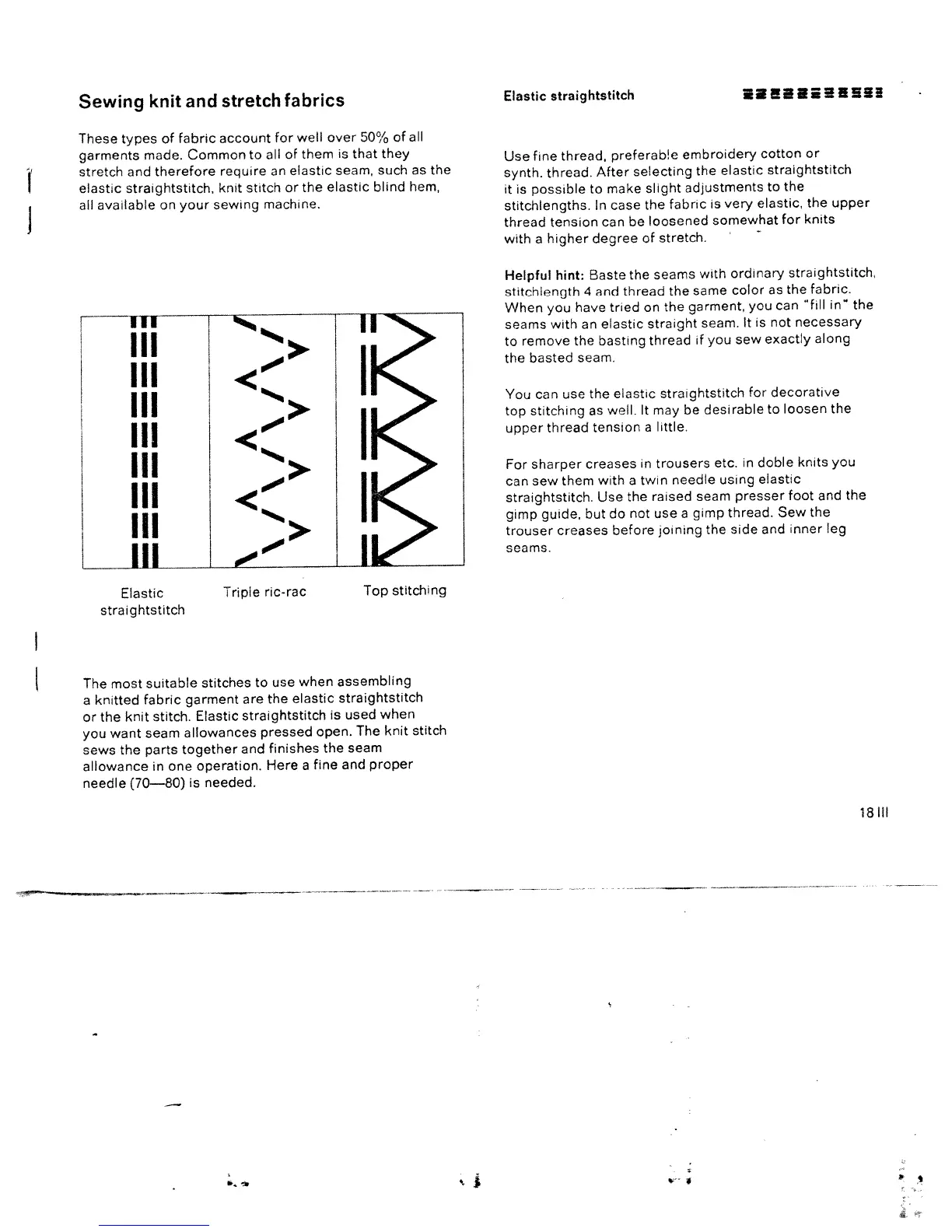
Elastic
Triple
ric-rac
Top
stitching
straightstitch
18111

Related product manuals