Need help?
Do you have a question about the Viking VESO1302SS and is the answer not in the manual?
Essential safety precautions to prevent fire, explosion, and injury.
Critical safety information to be read before operating the oven.
Guide to setting the time-of-day on digital and analog displays.
Explanation of controls for Professional and Designer series ovens.
Overview of the physical components and features of the electric oven.
Details on various baking, broiling, and convection modes available.
Instructions for using the digital and analog timing center and setting timers.
How to use the meat probe for precise temperature cooking.
Guidance on using oven racks and general cooking procedures.
Chart detailing food types, pan sizes, rack positions, temps, and times.
Common baking issues and their recommended solutions.
Techniques and tips for roasting meats and poultry.
Charts for convection roasting times and temperatures for various foods.
Guidelines for using high, medium, and low broil settings.
Quick reference for broiling times and settings for different meats and poultry.
Procedures for convection dehydrate and defrost functions.
Instructions for cleaning knobs, stainless steel, brass, racks, and probe.
Common oven problems and their possible causes and remedies.
What to do if the oven fails to operate and contact information.
Comprehensive warranty information for built-in electric ovens.
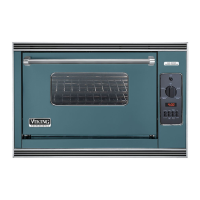
The Viking Built-In Electric Single and Double Ovens are designed for quality and performance, offering a broad range of cooking modes to suit various culinary needs. With up to eight cooking modes, these ovens are versatile enough for challenging baking projects. Key features include split baking and broiling elements that reduce preheating time and provide greater control and more even heating, ensuring consistent results. A reversing fan, twice the size of most on the market, promotes thorough and even cooking, especially when baking large quantities.
The ovens offer four convection modes, enhancing air circulation to shorten cooking times and cook foods more evenly. For broiling, there are dual broiling elements that produce intense radiant heat for faster broiling and a larger coverage area. Three broiling modes are available, including a low-broil mode for delicate broiling and top-browning. A new lighting system provides more light with less glare, improving visibility inside the oven. Cleaning is made easier with a profiled, hidden bake element. With six adjustable rack positions, these ovens offer the largest usable baking space in their class.
The control panel features an Electronic Timing Center for programming and controlling all timing functions. The time-of-day must be set before any other program can be used. The temperature control dial allows settings from 200°F (93.3°C) to 550°F (287.8°C), with separate settings for broiling and self-cleaning. The oven function selector includes options like Bake, Convection Bake, TruConvect™, High-Broil, Medium-Broil, Low-Broil, Convection Broil, Convection Roast, and Self-Clean.
The interior oven lights are controlled by a single switch on the control panel. The Two-Element Bake function uses full power from both the bottom bake element and supplemental heat from the broil element, ideal for single-rack baking and dishes requiring high temperatures. TruConvect™ uses only the rear element and a motorized fan for even heating, suitable for delicate foods like pastries, soufflés, and yeast breads, as well as multi-rack baking. Convection Bake utilizes the bottom element and supplemental top broil element with a motorized fan for even heat distribution, allowing multi-rack cooking and efficient thawing of frozen food.
Convection Roast combines the convection element with inner and outer broil elements and a high-speed reversible fan to seal moisture in roasts, offering time savings. Convection Broil uses the top element at full power with a motorized fan to reduce smoke and is suitable for broiling thick cuts of meat. The Self-Clean cycle is a pyrolytic process that burns off soils and deposits at elevated temperatures, with an integral smoke eliminator to reduce odors. Convection Dehydrate uses TruConvect™ at 200°F (93.3°C) to circulate warm air for drying fruits and vegetables, while Convection Defrost uses the fan without heat to accelerate natural defrosting.
For timing, the Min/Sec Timer can be set for up to 24 hours for precise cooking of delicate items. The Bake Hours and Start Time modes allow automatic oven turn-on and turn-off at preselected times, ideal for foods that won't spoil. The meat probe, available on Premiere Models, takes the guesswork out of roasting by automatically turning off the oven when the desired internal temperature is reached. It's recommended to set the probe temperature about 10°F (4°C) lower than the desired internal temperature, as the meat will continue to cook while "standing."
Maintenance involves regular cleaning of oven surfaces. Control knobs should be pulled straight off, washed with detergent, and dried. Stainless steel parts should be wiped with hot soapy water or a liquid cleaner, avoiding abrasive materials. Brass parts, if special ordered, have an epoxy coating and should be cleaned with everyday household cleaners, not brass cleaners or abrasives. The broiler pan and grid should be cleaned with detergent and hot water, using a soap-filled steel wool pad for stubborn spots. Oven racks should be cleaned with detergent and hot water; they should NOT be cleaned using the Self-Clean cycle as this can cause damage. The meat probe can be cleaned with soap and water or a soap-filled scouring pad, but should not be immersed in water or stored in the oven.
Before starting the Self-Clean cycle, oven racks and other utensils must be removed to prevent discoloration or damage. Large spills should be wiped off, and areas like the door gasket and frame should be cleaned by hand. The Self-Clean cycle automatically locks the door and reaches elevated temperatures to burn off soils, leaving a powder ash residue to be wiped away after the oven cools. For replacing interior halogen oven lights, the electric power must be disconnected, and the bulb handled with a soft cloth. The glass light cover unsnaps, the bulb is pulled out, replaced with a 12V-25W halogen bulb, and the cover snapped back into place before reconnecting power. The oven should not be used during a power failure.


 To Next Page
 General