

EasyManua.ls Logo

VQ CESSNA 208 - User Manual

VQ CESSNA 208
28 pages
Print Icon
To Next Page IconTo Next Page
Loading...
SPECIFICATIONS
Wingspan:.....................................1700mm
Length:...........................................1175mm
Electric Motor:.....................See next pager
Glow Engine:.................... .46 2-T / .70 4-T
RTF Weight: 3.2Kg / 7.05lbs (Will vary with
Equipment Used).
Radio:......................6 Channel / 6-7 Servos
Function: Ailerons-Elevator-Rudder-Throttle
Flaps.
WARNING! This radio controlled model is NOT a toy. If modified or flown carelessly it could go out of controll and
cause serious human injury or property damage. Before flying your airplane, ensure the air field is spacious enough.
Always fly it outdoors in safe areas and seek professional advice if you are unexperienced.
ACHTUNG! Dieses ferngesteuerte Modell ist KEIN Spielzeug! Es ist für fortgeschrittene Modellflugpiloten bestimmt,
die ausreichende Erfahrung im Umgang mit derartigen Modellen besitzen. Bei unsachgemässer Verwendung kann
hoher Personen- und/oder Sachschaden entstehen. Fragen Sie in einem Modellbauverein in Ihrer Nähe um
professionelle Unterstätzung, wenn Sie Hilfe im Bau und Betrieb benötigen. Der Zusammenbau dieses Modells ist
durch die vielen Abbildungen selbsterklärend und ist für fortgeschrittene, erfahrene Modellbauer bestimmt.
Radio control model / Flugmodel
ALL BALSA, PLYWOOD CONSTRUCTION AND ALMOST READY TO FLY
Instruction manual / Montageanleitung
TECHNISCHE DATEN
Spannweite:...................................1700mm
Lange:............................................1175mm
Elektroantrieb.............(siehe nächste Seite)
Verbrennerantrieb:...............7.45cc - 11.5cc
Fluggewicht:.......................................3.2Kg
Fernsteuerung.............6 Kanal / 6-7 Servos
CESSNA 208
Question and Answer IconNeed help?

Do you have a question about the VQ CESSNA 208 and is the answer not in the manual?

Summary

Required Items and Symbols

Required For Operation

Minimum 6 channel radio for airplane with 2 standard servos and four servo mini. Includes engine/motor requirements.

Adhesives and Tools Required

Lists glues like Thread locker, CA, Epoxy, and tools such as hobby knife, pliers, screwdriver, scissors, and cutters.

Assembly Symbols Guide

Explains symbols for drilling, glue types, covering removal, left/right assembly, and parts not included.

Measurement Conversion Table

Provides conversion between millimeters and fractional inches for measurements used in the manual.

Nose Gear Installation

Mount Nose Gear Strut

Attaching the nose gear strut assembly to the fuselage using 3x20mm screws.

Engine Mount Preparation

Attach Engine Mount Beams

Securing engine mount beams to the firewall, ensuring proper alignment and distance.

Mark and Drill Firewall Holes

Marking and drilling 6mm holes on the firewall for engine mount beam attachment.

Engine Mount and Engine Installation

Install Blind Nuts and Mount Beams

Inserting blind nuts and securing engine mount beams with 4x25mm screws.

Position Engine and Mark Holes

Positioning the engine with a 130mm prop hub to firewall distance and marking drill points.

Drill Engine Mounting Holes

Drilling 3mm holes perpendicular to the engine mount beam for engine attachment.

Engine and Electric Motor Mounting

Secure Engine to Mount Beams

Repositioning the engine and securing it to the mount beams with 3x25mm screws and sealant.

Prepare Electric Motor Mount Plate

Marking and drilling holes on a plywood motor mounting plate using an aluminum template.

Electric Motor Fire Wall Attachment

Mark and Drill Fire Wall

Marking the fire-wall with a wooden motor plate and drilling 5mm holes for mounting.

Attach Wooden Motor Mount

Securing the wooden motor mounting plate to the fire-wall with 5x80mm bolts and nuts.

Electric Motor Installation

Mount Motor to Wooden Plate

Securing the motor to the wooden motor mounting plate using 3mm bolts.

Adjust Motor Position

Adjusting the wooden motor mount for a 130mm prop hub to fire-wall distance.

Main Landing Gear Assembly

Attach Main Landing Gear Struts

Securing the main landing gear struts to the wing using 3x15mm screws.

Secure Lower Landing Gear Plates

Attaching the lower plates of the main landing gear using 4x20mm nylon bolts.

Main Wheel Installation

Mount Main Wheels

Securing the 75mm wheels to the landing gear using screws, nuts, and washers.

Horizontal Stabilizer Preparation

Prepare Covering for Stabilizer

Cutting away covering around slots for horizontal stabilizer and vertical fin installation.

Align and Trace Stabilizer

Inserting stabilizer, checking alignment, and tracing its outline on the fuselage.

Cut Stabilizer Covering

Carefully cutting away covering inside traced lines on the fuselage for stabilizer fit.

Horizontal Stabilizer and Vertical Fin Attachment

Glue Horizontal Stabilizer

Installing the horizontal stabilizer onto the fuselage and applying CA glue for secure attachment.

Attach Vertical Fin

Carefully inserting and securing the vertical fin into its slot on the fuselage.

Vertical Stabilizer Alignment and Gluing

Align Vertical Stabilizer

Ensuring the vertical stabilizer is perpendicular to the horizontal stabilizer and tracing its outline.

Glue Vertical Stabilizer

Applying thin CA glue to the vertical stabilizer where it contacts the fuselage and hinge.

Final Vertical Stabilizer Gluing

Glue Vertical Stabilizer Sides

Applying thin CA glue to the right and left sides of the vertical stabilizer hinge.

Wing Servo Installation

Install Aileron;Flap Servos

Sliding aileron extension cord into the wing and installing flap and aileron servos.

Wing Linkages Setup

Prepare Wing for Linkages

Cutting away covering on the wing to access linkage points.

Install Control Horns and Rods

Attaching control horns and connecting rods for flap and aileron linkages with CA glue.

Wing Brace Installation

Attach Wing Brace

Securing the wing brace to the wing using 3x12mm screws.

Wing Fairing Installation

Attach Wing Fairings

Attaching top (Piece A) and bottom (Piece B) fairings to the wing using tape and CA glue.

Wing Light Installation

Install Wingtip Lights

Securing light components to the wingtip using screws and applying CA glue.

Wing Light Connections

Connect Wing Lights

Connecting the light components, noting that parts might not be included.

Control Linkage Setup

Elevator Linkages

Connecting elevator pushrods to the servo and control horns.

Rudder & Nose Gear Linkages

Connecting rudder and nose gear pushrods to their respective servos.

Wing Joining Preparation

Prepare Fuselage for Wings

Ensuring blind nuts inside the fuselage are positioned for easy wing brace installation.

Wing Attachment and Cowling

Attach Wings to Fuselage

Securing the wings to the fuselage using screws and CA glue.

Install Cowling and Muffler

Securing the muffler to the cowl using CA glue and epoxy.

Strut and Nose Wheel Assembly

Assemble Strut and Nose Wheel

Securing the strut to the nose wheel assembly using screws, washers, and nuts.

Pilot and Canopy Installation

Install Pilot Figures

Gluing pilot figures into the cockpit area.

Attach Canopy Cover

Securing the canopy cover to the fuselage using screws.

Hatch and Cargo Area

Attach Magnetic Hatch

Gluing the magnetic hatch to the fuselage.

Drill Cargo Area

Drilling a hole in the cargo area using a 4x20mm nylon bolt.

Decal Application Instructions

Apply Model Decals

Instructions for cutting out and applying various decals (N950HL, DHL, SOUTHERN AIRWAY EXPRESS) to the model.

Final Checks and Setup

Set Center of Gravity (CG)

Balancing the plane upside down with an empty fuel tank, CG at 65-68mm from leading edge.

Adjust Control Surface Throws

Setting recommended throws for control surfaces for optimal flight performance.
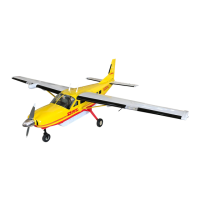
VQ CESSNA 208 Specifications

General IconGeneral
BrandVQ
ModelCESSNA 208
CategoryToy
LanguageEnglish