Sound Parameters – Oscillators Introduction
Waldorf microQ User´s Manual 54
The Sawtooth Wave
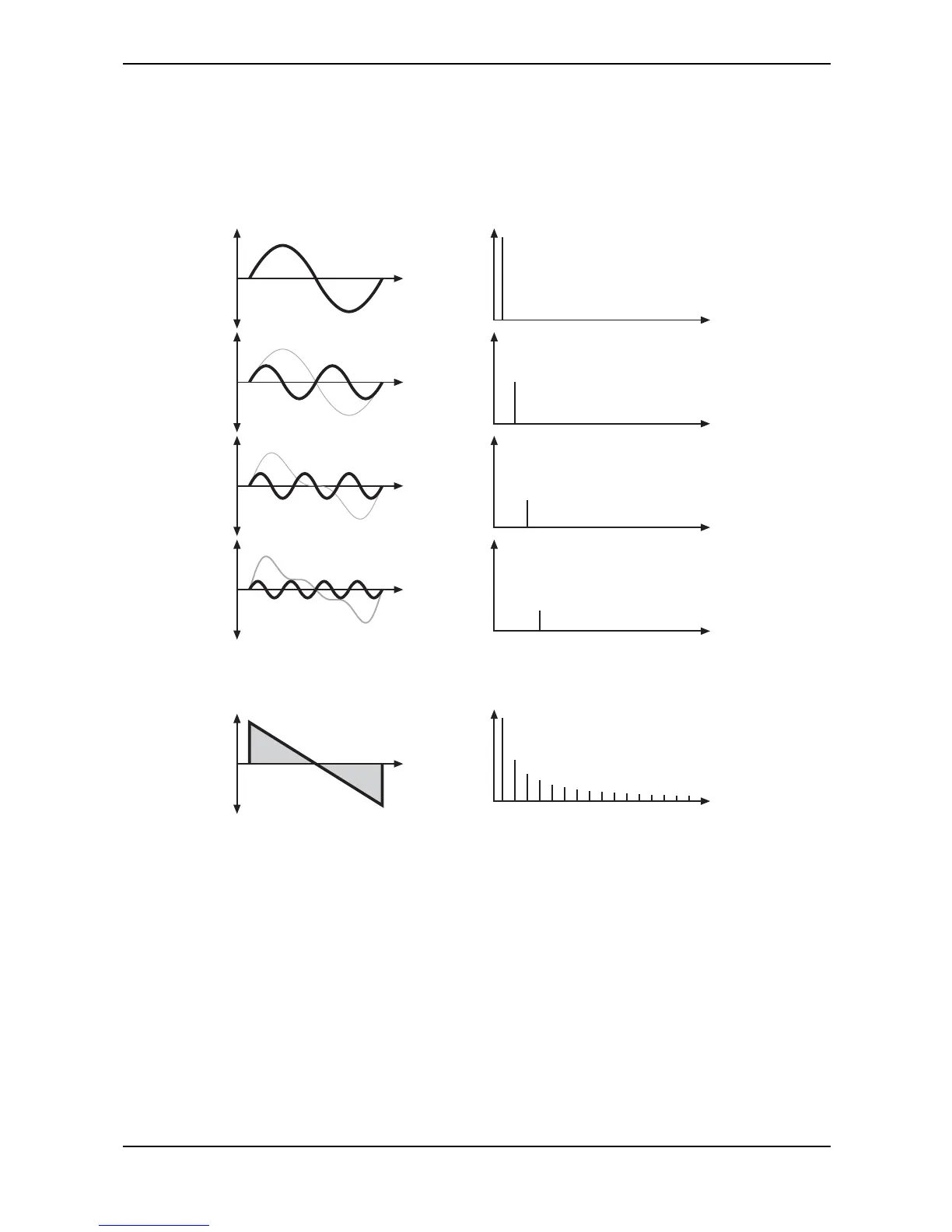
The Sawtooth Wave is the most popular synthesizer waveform. It consists of all harmonics in which
the magnitude of each harmonic descends by the factor of its position. This means that the first
harmonic (the fundamental) has full magnitude, the second harmonic has half magnitude, the third
harmonic has a third magnitude and so on. The following picture shows how the individual
harmonics build up the sawtooth wave:
14 81216
Frequency
Magnitude
Time
Amplitude
+
=
1st Harmonic
Magnitude 1
2nd Harmonic
Magnitude 1/2
3rd Harmonic
Magnitude 1/3
4th Harmonic
Magnitude 1/4
Harmonics
+
+
+
.
.
Picture 7: Additive components of the Sawtooth wave
The sawtooth wave was thought as an abstraction of the timbre of string and brass instruments. You
can easily understand that when you think of a violin. Imagine a bow pulling the string slightly into
one direction. At one point, the string abruptly comes off the bow and swings back to its original
position. The bow is still moved and so it catches the string again and the procedure is repeated. The
result is a waveform that looks like a sawtooth. The same is true for a brass instrument. The string in
this case are the lips while the bow is the air. The lips are moved by the air to a certain extent and
abruptly move back to their original position.



 To Next Page