Need help?
Do you have a question about the Waldorf microQ and is the answer not in the manual?
Details available software and hardware upgrades for the microQ series.
List of available merchandise, soundsets, and accessories.
Information on product warranty coverage and claims process.
Contact options for technical assistance and product inquiries.
Credits for the software and hardware development team.
List of individuals and entities thanked for their contributions.
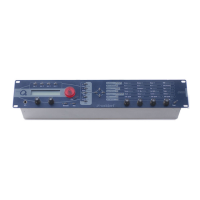
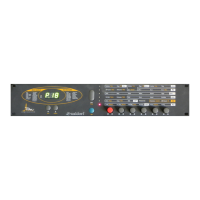
Overview of controls and connections on the rackmount unit's front panel.
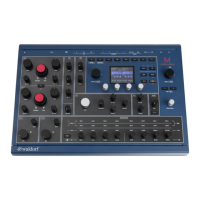
Overview of controls and connections on the keyboard unit's front panel.
Description of rear panel connections for the rackmount unit.
Description of rear panel connections for the keyboard unit.
Explains the manual's scope, terminology, and symbols used.
Guidance on which chapters to read based on user experience level.
Precautions for safe and proper operating environments and power supply.
Instructions on correct usage and device maintenance procedures.
List of items included with the microQ synthesizer.
Recommendations for placing and connecting the microQ unit.
Details on connecting audio outputs and inputs for signal routing.
Information on using external audio inputs and pedal/CV connections.
Description of the microQ's memory architecture for sounds and multis.
Explanation of how voice polyphony is managed dynamically.
Procedures for powering the microQ on/off and using the panic function.
Adjusting volume, using demos, and understanding the master control section.
Methods for choosing sounds, multis, and managing instruments.
How to adjust parameters, use menus, buffers, and save edits.
How to choose an instrument within a Multi for parameter adjustment.
Detailed parameters for instruments and the multi mixer.
Details on FM, Fast, and Standard modulation speeds.
How notes trigger voices and control envelope behavior.
Controls for pitch, tuning, FM, waveform selection, and edit menus.
Controls oscillator volumes, noise, external input, and filter routing.
Controls for cutoff, resonance, drive, modulation, and filter types.
Controls for volume, effects, and arpeggiator parameters.
Details on Chorus, Flanger, Phaser, Overdrive, Vocoder, Delay, Reverb effects.
Features and parameters for creating and customizing rhythmic patterns.
Configuring ADSR, ADS1DS2R, One Shot, and Loop envelope types.
Controls for Low Frequency Oscillators used for sound modulation.
Setting up complex modulation routings between sources and destinations.
Device-wide settings for MIDI, clock synchronization, and system behavior.
Functions for initializing sounds, multis, and drum maps to default values.
Table mapping MIDI controllers to sound parameters and value ranges.
How the microQ handles MIDI notes, aftertouch, and controllers.
Controlling parameters and dumping data using MIDI.
Instructions for updating the microQ's operating system via MIDI.
Procedure to reset the microQ to factory default settings.
Useful advice for optimizing sound design and performance.
Strategies for maximizing polyphony and processing power.
An alphabetical index of all controllable parameters and their page numbers.
Definitions of technical terms used throughout the manual.
Technical MIDI data and protocol information for the microQ.
Regulatory compliance statements for the device.
 General
| Polyphony | 16 voices |
|---|---|
| Oscillators | 3 oscillators per voice |
| Filter | 2 multi-mode filters per voice (Lowpass, Highpass, Bandpass, Notch) |
| Arpeggiator | Yes |
| MIDI | In, Out, Thru |
| Synthesis Type | Virtual Analog |
| Timbrality | Multitimbral |
| Waveforms | Sawtooth, Square, Sine, Triangle, Pulse |
| LFO | 2 LFOs |
| Effects | Reverb, Delay, Chorus |
| Memory | 128 presets |
| Headphone Output | 1/4" stereo headphone jack |
| Display | LCD |
| Type | Virtual Analog Synthesizer |
| Keyboard | No keyboard (desktop module) |


 To Next Page