Sound Parameters – Oscillators Introduction
Waldorf microQ User´s Manual 56
The Pulse Wave
The Pulse Wave is the most versatile wave in a classic synthesizer because its shape and therefore its
harmonic content can be changed in real time. This is done by changing the width of the upper and
lower portion of the waveform cycle. These portions are called pulses, hence the name pulse width.
The width of the first pulse is used to distinguish between different pulse waves and it is measured in
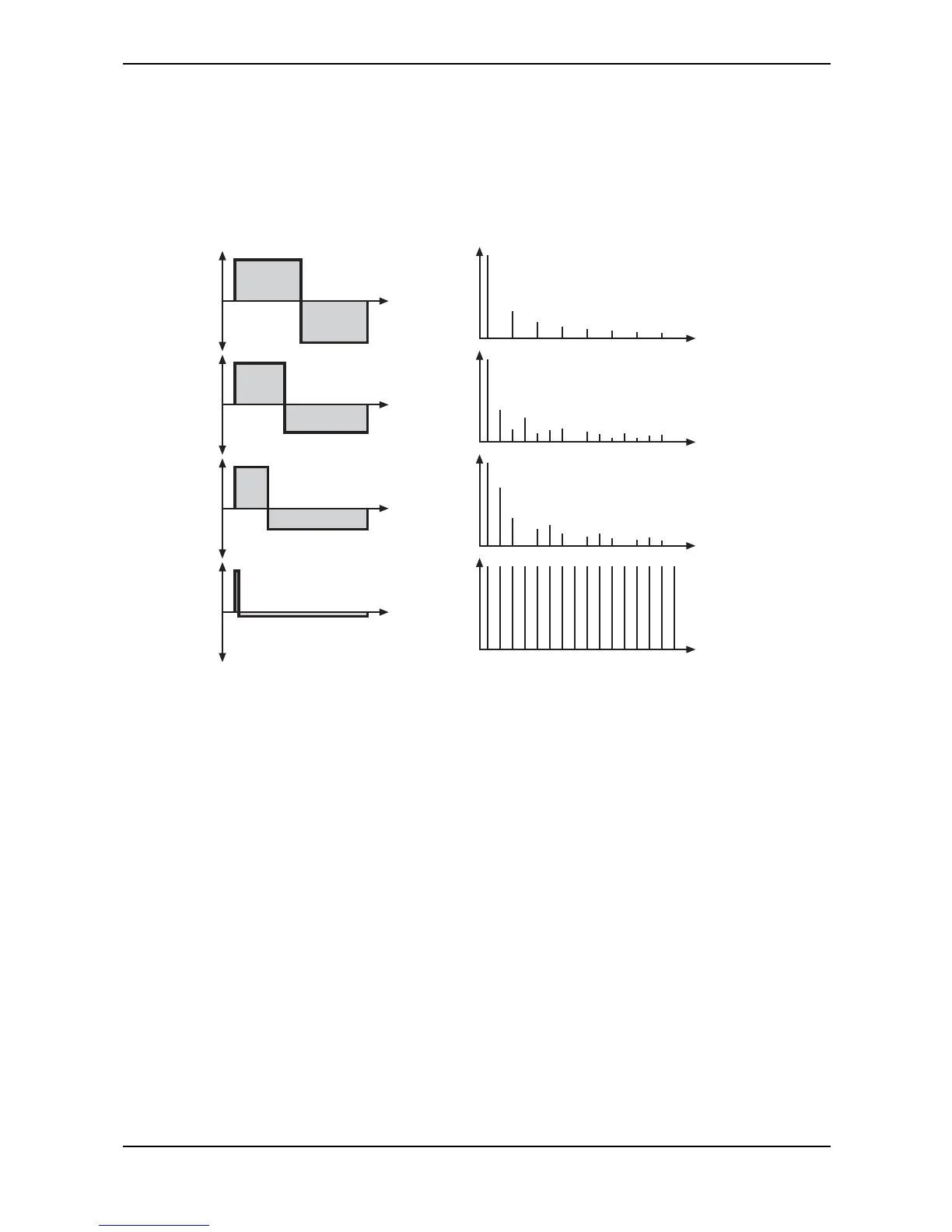
percent. The following picture shows several pulse waves with different pulse widths:
13
57911 13 15
1357911 13 15
1357911 13 15
1357911 13 15
50% Pulse
(Square Wave)
25% Pulse
<1% Pulse
(Impulse)
33% Pulse
Picture 9: Additive components of Pulse wave with different pulse widths
The first thing you probably observe is that the lower part of the wave has a narrower excursion. This
is because the energy of the wider pulse is higher than the one of the narrower pulse. If this were not
compensated for in the waveform, the overall signal would have an unwanted DC offset.
As you have read in the previous chapter, the harmonic content of a 50% pulse wave is a special
case. It has a very symmetrical harmonic content, while all other pulse widths create peaks or troughs
at certain frequencies. Another special case is a pulse wave with a very narrow pulse width, in the
above picture labelled as <1%. An infinitely thin pulse creates a spectrum that has all harmonics with
equal magnitudes. In a digital synthesizer, “infinitely” necessarily means one sample.
The pulse wave is an artificial wave, which means that it doesn’t occur in nature. It was built into
synthesizers because it could create a lot of different timbres with a minimum of technical effort.
However, certain pulse widths sound very close to the timbres of acoustic (or semi-acoustic)
instruments, i.e. a guitar or bass guitar, an e-piano or even a flute.
The most powerful feature of the pulse wave is the ability change its width while sounding. This is
called pulse width modulation. When the pulse width is changed, the waveform starts to sound
thicker. This happens because the effect is very similar to what you hear when you have two
oscillators running with slightly different frequencies. They interfere and create irregular troughs in the
resulting waveforms.



 To Next Page