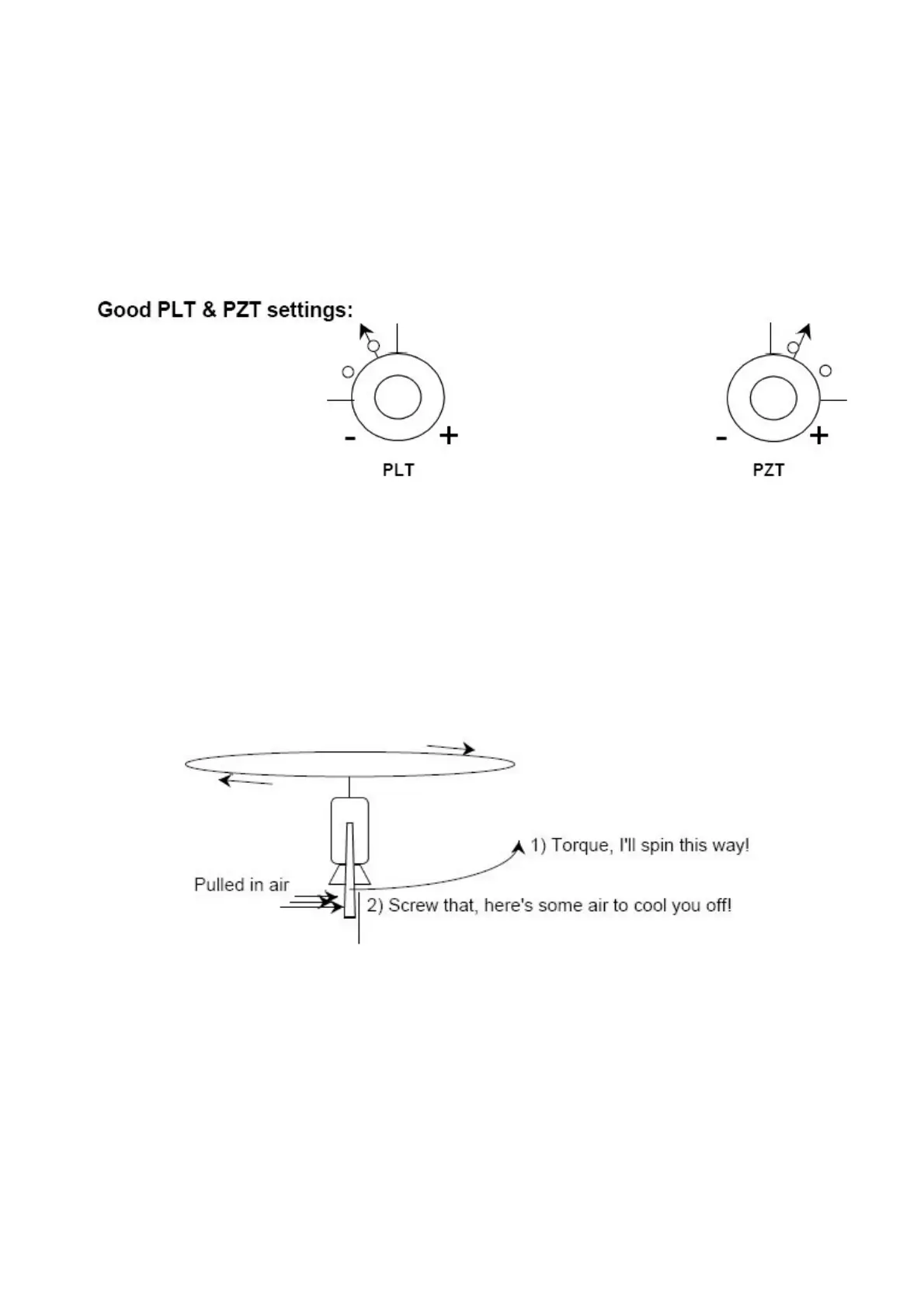
Ground effect: That wonderful bouncy feeling when a helicopter is near the ground, the air
hits it and has to go somewhere... outward & upward. When the air hits the tailfin, it pushes the fin
DOWN and the machine constantly drifts backward or rocks fore/aft. If you want to learn quicker, take
the fin off temporarily. A trimmed machine should need NO stick correction in hover for 3-5 seconds.
Obviously, not a beginner's machine. But we're getting there and when you're ready...everything can
be put back as you progress. Next... tweaking the tail gearbox, servo linkage and gyro!
7) Tail rotor/gears & Gyro adjustments
When I got into these back before gyros, we flew with full 4 channel control and fixed
pitch. When everything is trimmed out properly, it really isn't that hard to do. We would
hold right rudder (clockwise spinning main rotor) and bleed it off to neutral at
mid-throttle liftoff. Remember: A clockwise spin on the main rotor looking down from
above will cause a counterclockwise rotation of the machine itself. So to compensate
for this, the tail blades must be pushing air to your right, thus pushing the tail to your
left, or clockwise... and in turn counteracting the torque of the clockwise spinning main
rotor! The little head wants to do the opposite of whatever the big head is doing.
Action = equal & opposite reaction.
With this radio, you have a built in Tail Compensator, switch 5. This is the Heli/Acro
switch, ON will increase the pitch (left clockwise pull) of the tail rotor as you raise the
throttle. Only problem is, it's not adjustable... thus the need for a gyro. Remember that
all switches are actually ON when they are to the RIGHT. But the labeling next to the
switch bank is backwards, another nice Asian feature! Chinese folks read right to left, if
memory serves me. One eBook buyer refers to the manual grammar as “Chinglish”.
Eventually, mechanical tail mixing levers were introduced by Schluter, your throttle went
to a lower fork arm and the upper part went to the carburetor. On that near the middle
was a pivoting arm... rudder servo went to the lower part, upper arm went to the tail
rotor. So as the throttle was raised, the whole fork would move and the rudder arm


 To Next Page