
 Need help?
Do you have a question about the Wascomat W630 Classic and is the answer not in the manual?
Warnings on installation, electrical hazards, personal injury, manual use, and warranty.
Section for machine details and reminder for daily operational procedures.
Lists specific safety signs that must be affixed to the machine.
Covers safe usage, installation, avoiding hazards, servicing, and child safety.
Daily checks for door interlock, signs, and general machine condition.
Machine use, authorized maintenance, leak repair, and manual adherence.
Inner drum volume, drum speed, heating types, weight, G-factor, and connection details.
Table of dimensions in mm and diagram labeling key components.
Table of dimensions in inches and diagrams showing machine views.
Data on frequency of dynamic force and maximum floor load at extraction.
Voltage, kW, and Fuse A for No Heating/Steam and El Heating options.
Voltage, kW, and Fuse A for No Heating/Steam and El Heating options.
Voltage, kW, and Fuse A for No Heating/Steam and El Heating options.
Voltage, kW, and Fuse A for No Heating/Steam and El Heating options.
Voltage, kW, and Fuse A for No Heating/Steam and El Heating options.
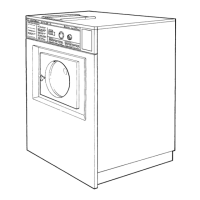
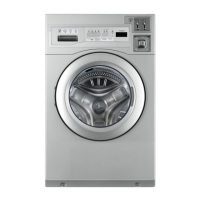
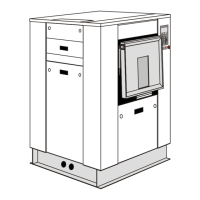
Lists models, describes features like programme unit, heating, and installation environments.
Introduction to machine functions and a diagram of key components.
Describes control panel interface and how the programme unit controls machine functions.
Describes the door lock mechanism, safety features, and control logic.
Details heating systems, water inlets, and the rear control unit components.
Describes the detergent compartment layout and the drain valve's working principle.
Lists daily checks and quarterly maintenance requiring qualified personnel.
Inspects internal components, belts, heating elements, and prevents dry running.
Lists components of the front and rear control units, including switches, contactors, and cards.
Explains the functions of the programme unit, level guards, thermostat, and rotary switch.
Details how jumpers A-I on the selector card modify wash program functions.
Details jumper settings A-I for program OL02, covering valve activation and program timing.
Details jumper settings A-F for program OL03, focusing on valve activation and program logic.
Describes the main power switch (Q1) and heating contactors (K21, K22).
Information on fuses F11/F12 and output blocks for external systems.
Notes that the option card is specific to machines with programme OL03.
Explains jumpers for warm rinses (N/M) and omitting prewash (O).
Describes jumpers R and S for selecting low/high water levels in wash phases.
Explains the pressure-based level switch, its settings, and fault diagnosis.
Steps to check water levels and troubleshoot high water level problems.
Details thermostat specifications, sensor location, and temperature control logic.
Warning about warranty voiding and steps for replacing the thermostat.
Describes the door lock mechanism, micro switches, emergency arm, and controller.
Details conditions required for locking and pulse activation.
Details conditions required for unlocking and pulse activation.
Describes LED behavior during normal operation and in various error states.
Covers reset button, voltage supply input (X90, X91), and lock/unlock request input (X92).
Defines inputs from rotation sensor and output to door lock, including voltage requirements.
Step-by-step guide to manually open the door lock in an emergency.
Detailed instructions for removing and installing a new door lock.
DANGER warning regarding safe measurement of capacitors and filters.
Describes motor fitting, drive belt, contactor control, and thermal overload protection.
Wiring diagrams for single-phase and three-phase motors with speed selection.
Details thermal overload protectors, their trip temperature, and manual reset capability.
Step-by-step guides for disassembling to remove and then installing a new motor.
Table of tension specs and instructions for adjusting drive belt tension.
Describes valve parts, access, and how water pressure operates it.
Warning about water spillage and detailed steps for disassembling the drain valve.
Instructions for reassembling the drain valve, connecting hoses, and verifying operation.
Describes the four compartments, water connections, and overflow protection.
Describes heating elements, sensor, contactors, and lists element sizes by model.
Explains control logic for electric heating and steam valve operation.
Warning about water spillage and detailed steps for replacing heating elements.
Instructions for accessing settings and details on switches for ratio, price, and reduction.
Table of S1 combinations for ratios and examples of setting ratios.
Formula (I = (P x A)/V) for price calculation and examples of programming scenarios.
Details switch S3 combinations for setting price reductions (0-75%).
Lists part numbers and descriptions for the complete tool kit.
Steps to remove C-clamp, affix puller, and use heat for easier removal.
Instructions on threading the shaft end and mounting the puller adapter.
Steps to assemble pulley components, secure, and perform a test run.
Lists part numbers for bearing kits for various machine models.
Instructions for removing pulley, wedge, and measuring shaft distance.
Steps to loosen bolts and press out the bearing house.
Steps to remove front bearing, rear gable, and sealings.
Describes methods like tapping or chiseling/grinding to remove the bushing.
Steps to tap bearings out and thoroughly clean the bearing house.
Instructions for greasing and tapping the front bearing into the housing.
Steps to install the rear bearing and sealing rings into the housing.
Instructions to grease the bearing housing interior for easier sealing ring mounting.
Steps to fill first sealing with grease and tap it carefully into the housing.
Instructions for filling second sealing with grease, placing spacer, and pressing drift.
Instructions to mount the third sealing, noting lip position and avoiding damage.
Check oil system, thread shaft, and mount bearing housing to rear gable with correct orientation.
Steps to mount rear gable package and check measurement between shaft end and bearing race.
Steps to mount shaft wedge, pulley components, and replace rear gable gasket.
Steps to insert drum package and perform final test run.


 To Next Page
 General