
 Need help?
Do you have a question about the Watts 800 Series and is the answer not in the manual?
Steps for safely taking apart the vacuum breaker for inspection or repair.
Guidance on putting the vacuum breaker back together using new parts.
Information on available repair kits for different sizes of Series 800 breakers.
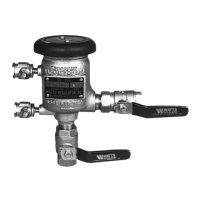
The Watts Series 800 Anti-Siphon Pressure Type Vacuum Breaker is a device designed to prevent back-siphonage of polluted water into a potable water supply system. It is suitable for industrial processing systems and other continuous pressure applications, particularly where water enters equipment below its overflow level, and can be placed in both hot and cold supply lines. The device is available in sizes from 1/2" through 2" (15-50mm) and is ASSE, UPC, and IAPMO listed (for 3/4" - 2").
The primary function of the Series 800 vacuum breaker is to protect potable water systems from contamination due to back-siphonage. When the downstream pressure drops to 1 psi or below, the spring-loaded disc float opens the atmospheric vent, and the spring-loaded check valve closes the inlet. This action prevents the creation of a vacuum in the discharge line, thereby preventing back-siphonage. As water flows through the valve, it pushes the check valve open and lifts the disc float, which then closes the atmospheric vent, preventing leakage. The disc float is designed to be free-floating without close-fitting guides, ensuring freedom from sticking. The durable silicone disc on both the disc float and check valve allows for use with both hot and cold water lines.
The Series 800 is recommended for applications where there is no danger of freezing and a drain or run-off is available. Examples of suitable applications include:
According to plumbing codes, the valve must be installed at least 12" (305mm) above the overflow level or flood rim of the fixture or container being supplied. It must be installed with the supply line connected to the bottom or inlet of the valve and in a vertical position, allowing for periodic inspection, servicing, and testing. Due to possible water spillage during operation, the valve should not be installed in concealed locations, inside a wall, or where freezing or spillage could cause water damage if a drain is not available.
ASSE standard 1020 requires that the atmospheric vent valve remains open until the valve body pressure exceeds 1 psi. During start-up, some spillage will occur at the atmospheric vent until this pressure is reached. To minimize this leakage, it is recommended to close the downstream shut-off valve and open the inlet shut-off valve quickly.
Vacuum breakers are not designed, tested, or approved to protect against backpressure backflow or water hammer shock. For protection against backpressure backflow, a Watts Model 909 Reduced Pressure Backflow Preventer should be installed. For protection against water hammer shock, Watts Model 15 Shock Arrestors should be installed.
The internal parts of the Series 800 can be removed, repaired, or inspected without removing the valve from the piping. This facilitates easier maintenance and repair.
Reassemble the valve in the reverse order of disassembly, utilizing new parts from the repair kit as needed.
Annual inspection of all water system safety and control valves is required and necessary. Regular inspection, testing, and cleaning ensure maximum life and proper function of the device.
This product contains chemicals known to the State of California to cause cancer and birth defects or other reproductive harm. Installers are required by California law to provide this warning to the consumer.
 General
| Brand | Watts |
|---|---|
| Model | 800 Series |
| Category | Control Unit |
| Language | English |





 To Next Page