136 CHAPTER 12 CLICK 172/174
and then assigned to the correct trac phases.
Installing and Wiring the Click 172/174
Use the following steps to install and wire the Click 172/174 cards:
1 Insert the Click 172/174 cards into the detector rack. Make sure that the Settings switch
is in position 3 (Run Setting) when plugged in. Wait approximately 30 seconds.
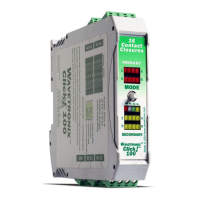
2 Connect the Click 200 to the rst Click 172/174 card by connecting an eight-. jumper
cable from the RJ-11 port on the front of the Click 200 to either one of the RJ-11 jacks
on the rst Click 172/174 card.
Operation Modes
Table 12.1 and the following sections describe the dierent operation modes. To use dual-
loop emulation with a specic mode, you must assign one input channel (lane) to a pair of
output channels; to use single-loop emulation, you must assign one input channel (lane) to
only one output channel.
Mode Definition
PR (Presence)
Outputs contact closures for single-loop or dual-loop emulation. Dual-
loop emulation will signal the radar’s speed and duration measure-
ments. Speed is signaled as the elapsed time between the primary
and secondary outputs. Duration in the radar beam is signaled as the
duration of the outputs. Single-loop emulation will simply signal the
radar’s duration measurement (no speed information).
PU (Pulse)
Outputs contact closures for single-loop or dual-loop emulation.
Dual-loop emulation will signal the radar’s speed measurement using
the time elapsed between the onset of the primary and secondary
outputs, but not the radar’s duration measurement. Instead the out-
puts will be held active for precisely 125 milliseconds for every vehicle
detected. This fixed period of time is necessary when integrating with
some systems and is often used in counting applications. Single-loop
emulation will simply signal that the radar detected a vehicle (no
duration or speed information).
AC (Actuation)
Outputs contact closures for single-loop emulation. This mode of
single-loop emulation is used both with true presence and continu-
ous passage detectors. True presence detectors signal the existence
of a stopped or moving vehicle within the detector beam. Continuous
passage detectors signal the existence of a moving vehicle meeting
specific criteria (speed, range, ETA) within the detector beam. When a
vehicle within the detector beam meets the requirements of the true
presence or continuous passage detector, the associated rack card out-
put will be closed. The minimum resolution of the output is five mil-
liseconds. This is the only mode used by SmartSensor Advance. With
side-fire radar sensors this mode is used for occupancy data collection.



 To Next Page