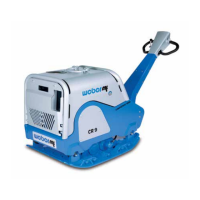
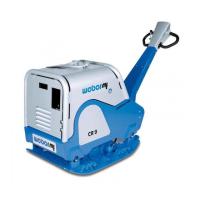
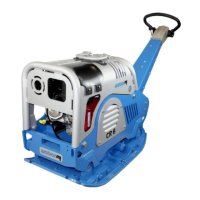
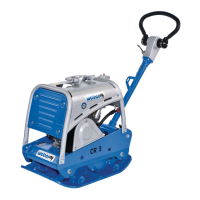
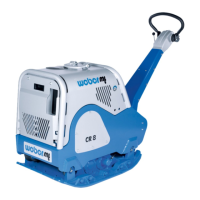
This document is an operating and maintenance manual for the Weber MT CR 2 and CR 2/55 reversible soil compactors.
Function Description
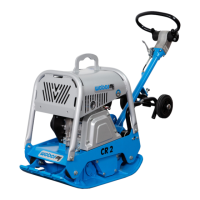
The Weber MT CR 2 and CR 2/55 are hand-guided, reversible soil compactors designed for compacting various materials. The machine consists of a bottom section, which houses the exciter, and a top section, containing the engine and controls. An air-cooled Hatz diesel engine powers the exciter via a centrifugal clutch, generating vibrations for compaction. The force is transmitted between the top and bottom sections via a V-belt. The engine speed can be adjusted between idle and full-throttle using a gas lever, and forward and reverse travel are variably controlled by a hydraulic system operated via the handle.
The machine is intended for compacting:
- Sand
- Gravel
- Crushed rock
- Low-cohesive mixed material
- Asphalt
- Paved surfaces
The operator's work position is behind the machine, guiding it safely with both hands on the handle.
Important Technical Specifications
The manual provides detailed technical data for both CR 2 and CR 2/55 models:
Weight:
- Operating weight CECE: CR 2 - 156 kg, CR 2/55 - 164 kg
Dimensions:
- Overall length: 1215 mm (both models)
- Overall width/with attachment plates: CR 2 - 450 mm, CR 2/55 - 550 mm
- Height with folded guide bar: 1065 mm (both models)
- Base plate length (base in mm): 200 mm (both models)
- Pressure surface: CR 2 - 200x450 mm, CR 2/55 - 500x450 mm
Drive:
- Engine manufacturer: Hatz (both models)
- Engine type: 1 B 20 (both models)
- Performance at operating speed (ISO 3046-1): 3.1 kW (both models)
- Combustion process: 4-stroke diesel (both models)
- Operating speed: 3000 1/min (both models)
- Operating speed (soil-dependent): 21 m/min (both models)
- Incline capacity (soil-dependent): 35% (both models)
Vibration:
- System: Two-shaft vibrator (both models)
- Drive concept: Mechanical (both models)
- Frequency: 100 Hz (both models)
- Centrifugal force: 25 kN (both models)
Noise Emissions (2000/14/EC):
- Sound pressure level LPA (EN 500): 98 dB (A) (both models)
- Sound power level LWA (EN ISO 3744 and EN 500): 108 dB (A) (both models)
Vibration Values:
- Root-mean-square acceleration value for hand-arm vibration (EN 500): 3.6 m/s² (both models)
Operating Fluids and Fill Levels:
- Engine oil: SAE 10W40 (API CD CE-CF-CG or SHPD, or CCMC D4-D5-PD2) - 0.9 liters
- Fuel tank: Diesel (DIN 51601-DK, BS2869-A1/A2, or STM D975-1D/2D) - 3.0 liters
- Vibrator: Fully-synthetic transmission fluid API GL-5/GL-4 (First filling: Fuchs Titan SINTOPOID LS SAE 75W-90) - 0.5 liters
- Gearshift: Transmission fluid DEXRON II-D-ATF (First filling: Fuchs Titan ATF 3000 or equivalent) - As necessary
Usage Features
Preparation for Initial Use:
- Remove all packaging material.
- Check for visible damage and contact the dealer if found.
- Verify the completeness of the shipment.
- Check and top off operating fluid levels.
- Set up the machine at the place of use.
Before Starting Work (Daily Checks):
- Visual inspections: Check hydraulic lines and fuel system for leaks, rubber buffers for cracks, and other damage.
- Fill levels: Check engine oil, hydraulic oil, and fuel levels, correcting if necessary.
- Other inspections: Ensure all threaded unions are firm and verify compliance with the maintenance schedule.
Starting the Engine:
- Adjust the guide bar height using the set screw.
- Bring the gas lever to the full-throttle position.
- Slowly pull the reversing starter handle until resistance is felt, then allow it to return.
- Pull the handle quickly and forcefully to start. Repeat if necessary.
- Set the gas lever to idle speed and allow the engine to warm up.
- Safety Note: Start the engine only in well-ventilated environments. Do not use starter spray.
Compacting:
- Start the engine and bring the gas lever to full-throttle.
- Switch between forward and reverse travel by adjusting the handle direction.
- The machine's speed is infinitely variable and controlled by the handle's deflection.
- Safety Note: Operate only in full-throttle mode to prevent V-belt slippage and material damage. Use caution when working near walls to avoid crushing hazards. Guide the machine with both hands.
Switching Off the Engine:
- Bring the gas lever to the idle speed position.
- Press the switch-off button.
Transport:
- The machine can be lifted for loading onto a vehicle using the designated lifting ring.
- Safety Note: Use slings with appropriate carrying capacity. Lock the guide bar in the folded position. Fit the crane hook into the lifting ring and lift the machine straight.
Storage:
- Construction site storage: Secure against theft and unauthorized use. Parked machines must be secured according to statutory regulations, especially in public traffic areas.
- Extended storage (longer than one month): Thoroughly clean the machine, check for leaks, empty and refill the fuel tank with clean fuel, check engine oil, check and clean air and fuel filters (replace if damaged), and lightly oil all bare parts, levers, and accelerator control cables. For storage longer than six months, contact Weber MT service.
Maintenance Features
The manual outlines a comprehensive maintenance schedule, emphasizing the importance of regular checks to prevent excessive wear and damage. Maintenance and repairs should only be carried out by trained professionals wearing appropriate personal protective equipment (hard hat, hearing protection, protective gloves, work shoes/boots with toe guard). All maintenance work must be performed when the engine is cold, and the engine must be safeguarded against unauthorized start attempts.
Maintenance Overview (Frequency-based):
-
Initial maintenance (after 25 operating hours):
- Change the engine oil.
- Check the valve play of the engine (adjust if necessary).
- Re-tighten all accessible threaded connections.
-
Every 8 operating hours/daily:
-
Every 150 operating hours/every six months:
- Change the fuel filter.
- Check the oil level of the transmission.
-
Every 150 operating hours/every year:
- Change the engine oil.
- Clean the engine oil filter.
-
Every 250 operating hours:
- Check the valve play of the engine (adjust if necessary).
- Change the oil in the exciter.
Description of Maintenance Operations:
- Clean the air filter: Unscrew the cover, remove the knurled nut and insert, blow out the insert with compressed air (from inside to outside), check/replace the cartridge, tighten the cartridge, and screw on the cover.
- Check V-belt: Shut down the machine, remove the V-belt guard, check the V-belt for cracks and wear, replace if necessary, and refit the guard.
- Check the engine oil level: Park on a horizontal surface, wait for oil to collect, unscrew/wipe/re-screw/unscrew the dipstick, check level (between min/max marks), and fill fresh oil if at "min."
- Change the engine oil: Warm up the engine, switch off, unscrew the oil dipstick (which also seals the filler neck), place a collection vessel, remove the cover cap from the drain valve, screw on the drain hose, allow oil to drain, unscrew the drain pipe, attach the cover cap, fill fresh oil, check level, and screw in the dipstick.
- Clean the engine oil filter: Drain engine oil, loosen the fastening screw of the oil filter, pull out the filter, blow out with compressed air, check/replace sealing rings, lightly oil rings, press filter into case, and tighten the fastening screw (ensuring tension spring rests on filter).
- Check the water separator: Place a transparent vessel under the drain plug, unscrew the plug to one thread, allow fuel-water mix to drain until only pure fuel flows, and seal the plug.
- Change the fuel filter: Drain the fuel tank, pull off the fuel line from both sides of the filter, insert a new filter, and fill the fuel tank.
- Check the hydraulic oil level: Lock the guide bar in transport position, check the oil level in the view glass (should be in the middle).
- Change the oil in the exciter: Warm up the engine, switch off, tilt the machine slightly, place a collection vessel, loosen the oil drain plug, allow oil to drain, tilt the machine in the other direction, fill fresh oil, and close the drain plug.
Safety during Maintenance:
- Wear protective gloves when handling lubricating oils and fuel.
- Allow the combustion engine to cool down before working on it to prevent burn injuries.
- Collect and dispose of discharged operating fluids according to environmental regulations.
- Ensure all protective fixtures are refitted after maintenance.
- Remove all loose parts (screws, tools) before starting the machine after maintenance.
- Keep the machine clean and replace damaged stickers.
The manual also emphasizes complying with the engine manufacturer's operating and maintenance manuals in addition to the provided information.


 To Next Page
 General