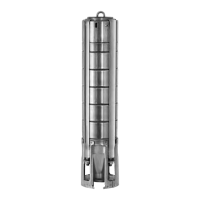
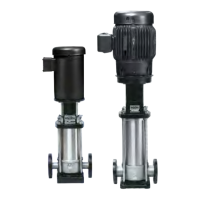
A typical installation diagram is shown in (Figure 1, page 4). All electrical work should be performed by a competent
electrician in accordance with the National Electrical Code, as well as local codes and regulations.
Never run the pump unless it is completely submerged in water. If operated without water, the pump and motor could be
severely damaged.
The riser pipe should be properly sized and selected based upon the flow rate and friction-loss factors.
Protect all piping, fittings and water system components from freezing.
When lowering the pump into the well, use the discharge pipe. A safety cable may be attached to the pump’s discharge
head lifting eye. Never use the electrical cable to raise or lower the pump. Do not scrape the electrical cable against the
well casing while raising or lowering the pump into well. Secure the cable to the discharge pipe at 10’ intervals with elec-
trical tape and use cable guards every 20’ to avoid cable damage.
Notice: Webtrol 4” Submersible Pumps are assembled with right hand threads. Hold the pump’s discharge head with
a wrench while installing the riser pipe or a check valve. Be sure you do not loosen the discharge in the tube.
Do not hold the pump housing during installation of the riser pipe or a check valve.
Plastic pipe has a tendency to stretch under load. When securing the cable to the riser pipe, allow 2 inches of
slack between the taped intervals.
To ensure that the pump and motor are free to rotate, remove the screen and rotate the shaft by hand.
If the pump is capable of over pumping the well, a liquid level control is required.
Attach the riser pipe to the pump. If plastic pipe is used, provide torque arrestors and safety cable. Review typical
installation shown.
When installing Schedule 80 threaded plastic pipe and extruded couplings, caution should be taken to prevent excessive
tightening which can damage the fitting and/or pipe. The correct degree of tightness may be determined by threading the
extruded coupling hand tight, plus a half turn with a strap wrench. Pipe wrenches or pliers that may indent or scratch the
pipe should not be used. Over tightening may result in eventual or immediate failure due to excessive stress. Do not use
pipe dope. Use teflon tape if needed.
An ohmmeter, or megger should be used to measure the insulation resistance on the power cable every 20 feet as the
pump is lowered. This will locate any fault in the cable.
A check valve should always be installed in submersible pump installations. If the pump does not have a built-in check
valve, a line check valve should be installed in the discharge line. A line check valve should be installed within 25 feet of
the pump, and below the drawdown level of the water supply. For installations deeper than 200 feet, check valves
should be installed in 200 foot intervals.
- 3 -
Installation
Caution: Restarting the motor within 5 seconds after power is removed may cause the motor overload to trip.
Warning: Failure to ground the control box or panel grounding terminal can result in a serious or fatal electrical
shock hazard if a circuit fault occurs.
2-Wire Motor Solid State Controls.


 To Next Page
 Loading...