EasyManua.ls Logo

Weed Eater VIP HDF550A - Before Starting Engine

Weed Eater VIP HDF550A
24 pages
Print Icon
To Next Page IconTo Next Page
To Previous Page IconTo Previous Page
Loading...
TRANSPORTING
YOUR
TILLER
A
CAUTION:
Before
lifting
or
transport¬
ing,
allow
tiller
engine
and
muffler
to
cool.
Disconnect
spark
plug
wire.
Drain
gasoline
from
fuel
tank.
AROUND
THE
YARD
Tip
depth
stake
forward
until
it
is
held
by
the
stake
spring.
Push
tiller
handles
down,
raising
tines
off
the
ground.
Push
or
pull
tiller
to
desired
location.
AROUND
TOWN
»
Disconnect
spark
plug
wire.
Drain
fuel
tank.
Transport
in
upright
position
to
prevent
oil
leakage.
BEFORE
STARTING
ENGINE
IMPORTANT;
BE
VERY
CAREFUL
NOT
TO
ALLOW
DIRT
TO
ENTER
THE
ENGINE
WHEN
CHECKING
OR
ADDING
OIL
OR
FUEL.
USE
CLEAN
OIL
AND
FUEL
AND
STORE
IN
APPROVED,
CLEAN,
COVERED
CONTAINERS.
USE
CLEAN
FILL
FUNNELS.
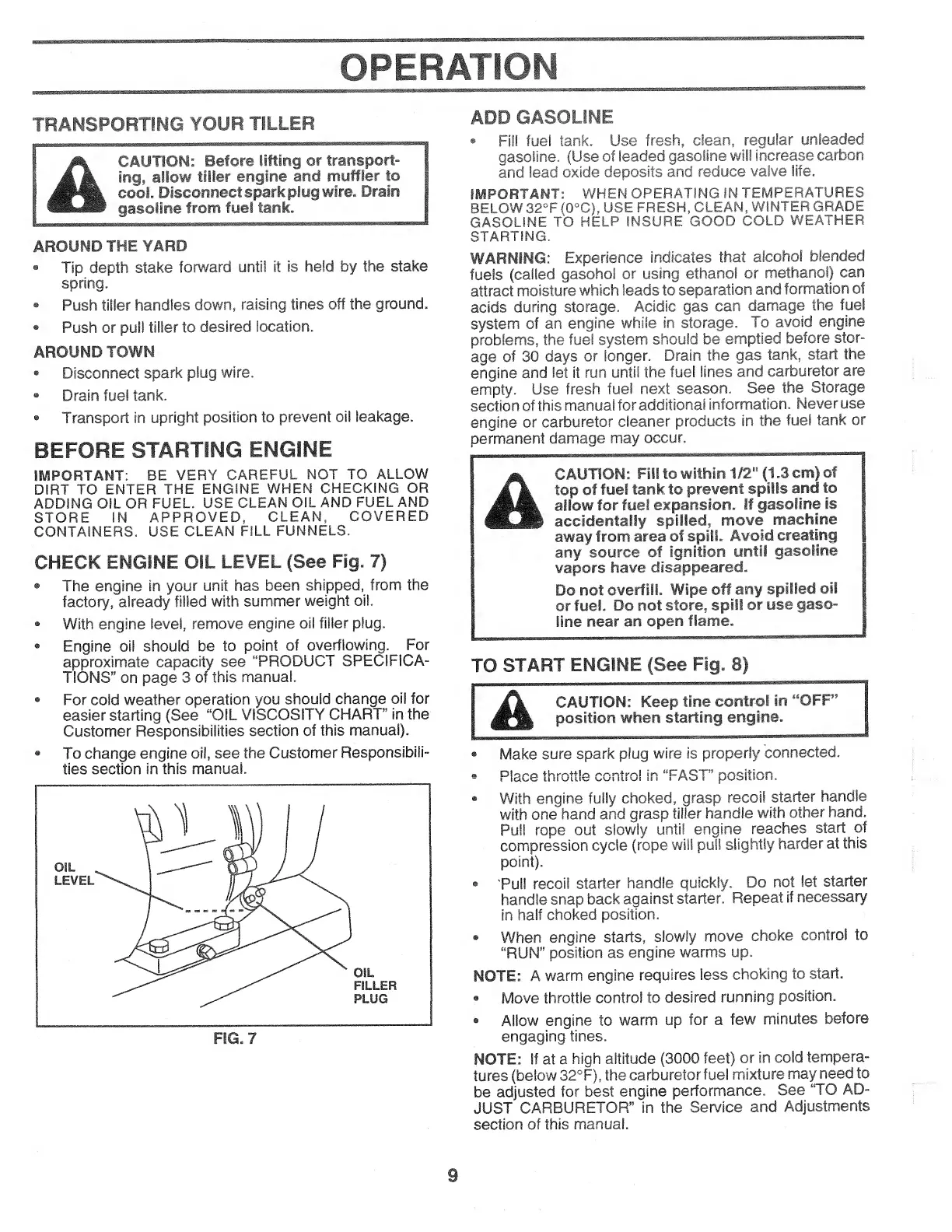
CHECK
ENGINE
OIL
LEVEL
(See
Fig.
7)
The
engine
in
your
unit
has
been
shipped,
from
the
factory,
already
filled
with
summer
weight
oil,
With
engine
level,
remove
engine
oil
filler
plug.
Engine
oil
should
be
to
point
of
overflowing.
For
approximate
capacity
see
“PRODUCT
SPECIFICA¬
TIONS”
on
page
3
of
this
manual.
For
cold
weather
operation
you
should
change
oil
for
easier
starting
(See
“OIL
VISCOSITY
CHART”
in
the
Customer
Responsibilities
section
of
this
manual).
To
change
engine
oil,
see
the
Customer
Responsibili¬
ties
section
in
this
manual.
ADD
GASOLINE
Fill
fuel
tank.
Use
fresh,
clean,
regular
unleaded
gasoline.
(Use
of
leaded
gasoline
will
increase
carbon
and
lead
oxide
deposits
and
reduce
valve
life.
IMPORTANT:
WHEN
OPERATING
IN
TEMPERATURES
BELOW
32“F
(0°C),
USE
FRESH,
CLEAN,
WINTER
GRADE
GASOLINE
TO
HELP
INSURE
GOOD
COLD
WEATHER
STARTING.
WARNING:
Experience
indicates
that
alcohol
blended
fuels
(called
gasohol
or
using
ethanol
or
methanol)
can
attract
moisture
which
leads
to
separation
and
formation
of
acids
during
storage.
Acidic
gas
can
damage
the
fuel
system
of
an
engine
while
in
storage.
To
avoid
engine
problems,
the
fuel
system
should
be
emptied
before
stor¬
age
of
30
days
or
longer.
Drain
the
gas
tank,
start
the
engine
and
let
it
run
until
the
fuel
lines
and
carburetor
are
empty.
Use
fresh
fuel
next
season.
See
the
Storage
section
of
this
manual
for
additional
information.
Never
use
engine
or
carburetor
cleaner
products
in
the
fuel
tank
or
permanent
damage
may
occur.
CAUTION:
Fill
to
within
1/2"
(1.3
cm)
of
top
of
fuel
tank
to
prevent
spills
and
to
allow
for
fuel
expansion.
If
gasoline
is
accidentally
spilled,
move
machine
away
from
area
of
spill.
Avoid
creating
any
source
of
ignition
until
gasoline
vapors
have
disappeared.
Do
not
overfill.
Wipe
off
any
spilled
oil
or
fuel.
Do
not
store,
spill
or
use
gaso¬
line
near
an
open
flame.
TO
START
ENGINE
(See
Fig.
8)
A
CAUTION:
Keep
tine
control
in
“OFF”
position
when
starting
engine.
Make
sure
spark
plug
wire
is
properly
connected.
®
Place
throttle
control
in
“FAST”
position.
With
engine
fully
choked,
grasp
recoil
starter
handle
with
one
hand
and
grasp
tiller
handle
with
other
hand.
Pul!
rope
out
slowly
until
engine
reaches
start
of
compression
cycle
(rope
will
puli
slightly
harder
at
this
point).
Pull
recoil
starter
handle
quickly.
Do
not
let
starter
handle
snap
back
against
starter.
Repeat
if
necessary
in
half
choked
position.
»
When
engine
starts,
slowly
move
choke
control
to
“RUN”
position
as
engine
warms
up.
NOTE;
A
warm
engine
requires
less
choking
to
start.
Move
throttle
control
to
desired
running
position.
Allow
engine
to
warm
up
for
a
few
minutes
before
engaging
tines.
NOTE:
If
at
a
high
altitude
(3000
feet)
or
in
cold
tempera¬
tures
(below
32°F),
the
carburetor
fuel
mixture
may
need
to
be
adjusted
for
best
engine
performance.
See
“TO
AD¬
JUST
CARBURETOR”
in
the
Service
and
Adjustments
section
of
this
manual.
9

Related product manuals