EasyManua.ls Logo

Weil-McLain CG-4 - Page 6

Weil-McLain CG-4
23 pages
Print Icon
To Next Page IconTo Next Page
To Previous Page IconTo Previous Page
Loading...
Section
III:
Piping
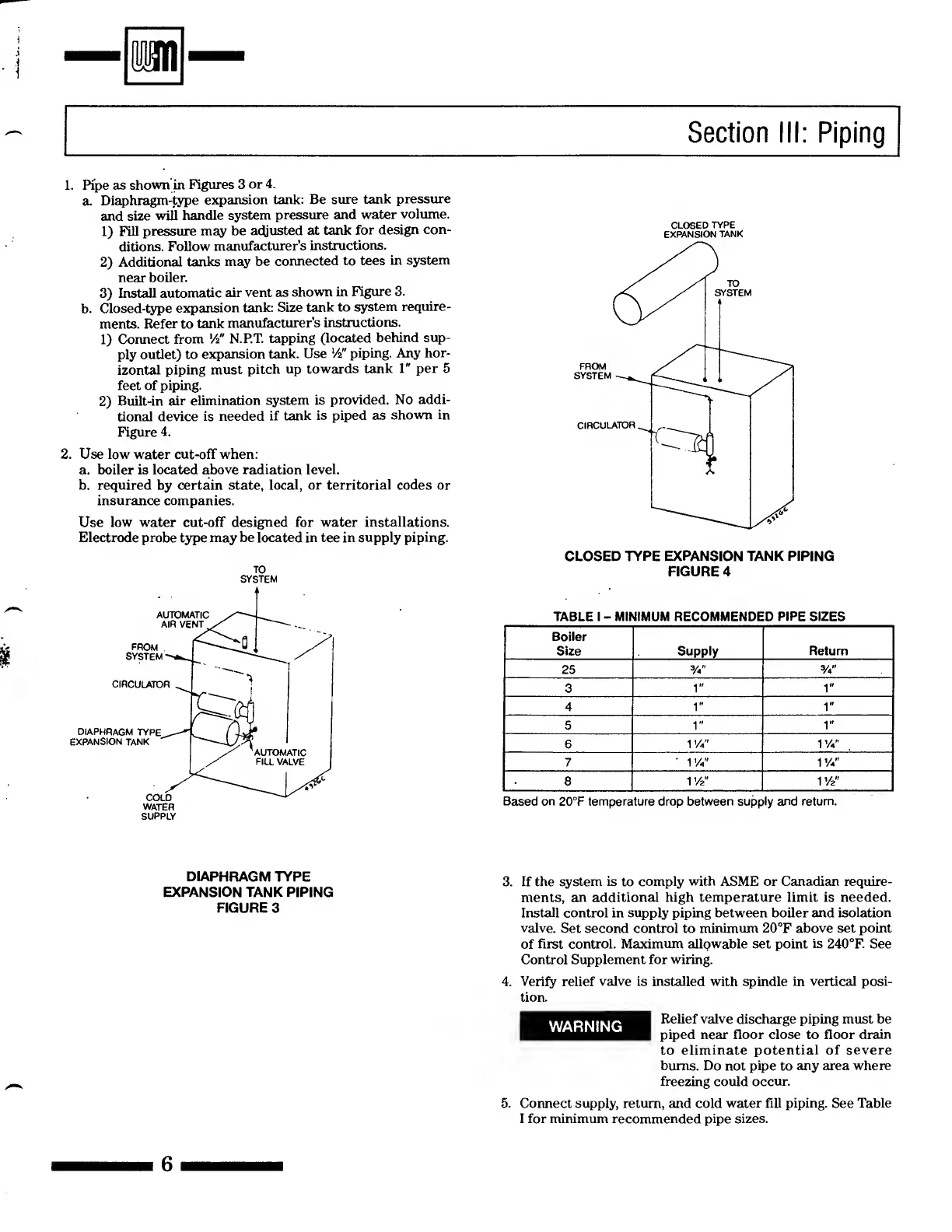
1.
Pipe
as
shown'in
Figures
3
or
4.
a.
Diaphragm-type
expansion
tank:
Be
sure
tank
pressure
and
size
will
handle
system
pressure
and
water
volume.
1)
Fill
pressure
may
be
adjusted
at
tank
for
design
con¬
ditions.
Follow
manufacturer’s
instructions.
2)
Additional
tanks
may
be
connected
to
tees
in
system
near
boiler.
3)
Install
automatic
air
vent
as
shown
in
Figure
3.
b.
Closed-type
expansion
tank:
Size
tank
to
system
require¬
ments.
Refer
to
tank
manufacturer’s
instructions.
1)
Connect
from
V4"
N.P.T.
tapping
(located
behind
sup¬
ply
outlet)
to
expansion
tank.
Use
Vi"
piping.
Any
hor¬
izontal
piping
must
pitch
up
towards
tank
1"
per
5
feet
of
piping.
2)
Built-in
air
elimination
system
is
provided.
No
addi¬
tional
device
is
needed
if
tank
is
piped
as
shown
in
Figure
4.
2.
Use
low
water
cut-off
when:
a.
boiler
is
located
above
radiation
level.
b.
required
by
certain
state,
local,
or
territorial
codes
or
insurance
companies.
Use
low
water
cut-off
designed
for
water
installations.
Electrode
probe
type
may
be
located
in
tee
in
supply
piping.
TO
SYSTEM
WATER
SUPPLY
CLOSED
TYPE
EXPANSION
TANK
CLOSED
TYPE
EXPANSION
TANK
PIPING
FIGURE
4
TABLE
I
-
MINIMUM
RECOMMENDED
PIPE
SIZES
Based
on
20°F
temperature
drop
between
supply
and
return.
DIAPHRAGM
TYPE
EXPANSION
TANK
PIPING
FIGURE
3
3.
If
the
system
is
to
comply
with
ASME
or
Canadian
require¬
ments,
an
additional
high
temperature
limit
is
needed.
Install
control
in
supply
piping
between
boiler
and
isolation
valve.
Set
second
control
to
minimum
20°F
above
set
point
of
first
control.
Maximum
allowable
set
point
is
240°F.
See
Control
Supplement
for
wiring.
4.
Verify
relief
valve
is
installed
with
spindle
in
vertical
posi¬
tion.
WARNING
Relief
valve
discharge
piping
must
be
piped
near
floor
close
to
floor
drain
to
eliminate
potential
of
severe
bums.
Do
not
pipe
to
any
area
where
freezing
could
occur.
5.
C
onnect
supply,
return,
and
cold
water
fill
piping.
See
Table
I
for
minimum
recommended
pipe
sizes.