
 Need help?
Do you have a question about the Wenglor P1KH001 and is the answer not in the manual?
Warns against using the product in explosive atmospheres or with unauthorized accessories.
Prohibits product modification due to risks of injury, damage, and voiding warranty.
Details laser class 1 and 2 warnings and compliance with relevant safety standards.
Covers supply power, voltage, current, protection features, and interface specifications.
Provides characteristic curves and specific spot diameter values for different ranges.
Provides connection diagrams and a legend for wiring configurations.
Details how to adjust the sensor for suppressing backgrounds or undersurfaces.
Explains how to adjust the sensor for optimal detection of objects without interference.
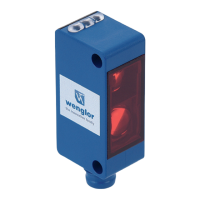
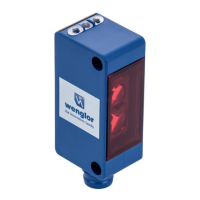
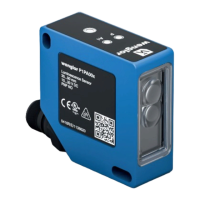
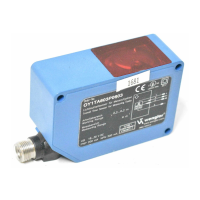
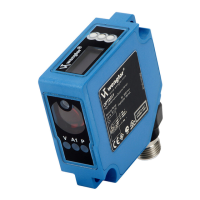
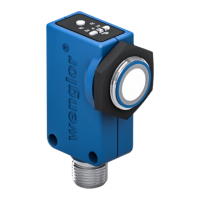
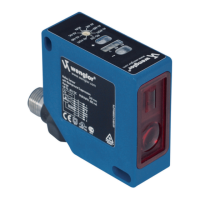
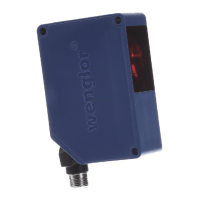
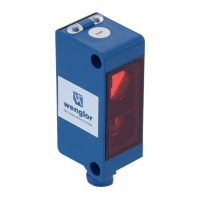
The Wenglor P1KHxxx series comprises reflex sensors with background suppression, designed for reliable object detection across various industrial applications. These sensors operate on the principle of angular measurement, which minimizes the influence of an object's color, shape, and surface characteristics on the detection range. This allows for the dependable detection of even dark objects against bright backgrounds. The output of the sensor switches as soon as an object enters the selected detection range.
The P1KHxxx reflex sensors utilize a light emitter and receiver to detect objects by analyzing the reflected light. The background suppression feature ensures that only objects within a specified adjustable range are detected, effectively ignoring any background elements beyond this range. This is achieved through an angular measurement principle, where the angle of the reflected light determines whether an object is within the set switching distance.
For object detection directly in front of a background or undersurface, the sensor should be securely mounted such that the light spot strikes the object at a right angle. The potentiometer should be turned all the way to the right. After removing the object, the potentiometer is slowly turned back until the output switches, thereby suppressing the background or undersurface. The object is then reintroduced to verify activation.
For detecting objects without an interfering background, the sensor is mounted with the spot striking the object at a right angle. The potentiometer is turned all the way to the left, then slowly turned up until activation occurs. For increased switching reliability, it can be turned up a bit further.
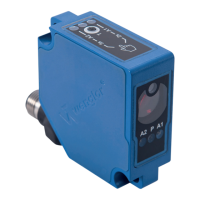
The sensors are equipped with status indicators: a switching status indicator/contamination warning (LED 30) and a supply power indicator (LED 68). These LEDs provide visual feedback on the sensor's operational status and potential issues.
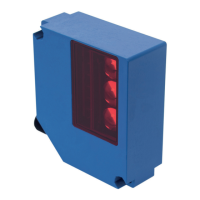
The P1KHxxx series offers various models with different ranges and adjustable ranges.
The P1KHxxx sensors are versatile and suitable for a wide range of industrial sectors, including:
The sensors are not safety components according to 2006/42/EC (Machinery Directive) and are not suitable for use in potentially explosive atmospheres. They should only be used with accessories supplied or approved by Wenglor.
The sensors feature a potentiometer (05) for adjusting the switching distance. LEDs indicate the switching status/contamination warning (30) and supply power (68).
The sensor provides diagnostic feedback through the blinking patterns of its LEDs.
In case of fault, the machine should be shut down, the cause of error analyzed and eliminated. If the error persists or cannot be unequivocally clarified, Wenglor's support department should be contacted.
The Wenglor P1KHxxx sensor is generally maintenance-free. However, the following points are advisable:
Proper disposal of unusable or irreparable products must comply with national waste disposal regulations. Wenglor sensoric GmbH does not accept returns of such products.
 General
| Brand | Wenglor |
|---|---|
| Model | P1KH001 |
| Category | Accessories |
| Language | English |


 To Next Page