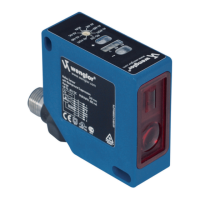
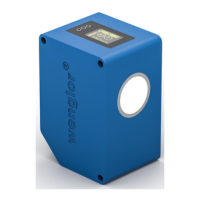
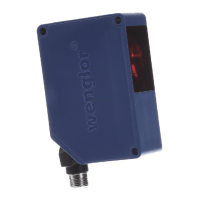
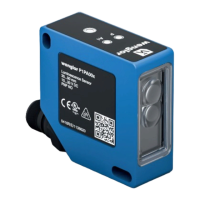
The wenglor P1PA00x series consists of luminescence sensors designed for detecting luminescent objects by emitting UV light and sensing the reflected visible light. These sensors are available in two versions, P1PA001 and P1PA002, differing primarily in their receiver filters to suit various application needs.
Function Description:
Luminescence sensors operate on the principle of fluorescence. They emit UV light at a wavelength of 375 nm. When this UV light strikes a luminescent object, the object reflects light within a visible wavelength range of 420 to 750 nm, depending on the luminophor used. This fluorescent effect allows the sensor to detect markings or materials that are invisible to the human eye under daylight conditions. The P1PA001 model features a blue permeable receiver filter (type GG-420) and is suitable for detecting blue luminescent surfaces. The P1PA002 model incorporates a yellow/green permeable receiver filter (type OG-570), which enables it to suppress interfering whitening agents and is ideal for detecting yellow-green luminescent surfaces. Both models have a working distance ranging from 30 to 90 mm.
The sensors offer integrated teach-in technology for setting switching thresholds. This function allows the sensor to automatically calculate optimal setting values based on recorded measurements, which are then saved to memory either by pressing a teach-in key or by receiving an external control signal. Two primary teach-in methods are supported:
- Two-point Teach-in: This method involves teaching the marking to be detected first, followed by the background. The sensor then automatically determines the optimum switching threshold. The sensor's output A is activated when it recognizes the intensity value taught first and deactivated when it recognizes the intensity value taught second. If the difference between the two recorded intensity values is too small, the output switching status indicator A1 flashes rapidly (8 Hz), indicating that the switching thresholds were not updated, and the procedure must be repeated.
- Dynamic Teach-in: This function continuously records all intensity values from both the background and the marking. It is particularly useful for applications where objects move continuously at a constant speed and cannot be brought to a standstill during the production process, such as detecting luminescent adhesive strips on continuously fed packaging material or luminescent markings on rapidly rotating parts. Similar to two-point teach-in, if the intensity difference is too small, the A1 indicator flashes rapidly, and the thresholds are not updated. The teach-in input on pin 5 can also be used for external teach-in, mimicking the function of the teach-in key.
Important Technical Specifications:
- Working Range: 30-90 mm
- Working Distance: 40 mm
- Receiving Range:
- P1PA001: 420-750 nm
- P1PA002: 570-750 nm
- Switching Hysteresis: < 10%
- Light Source: UV light
- Wavelength: 375 nm
- Service Life (ambient temp. = 25 °C): 100,000 h
- Max. Permitted Ambient Light: 10,000 lux
- Light Spot Diameter: Varies with working distance (e.g., 3 mm at 30 mm, 7 mm at 90 mm for P1PA001; 4 mm at 30 mm, 9 mm at 90 mm for P1PA002).
- Supply Voltage: 10-30 V DC (IO-Link: 18-30 V DC)
- Current Consumption (operating voltage = 24 V): < 25 mA
- Switching Frequency: 2,500 Hz
- Response Time: 200 µs
- On/Off-delay: 0-200 ms
- Temperature Drift: < 5%
- Temperature Range: -25 to 60 °C
- Number of Switching Outputs: 2
- Switching Output Voltage Drop: 1.5 V
- Switching Output Switching Current: 100 mA
- Protection: Short-circuit protected, reverse polarity protected
- Lockable: Yes
- Interface: IO-Link (Version 1.1)
- Protection Class: III
- Setting Method: Teach-in
- Housing Material: Plastic
- Degree of Protection: IP67
- Connection Type: M12x1; 5-pin
Usage Features:
The P1PA00x sensors are versatile and can be used across various industry sectors, including special-purpose mechanical engineering, logistics, automotive, food, packaging, pharmaceuticals, plastics, woodworking, consumer goods, paper, electronics, printing, and chemicals.
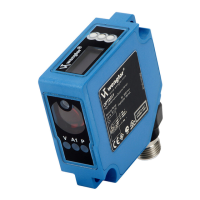
The control panel features a teach-in key (06), a switching status indicator/contamination warning LED (30), and a supply voltage indicator (68).
The sensor's factory default settings include:
- On-delay: Off
- Off-delay: Off
- Output stage: PNP
- Teach-In mode for external teach-in: Two-point
- Automatic intensity read-out via IO-Link: On
Installation and Electrical Connection:
- Protection against contamination and mechanical influences is crucial during installation.
- All applicable electrical and mechanical regulations, standards, and safety rules must be observed.
- The sensor must be mounted securely.
- For smooth object surfaces, the angle between the sound wave axis and the object surface should be 90° ±3°. For rough surfaces, a larger angle is permissible.
- Objects to be detected must be within the sensor's working range.
- Specified torque values must be adhered to.
- Electrical connection requires a supply voltage of 18 to 30 V DC. Only suitably qualified personnel should connect the device to prevent personal injury or property damage.
Diagnosis:
The sensor provides diagnostic feedback through its LEDs:
- Warning (flashes continuously at approx. 1.5 Hz): Indicates a warning signal, often due to the distance between the sensor and object being outside the working range, or contamination of the optic cover. Solutions involve adjusting the distance or cleaning the optic cover.
- Error (flashes continuously at approx. 3 Hz): Indicates undervoltage, short circuit, over-temperature, or a general device error. Solutions include increasing voltage supply, checking wiring, disconnecting and restarting the sensor, allowing it to cool, or replacing the sensor if a device error persists.
- Contamination Warning Flowcharts: Detailed flowcharts illustrate LED behavior for "no contamination," "beginning contamination," and "advanced contamination" in reflex mode, guiding users on when to clean the sensor.
Maintenance Features:
- The wenglor P1PA00x sensor is maintenance-free.
- Regular cleaning of the lens and checking of plug connections are recommended.
- Avoid cleaning with solvents or cleansers that could damage the device.
- The product must be protected against contamination during initial start-up.
Proper Disposal:
wenglor sensoric GmbH does not accept the return of unusable or irreparable products. Disposal must comply with national waste disposal regulations.
Approvals and Protection Class:
The product carries CE, cULus Listed (IND. CONT. EQ. 72HL, for use in class 2 circuits, Environmental Type 1), RoHS, and EAC approvals. It also features a UV radiation warning (RISK GROUP 2 PRODUCT, EN62471: 2008).

 Need help?
 General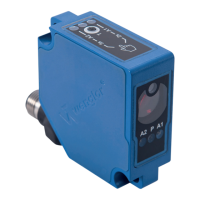


 To Next Page