Using the Solid Element Surface Units
Before placing a pan on solid element surface units for the first time, heat on
HI setting for five minutes. The surface units will give off smoke as the
protective coating, applied at the factory, finishes bonding to the surfaces.
Solid element surface units are made of heavy cast-iron to provide even cook-
ing. Each surface unit has a built-in protective limiter. The limiter senses
uneven cooking temperatures and automatically reduces the heat setting. The
limiter will sense uneven heat when a pan boils dry, when a pan does not have
a flat bottom, or when a pan is removed and the surface unit is left on.
Solid elements hold heat longer than conventional surface units. For best cook-
ing results, use a high setting for only a very short period of time. Then use
a lower setting to complete the cooking. You may want to turn the solid element
OFF a few minutes before you finished cooking.
I CAUTION: Solid elements stay hot for a long time. Do not use the HI seffing
for long periods of time or leave pans on hot elements when cooking is
done. Burned food and damage to the cookware could result.
For some foods you may be able to start and complete cooking on MEDIUM-
HIGH. If solid elements are new to you, you will need to learn to use different
settings than you have in the past.
Until you get used to the settings, use the following as a guide.
Use HI to start Use MED-HI to
foods cook- hold a rapid
ing; to bring boil; to start
liquids to a frying chicken
boil. When or pancakes.
cooking foods, Turn to a LO
turn to a LO or MED-LO
or MED-LO setting when
setting when sizzle starts.
sizzle starts.
Cookware
Use MED for Use MED-LO Use LO to
gravy, pud- to keep food keep food
dings end cooking after cooking after
icing; to cook starting it on a starting it on a
large amounts higher setting, higher setting,
of vegetables to keep food
Turn to a LO warm or to
setting to melt chaco-
finish cooking, late or
shortening.
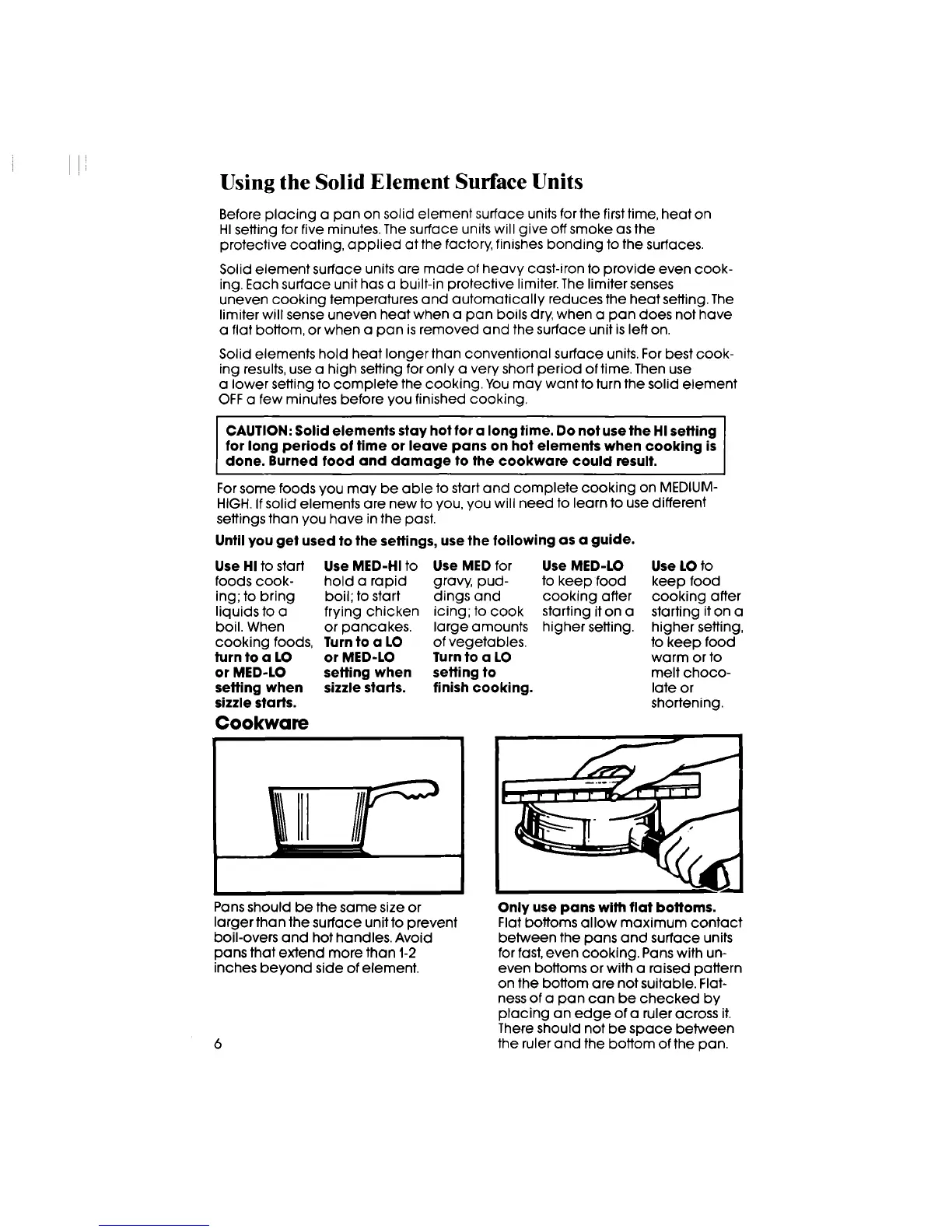
Pans should be the same size or
larger than the surface unit to prevent
boil-overs and hot handles. Avoid
pans that extend more than 1-2
inches beyond side of element.
Only use pans with flat bottoms.
Flat bottoms allow maximum contact
between the pans and surface units
for fast, even cooking. Pans with un-
even bottoms or with a raised pattern
on the bottom are not suitable. Flat-
ness of a pan can be checked by
placing an edge of a ruler across it.
There should not be space between
the ruler and the bottom of the pan.



 To Next Page