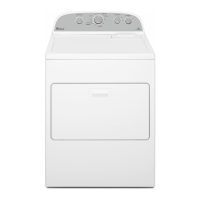
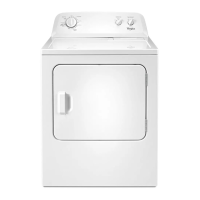
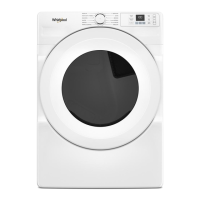
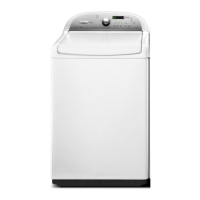
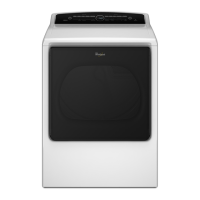
This document outlines the installation and usage requirements for a Whirlpool dryer, available in both gas and electric models. The dryer is designed to efficiently dry clothes while offering various installation options to suit different home layouts.
Function Description
The Whirlpool dryer's primary function is to dry clothes using either natural gas or electricity, depending on the model. It is designed to be installed in various locations, including recessed areas, closets, and open spaces, with specific clearance and venting requirements to ensure safe and optimal operation. The dryer can be configured with different door types, including a wide-opening side-swing door and a wide-opening hamper door, to accommodate user preferences and laundry room layouts. Some models also feature steam capabilities, requiring a cold water connection for operation.
Usage Features
Installation Flexibility:
The dryer offers significant flexibility in installation. It can be placed in recessed areas or closets, provided the minimum spacing requirements are met. For closet installations, adequate ventilation openings in the top and bottom of the door are crucial, and louvered doors with equivalent ventilation are acceptable. The design also considers companion appliance spacing, allowing for harmonious integration into a laundry setup.
Door Options:
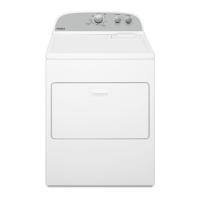
Users can choose between two main door configurations: a wide-opening side-swing door (A) and a wide-opening hamper door (B). These options cater to different user preferences and room configurations, making loading and unloading laundry more convenient.
Leveling Legs:
The dryer is equipped with leveling legs, which should be adjusted to a minimum height of 1/2" (13 mm) or high enough to match the height of an accompanying washer. This ensures stability and a uniform appearance in the laundry area.
Steam Models (Water Connection):
For steam-enabled models, a cold water faucet connection is required. The dryer must be connected using new inlet hoses, and users are cautioned against overtightening to prevent damage. The cold water faucet should be located within 4 ft. (1.2 m) of the water fill valves, and the water pressure should be between 20-100 psi (137.9-689.6 kPa). A "Y" connector and short hose are provided, allowing the dryer to share the water supply with a washer if needed.
Electrical and Gas Supply:
Gas models require a 3- or 4-wire, single-phase, 120/240 volt, 60 Hz, AC-only electrical supply (or 120/208 volt if specified on the serial/rating plate) on a separate 30 amp circuit. It is crucial to connect to an individual branch circuit and avoid using a fuse in the neutral or grounding circuit, or an extension cord. Gas supply requires a 1/2" IPS rigid pipe or 3/8" approved aluminum or copper tubing for shorter lengths. An individual manual shut-off valve must be installed within 6 ft (1.8 m) of the dryer.
Electric models also require a 3- or 4-wire, single-phase, 120/240 volt, 60 Hz, AC-only electrical supply (or 120/208 volt if specified on the serial/rating plate) on a separate 30 amp circuit, connected to an individual branch circuit without a fuse in the neutral or grounding circuit, and no extension cord.
Maintenance Features
Venting Requirements:
Proper venting is critical for the dryer's performance and safety. The dryer MUST be exhausted outdoors using a 4" (102 mm) heavy metal exhaust vent and clamps. Plastic or metal foil vents are explicitly prohibited. The vent path should be as straight and direct as possible, minimizing the number of elbows and turns. When turns are necessary, they should be gradual to avoid kinking.
Vent Material and Length:
Rigid metal vents are recommended for best drying performance and to prevent crushing and kinking. Flexible metal vents are acceptable only if accessible for cleaning, fully extended, and supported. The total length of flexible metal vents should not exceed 73/4 ft. (2.4 m). If an existing vent system is used, it must be thoroughly cleaned of lint, and any plastic or metal foil vents must be replaced with rigid or flexible metal vents.
Exhaust Hoods:
Exhaust hoods must be positioned at least 12" (305 mm) from the ground or any object that could obstruct exhaust, such as flowers, rocks, bushes, or snow. Recommended styles include louvered hoods and box hoods.
Noise Reduction:
To reduce noise transfer, it is recommended to allow an additional 1" (25 mm) of spacing on all sides of the dryer.
Clearance for Servicing:
When installing the dryer, it's important to consider allowing extra space for ease of installation and future servicing. This includes ensuring enough room for the door to fully open and for any necessary maintenance access.
Code Compliance:
Users are advised to check local code requirements, as some codes may limit or prohibit dryer installation in garages, closets, mobile homes, or sleeping quarters. Contacting the local building inspector is recommended to ensure compliance.
Lint Cleaning:
For existing vent systems, it is crucial to clean lint from the entire length of the system and ensure the exhaust hood is not plugged. This helps maintain optimal airflow and prevents potential fire hazards.


 To Next Page

 General