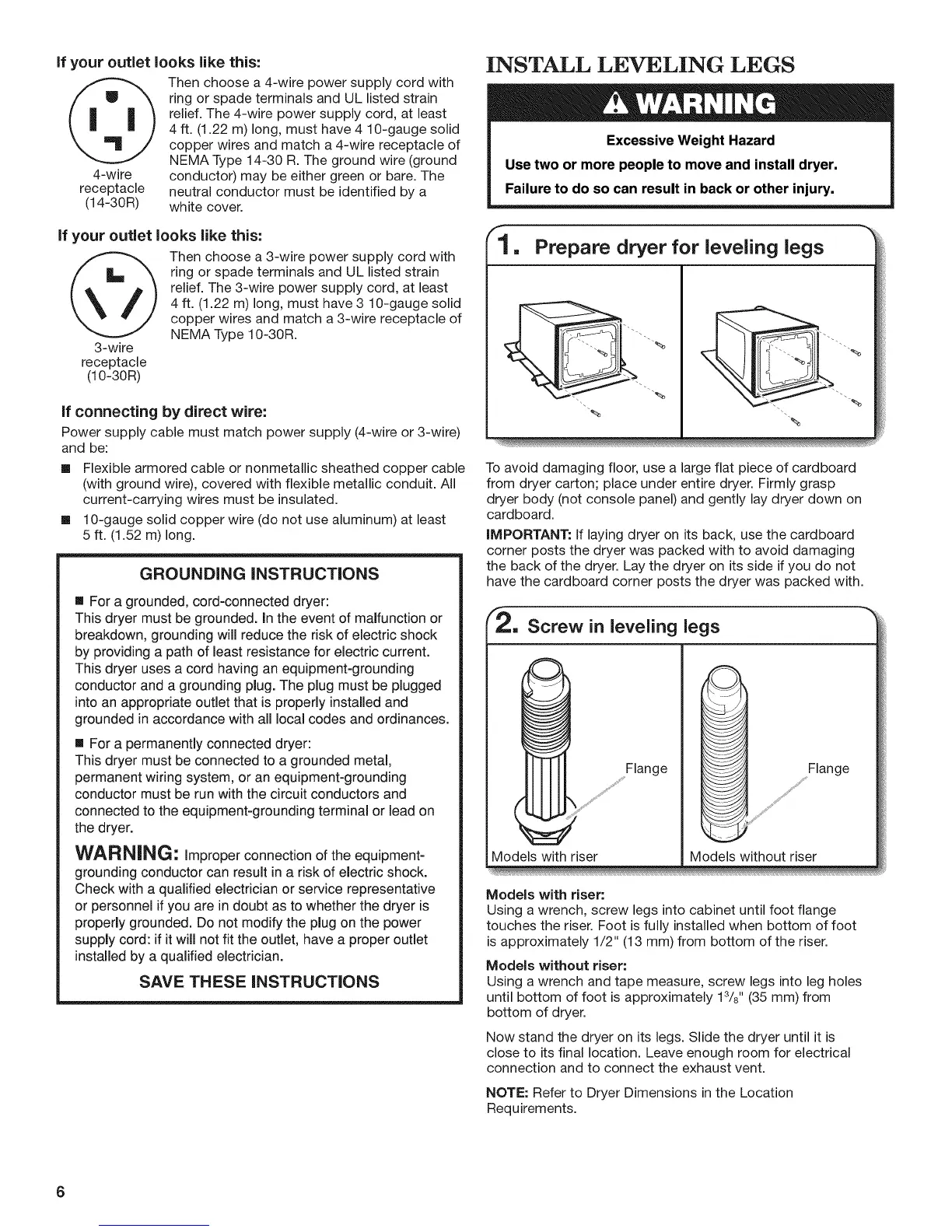
if your outlet looks like this:
4-wire
receptacle
(14-30R)
Then choose a 4-wire power supply cord with
ring or spade terminals and UL listed strain
relief. The 4-wire power supply cord, at least
4 ft. (1.22 m) long, must have 4 10-gauge solid
copper wires and match a 4-wire receptacle of
NEMA Type 14-30 R. The ground wire (ground
conductor) may be either green or bare. The
neutral conductor must be identified by a
white cover.
If your outlet looks like this:
Then choose a 3-wire power supply cord with
ring or spade terminals and UL listed strain
relief. The 3-wire power supply cord, at least
4 ft. (1.22 m) long, must have 3 10-gauge solid
copper wires and match a 3-wire receptacle of
NEMA Type 10-30R.
3-wire
receptacle
(10-30R)
If connecting by direct wire:
Power supply cable must match power supply (4-wire or 3-wire)
and be:
[] Flexible armored cable or nonmetallic sheathed copper cable
(with ground wire), covered with flexible metallic conduit. All
current-carrying wires must be insulated.
[] 10-gauge solid copper wire (do not use aluminum) at least
5 ft. (1.52 m) long.
GROUNDING INSTRUCTIONS
[] For a grounded, cord-connected dryer:
This dryer must be grounded. In the event of malfunction or
breakdown, grounding will reduce the risk of electric shock
by providing a path of least resistance for electric current.
This dryer uses a cord having an equipment-grounding
conductor and a grounding plug. The plug must be plugged
into an appropriate outlet that is properly installed and
grounded in accordance with all local codes and ordinances.
[] For a permanently connected dryer:
This dryer must be connected to a grounded metal,
permanent wiring system, or an equipment-grounding
conductor must be run with the circuit conductors and
connected to the equipment-grounding terminal or lead on
the dryer.
WARNING: Improper connection of the equipment-
grounding conductor can result in a risk of electric shock.
Check with a qualified electrician or service representative
or personnel if you are in doubt as to whether the dryer is
properly grounded. Do not modify the plug on the power
supply cord: if it will not fit the outlet, have a proper outlet
installed by a qualified electrician.
SAVE THESE INSTRUCTIONS
INSTALL LEVELING LEGS
Excessive Weight Hazard
Use two or more people to move and install dryer.
Failure to do so can result in back or other injury.
f*'l. Prepare dryer for leveling legs
To avoid damaging floor, use a large flat piece of cardboard
from dryer carton; place under entire dryer. Firmly grasp
dryer body (not console panel) and gently lay dryer down on
cardboard.
IMPORTANT: If laying dryer on its back, use the cardboard
corner posts the dryer was packed with to avoid damaging
the back of the dryer. Lay the dryer on its side if you do not
have the cardboard corner posts the dryer was packed with.
f:_. Screw in leveling legs
Flange Flange
/,
Models with riser Models without riser
Models with riser:
Using a wrench, screw legs into cabinet until foot flange
touches the riser. Foot is fully installed when bottom of foot
is approximately 1/2" (13 mm) from bottom of the riser.
Models without riser:
Using a wrench and tape measure, screw legs into leg holes
until bottom of foot is approximately 13/8"(35 mm)from
bottom of dryer.
Now stand the dryer on its legs. Slide the dryer until it is
close to its final location. Leave enough room for electrical
connection and to connect the exhaust vent.
NOTE: Refer to Dryer Dimensions in the Location
Requirements.
6



 To Next Page