EasyManua.ls Logo

White Rodgers 1F56 Series - User Manual

White Rodgers 1F56 Series
6 pages
Print Icon
To Next Page IconTo Next Page
Loading...
Printed in U.S.A.
PART NO. 37-6097A
9916
PRECAUTIONS
FAILURE TO READ AND FOLLOW ALL INSTRUCTIONS CAREFULLY
BEFORE INSTALLING OR OPERATING THIS CONTROL COULD CAUSE
PERSONAL INJURY AND/OR PROPERTY DAMAGE.
DESCRIPTION
Operator: Save these instructions for future use!
This low voltage thermostat is designed to provide conve-
nient control of the heating/cooling system. To provide
greater room comfort, the sensitive spiral bimetal is com-
bined with an adjustable heating anticipator and a fixed
cooling anticipator to provide maximum comfort.
1F56 Series
Low Voltage Heating/Cooling Thermostats
INSTALLATION INSTRUCTIONS
CONTENTS
Description ......................................................... 1
Precautions ........................................................ 1
Specifications..................................................... 2
Installation.......................................................... 2
Select Thermostat Location
Route Wires to Location
Attach Subbase to Wall
Special System Configurations
Electric Heat Furnaces (Single Trans-
former Systems Only)
Two-Transformer Systems
Heat Pump Applications
Special Application Terminals
Attach Thermostat to Subbase
Operation & Maintenance .................................. 5
Adjusting Heat Anticipator
Calibrating Thermostat
WHITE-RODGERS
WHITE-RODGERS DIVISION
EMERSON ELECTRIC CO.
9797 REAVIS ROAD
ST. LOUIS, MISSOURI 63123-5398
If in doubt about whether your wiring is millivolt, line, or low
voltage, have it inspected by a qualified heating and air
conditioning contractor, electrician, or someone familiar
with basic electricity and wiring.
Do not exceed the specification ratings.
All wiring must conform to local and national electrical
codes and ordinances.
This control is a precision instrument, and should be
handled carefully. Rough handling or distorting compo-
nents could cause the control to malfunction.
To prevent electrical shock and/or equipment
damage, disconnect electric power to system at
main fuse or circuit breaker box until installation
is complete.
Do not short out terminals on gas valve or pri-
mary control to test. Short or incorrect wiring will
burn out heat anticipator and could cause per-
sonal injury and/or property damage.
Do not use on circuits exceeding 30 volts. Higher
voltage will damage control and could cause
shock or fire hazard.
CAUTION
!
WARNING
!
Question and Answer IconNeed help?

Do you have a question about the White Rodgers 1F56 Series and is the answer not in the manual?

Summary

Description

Precautions

Electrical Shock and Equipment Damage Prevention

Prevent electrical shock and equipment damage by disconnecting power before installation.

Voltage Limit Warning

Do not use on circuits exceeding 30 volts to avoid damage and fire hazard.

Specifications

ELECTRICAL DATA

Details on switch rating, heating/cooling current, and switch action.

THERMAL DATA

Information on temperature range and differential settings.

APPLICATIONS

Intended uses and systems for the thermostat, including limitations.

Installation

SELECT THERMOSTAT LOCATION

Guidelines for choosing the optimal location for thermostat placement.

ROUTE WIRES TO LOCATION

Instructions for routing thermostat wires through walls and floors.

Attach Subbase to Wall

SPECIAL SYSTEM CONFIGURATIONS

Specific wiring instructions for electric heat and two-transformer systems.

Heat Pump Applications

Instructions for single-stage heat pump system wiring and terminal use.

ATTACH THERMOSTAT TO SUBBASE

Steps for physically connecting the thermostat to its subbase.

Typical Wiring Diagrams

Figure 3. Typical wiring diagram

General wiring overview showing terminal identification and hookup.

Figure 4. Single Transformer System Wiring

Wiring diagram for a single transformer heating/cooling system.

Figure 5. Two Transformer System Wiring

Wiring diagram for a two-transformer heating/cooling system.

Operation & Maintenance

Subbase switching and thermostat;system operation

Explanation of how system and fan switches control operation.

Adjusting Heat Anticipator

Calibrating Thermostat

Summary

Description

Precautions

Electrical Shock and Equipment Damage Prevention

Prevent electrical shock and equipment damage by disconnecting power before installation.

Voltage Limit Warning

Do not use on circuits exceeding 30 volts to avoid damage and fire hazard.

Specifications

ELECTRICAL DATA

Details on switch rating, heating/cooling current, and switch action.

THERMAL DATA

Information on temperature range and differential settings.

APPLICATIONS

Intended uses and systems for the thermostat, including limitations.

Installation

SELECT THERMOSTAT LOCATION

Guidelines for choosing the optimal location for thermostat placement.

ROUTE WIRES TO LOCATION

Instructions for routing thermostat wires through walls and floors.

Attach Subbase to Wall

SPECIAL SYSTEM CONFIGURATIONS

Specific wiring instructions for electric heat and two-transformer systems.

Heat Pump Applications

Instructions for single-stage heat pump system wiring and terminal use.

ATTACH THERMOSTAT TO SUBBASE

Steps for physically connecting the thermostat to its subbase.

Typical Wiring Diagrams

Figure 3. Typical wiring diagram

General wiring overview showing terminal identification and hookup.

Figure 4. Single Transformer System Wiring

Wiring diagram for a single transformer heating/cooling system.

Figure 5. Two Transformer System Wiring

Wiring diagram for a two-transformer heating/cooling system.

Operation & Maintenance

Subbase switching and thermostat;system operation

Explanation of how system and fan switches control operation.

Adjusting Heat Anticipator

Calibrating Thermostat

Overview

This document provides comprehensive installation and operational instructions for the White-Rodgers 1F56 Series Low Voltage Heating/Cooling Thermostats. It emphasizes the importance of careful handling and adherence to safety precautions to prevent personal injury and property damage. The thermostat is designed to offer convenient and comfortable control over heating and cooling systems in residential and light commercial settings.

Function Description

The White-Rodgers 1F56 Series thermostat is a low-voltage control device engineered to regulate indoor temperatures by managing heating and cooling equipment. Its core function is to sense the ambient room temperature and activate or deactivate the connected HVAC system to maintain a user-defined set point. The thermostat utilizes a sensitive spiral bimetal element for accurate temperature sensing, which is paired with an adjustable heating anticipator and a fixed cooling anticipator. These anticipators are crucial for optimizing system cycles, preventing temperature overshoots, and ensuring consistent comfort by predicting when the heating or cooling system needs to turn on or off slightly before the set point is reached.

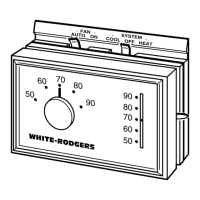
The device is equipped with a system switch that allows users to select between "COOL," "OFF," and "HEAT" modes, enabling seasonal control over the HVAC system. Additionally, a fan switch provides options for "AUTO" or "ON" operation. In "AUTO" mode, the fan cycles with the heating or cooling system, turning on only when the system is actively heating or cooling. In "ON" mode, the fan runs continuously, regardless of whether the heating or cooling system is active, which can be useful for improving air circulation or filtration.

The thermostat is designed for single-stage applications, meaning it can control one stage of heating and one stage of cooling. It is compatible with various system configurations, including standard heating and cooling systems, electric heating and cooling systems, single-stage heat pump systems, and two-transformer systems. It can also integrate with electronic air cleaners, humidifiers, and zone dampers, enhancing its versatility in a complete home comfort system.

Usage Features

The 1F56 Series thermostat is designed for straightforward operation, making it user-friendly for homeowners. Key usage features include:

  • Temperature Setting: Users can easily adjust the desired room temperature using a temperature lever, which corresponds to a clear temperature scale on the thermostat face. This allows for precise control over the indoor climate.
  • System Mode Selection: The system switch provides intuitive control over the HVAC system's primary function. By moving the switch to "HEAT," "COOL," or "OFF," users can prepare their system for the appropriate season or turn it off entirely when not needed.
  • Fan Operation Control: The fan switch offers flexibility in how the system's fan operates. The "AUTO" setting is ideal for energy efficiency, as the fan only runs when the heating or cooling system is active. The "ON" setting provides continuous air circulation, which can be beneficial for maintaining a more even temperature throughout the home or for air purification purposes.
  • Comfort Optimization: The inclusion of an adjustable heating anticipator and a fixed cooling anticipator is a significant usage feature. These components work behind the scenes to minimize temperature swings, ensuring that the room temperature remains closer to the set point without noticeable fluctuations. This contributes to a more consistent and comfortable indoor environment.
  • Broad System Compatibility: The thermostat's design allows it to be used with a wide range of single-stage HVAC systems, including those with electric heat, heat pumps, and two-transformer setups. This broad compatibility makes it a suitable replacement or initial installation choice for many residential and light commercial applications.
  • Clear Visual Indicators: The thermostat's design includes clear markings for temperature settings, system modes, and fan operations, making it easy for users to understand and adjust their settings at a glance.
  • Installation Flexibility: The manual provides detailed instructions for selecting an optimal thermostat location and routing wires, ensuring that the device can be installed in a way that maximizes its performance and accuracy. This includes guidance on avoiding common pitfalls like direct sunlight, drafts, or proximity to heat-radiating equipment.

Maintenance Features

While the White-Rodgers 1F56 Series thermostat is designed for reliable operation with minimal user intervention, the manual outlines specific maintenance-related features and procedures to ensure its continued accuracy and performance:

  • Adjusting Heat Anticipator: This is a critical maintenance feature for optimizing heating system performance. The thermostat comes factory-preset, but environmental conditions or specific system characteristics might require fine-tuning. Users can adjust the heat anticipator dial setting to lengthen or shorten heating cycles, thereby preventing temperature overshoots or undershoots. This adjustment helps maintain a tighter temperature control and improves overall comfort and efficiency. The manual provides clear steps for this adjustment, including removing the cover and manipulating the dial.
  • Calibrating Thermostat: Although the thermostat is carefully adjusted at the factory, the manual acknowledges that environmental conditions or prolonged use might lead to slight discrepancies between the indicator setting and the actual room temperature. The calibration procedure allows users to correct these differences, ensuring that the thermostat accurately reflects and controls the desired temperature. This involves a precise adjustment of the bimetal element using a specific wrench, ensuring that the mercury switch shifts correctly at the set point. The instructions emphasize disconnecting power and allowing the bimetal to stabilize for accurate calibration.
  • Durable Design: The use of a sealed mercury switch contributes to the thermostat's longevity and reduces the need for frequent maintenance related to switch contacts. Mercury switches are known for their reliability and resistance to dust and corrosion, which can often affect other types of switches.
  • Clear Wiring Diagrams: The comprehensive wiring diagrams provided in the manual are essential for both initial installation and any future troubleshooting or maintenance. They clearly illustrate the terminal identifications and hookups for various system configurations, enabling qualified individuals to correctly connect or inspect the wiring.
  • Safety Precautions: The manual consistently highlights safety precautions, such as disconnecting electrical power before installation or maintenance. This emphasis on safety is a crucial "maintenance feature" as it guides users to perform any necessary adjustments in a safe manner, preventing electrical shock or damage to the equipment.
  • Troubleshooting Guidance (Implicit): While not explicitly a "troubleshooting" section, the detailed descriptions of how the system and fan switches operate, along with the wiring diagrams, implicitly provide a basis for diagnosing common operational issues. Understanding the expected behavior of the thermostat under different settings can help users identify if the system is functioning as intended or if a problem exists.
  • Accessibility for Adjustments: The design allows for relatively easy access to the heat anticipator and calibration points by simply removing the thermostat cover. This user-friendly access facilitates necessary adjustments without requiring specialized tools beyond a small wrench for calibration.

In summary, the White-Rodgers 1F56 Series thermostat is a robust and user-friendly device designed for effective temperature control. Its features are geared towards providing consistent comfort, ease of operation, and the ability for users to maintain its accuracy over time through simple, well-documented adjustment procedures.

White Rodgers 1F56 Series Specifications

General IconGeneral
Power SourceBattery (2 AA)
Stages1 Heat/1 Cool
TypeNon-programmable
Voltage24 VAC
MountingWall

Related product manuals