EasyManua.ls Logo

White 1550 - Basic Sewing Techniques; Basting and Staystitching; Direction Changes and Seam Fastening

Default Icon
47 pages
Print Icon
To Next Page IconTo Next Page
To Previous Page IconTo Previous Page
Loading...
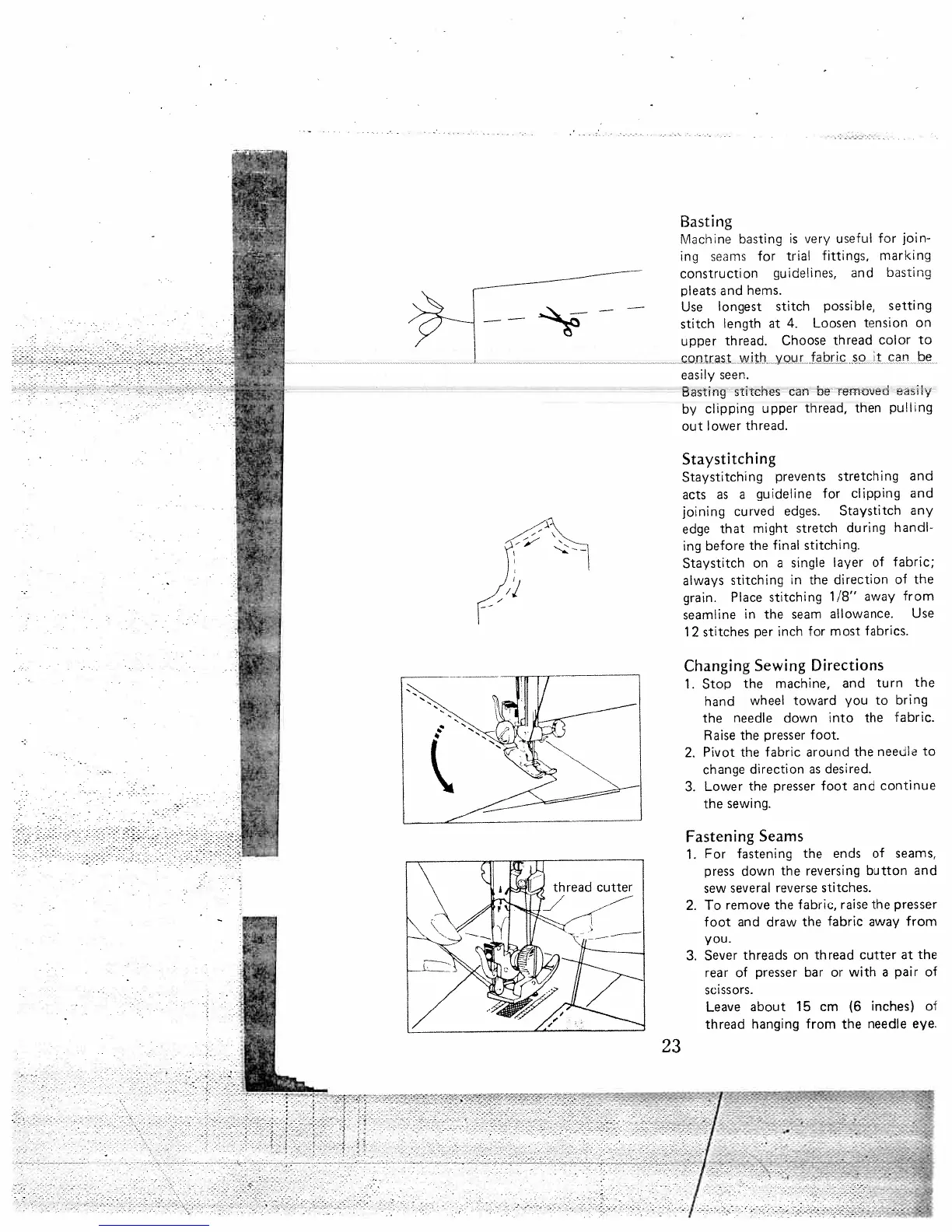
Basting
Machine
basting
is
very
useful
for
join
ing
seams
for
trial
fittings,
marking
construction
guidelines,
and
basting
pleats
and
hems.
Use
longest
stitch
possible,
setting
stitch
length at
4.
Loosen
tension
on
upper
thread.
Choose
thread
color
to
contrast
with
your
fabric
so
it
can
be
easily
seen.
Basting
stitches
can
be
removed
easily
by
clipping
upper
thread,
then
pulling
out
lower
thread.
Staystitching
Staystitching
prevents
stretching
and
acts
as
a
guideline for
clipping
and
joining
curved
edges.
Staystitch
any
edge
that
might
stretch
during
handl
ing
before
the
final
stitching.
Staystitch
on
a
single
layer
of
fabric;
always
stitching
in
the
direction
of
the
grain.
Place
stitching
1/8”
away
from
seamline
in
the
seam
allowance.
Use
12
stitches
per
inch
for
most
fabrics.
Changing
Sewing
Directions
1.
Stop
the
machine,
and
turn
the
hand
wheel
toward
you
to
bring
the
needle
down
into
the
fabric.
Raise
the
presser
foot.
2.
Pivot the
fabric
around
the
needle
to
change
direction
as
desired.
3.
Lower
the presser
foot
and
continue
the
sewing.
Fastening
Seams
1.
For
fastening the
ends
of
seams,
press
down
the
reversing
button
and
sew
several
reverse
stitches.
2.
To
remove
the
fabric,
raise
the
presser
foot
and
draw
the
fabric
away
from
you.
23
3.
Sever
threads
on
thread
cutter
at
the
rear
of
presser
bar
or
with
a
pair
of
scissors.
Leave
about
15
cm
(6
inches)
o4
thread
hanging
from
the
needle
eye.
-

Related product manuals