
 Need help?
Do you have a question about the WilTec SUNSUN HW-302 and is the answer not in the manual?
Essential safety guidelines for operating the aquarium filter to prevent injury and damage.
Instructions on how to unclip buckles to separate the filter head from the filter base.
Guide on accessing filter trays for cleaning or adding filter media, and reattaching the head.
Steps for inserting and securing inlet/outlet taps, and attaching hoses.
Instructions for attaching input downpipes and output spraybars to the filter system.
Guide on using the primer button to draw water into the filter and pipework.
Location and function of the UV unit switch and indicator light.
Explanation of the protect switch that turns off the UV when the filter base is separated.
Table listing common operational issues, their causes, and recommended solutions.
Guidance on filter system maintenance, common leaks, and sealing advice.
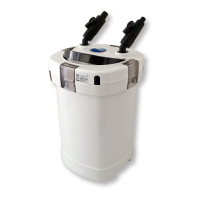
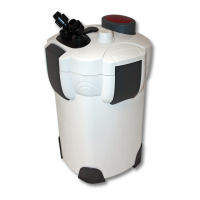
This document outlines the operation and maintenance of an external aquarium filter, designed for indoor use with aquariums. The filter is a multi-stage filtration system that helps maintain water quality by removing physical debris, biological waste, and chemical impurities.
The external aquarium filter operates by drawing water from the aquarium, passing it through various filter media, and then returning the cleaned water to the tank. The core of the system involves a filter head, which houses the pump and control mechanisms, and a filter base, which contains multiple filter trays for different media.
Water enters the filter through an inlet downpipe and is then pumped through the filter media in a specific order. The filtration process typically begins with mechanical filtration, where coarse debris is removed. This is followed by biological filtration, where beneficial bacteria colonize the media to break down harmful ammonia and nitrites. Finally, chemical filtration may be employed to remove specific impurities, odors, or discoloration. After passing through all stages, the filtered water is returned to the aquarium via an output spraybar.
Some models of this filter are equipped with a UV unit. This UV lamp, located within the filter head, provides an additional layer of sterilization by exposing the water to ultraviolet light, which helps to control algae and harmful microorganisms. The UV unit has a dedicated switch for activation and an indicator light to show its operational status. A safety feature ensures that the UV lamp automatically turns off when the filter head is separated from the filter base, preventing accidental exposure to UV light and potential damage to the filter base.
The filter system includes a primer button on the filter head, which facilitates the initial priming process. Pressing this button helps to draw water into the filter and fill the pipework, ensuring proper operation from the start. The inlet and outlet taps, secured to the filter head, control the water flow and also act as valve shut-offs, allowing for easy disconnection and maintenance without significant water spillage.
Setting up the filter involves a few key steps. First, the filter head is unclipped from the filter base by releasing the buckles. This allows access to the filter trays for arranging or adding filter media. The manual suggests a typical media arrangement: bio balls at the bottom for biological filtration and coarse dirt retention, followed by ceramic rings, and then a filter sponge covered with filter cotton at the top. Activated carbon can be added temporarily for specific needs, such as after medication treatment or for turbid water. It is crucial to ensure that the filter media is suitable for the specific aquarium and its inhabitants.
Once the media is in place, the filter head is re-fastened to the filter base. The inlet and outlet taps are then pushed into the filter head and secured. Hoses are attached to each tap and fastened with screw taps. The input downpipes and output spraybars are then connected to the aquarium.
To start the filter, the primer button on the filter head is pressed repeatedly until the entire pipework is filled with water. The UV unit, if present, can then be switched on using its dedicated switch.
The manual emphasizes the importance of proper air evacuation from the filter system. If air remains, it can cause abnormal sounds and inhibit water flow. A recommended method involves directing the return-flow hose into a clean bucket placed below the filter and activating the manual pump until no air bubbles are visible. This ensures efficient operation and prevents issues caused by trapped air.
Regular maintenance is crucial for the optimal performance and longevity of the external aquarium filter. The manual highlights several key maintenance aspects:
The manual also includes a troubleshooting guide to address common issues such as the primer button not operating, the motor not working, inhibited water flow, and abnormal sounds during operation. These solutions often involve checking connections, cleaning components, or replacing damaged parts.
 General
| Brand | WilTec |
|---|---|
| Model | SUNSUN HW-302 |
| Category | Water Filtration Systems |
| Language | English |


 To Next Page