EasyManua.ls Logo

Wilton 7060 - User Manual

Wilton 7060
28 pages
Print Icon
To Next Page IconTo Next Page
Loading...
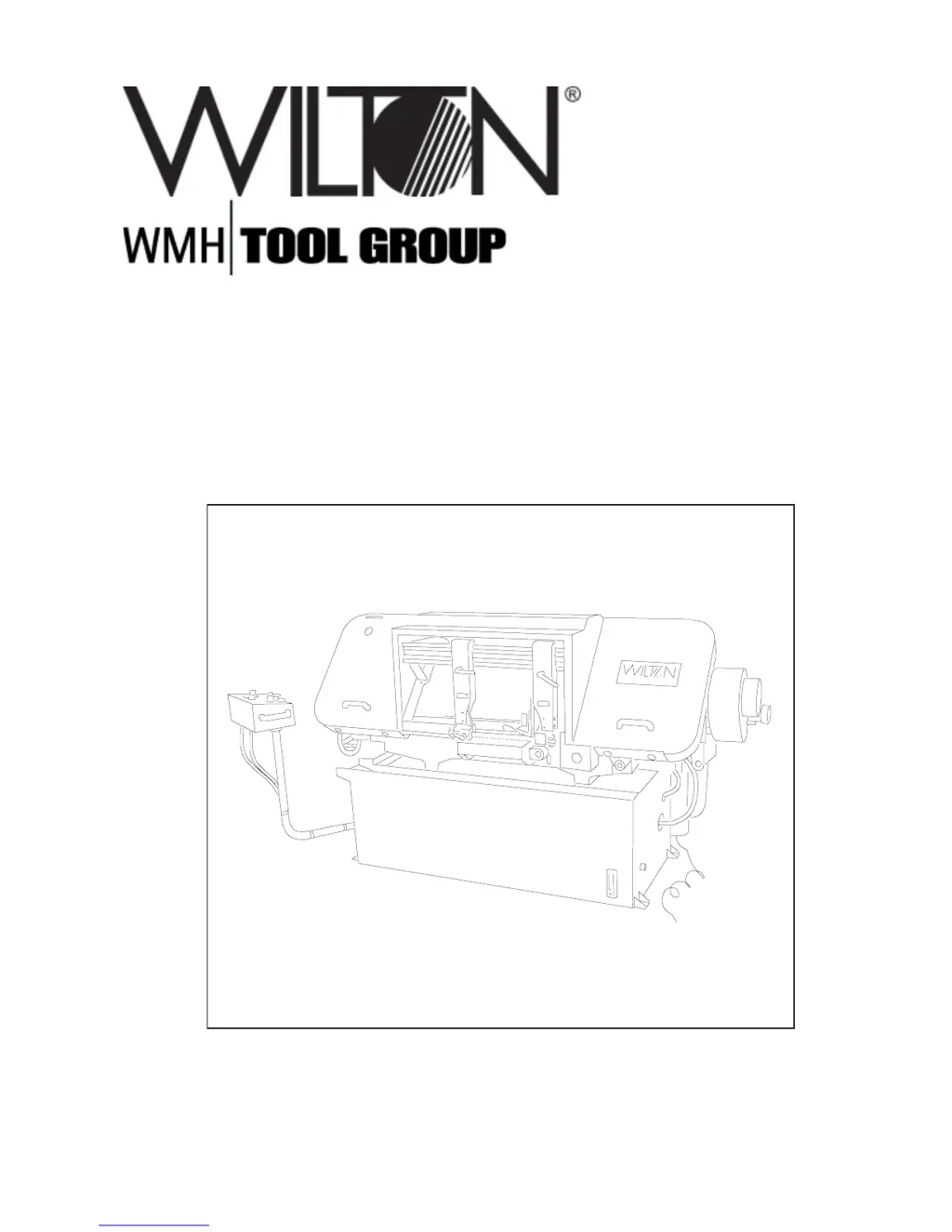
Operating Instructions — Parts Manual
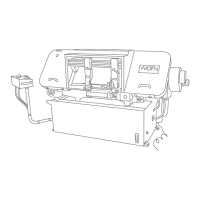
20-Inch x 20-Inch Semi Automatic
Horizontal Cut-Off Band Saw
Model: 7060
WHM TOOL GROUP
2420 Vantage Drive
Elgin, Illinois 60124 Part No. 5511736
Ph.: 800-274-6848 Revision A2 08/06
www.wmhtoolgroup.com Copyright © WMH Tool Group

Questions and Answers

  • M
    Mary DavisAug 15, 2025
    Why is my Wilton Saw blade breaking so much?
    • T
      timothynorrisAug 15, 2025
      Excessive blade breakage in your Wilton Saw can stem from several issues. It could be due to the material not being securely clamped in the vise, incorrect speed or feed settings, using teeth that are too coarse for the material, improper blade tension, the saw blade contacting the workpiece before starting, the blade rubbing on the wheel flange, misaligned guides, or cracking at the weld. To address this, ensure the material is securely clamped. Check the Machinist’s Handbook for appropriate speed and feed settings, as well as recommended blade type. Adjust blade tension to prevent slipping on the wheel. Always start the motor before placing the saw on the workpiece. Adjust blade tracking and guides as needed. For cracking at the weld, a longer annealing cycle may be necessary.
  • D
    Donald ClaytonAug 21, 2025
    Why Wilton Saw blade dulls prematurely?
    • J
      James GonzalezAug 21, 2025
      Premature blade dulling in your Wilton Saw can occur for several reasons. The blade teeth might be too coarse, the blade speed might be too high, the feed pressure might be inadequate, there could be hard spots or scale on the workpiece, the material might be work hardening (especially stainless steel), blade tension might be insufficient, or you might be operating the saw without pressure on the workpiece. To fix this, use a finer tooth blade, try a lower blade speed, decrease spring tension to increase feed pressure, increase feed pressure for hard spots or reduce speed and increase feed pressure for scale, increase feed pressure by reducing spring tension for work hardening, increase blade tension to the proper level, and avoid running the blade at idle in/on the material.
  • M
    Margaret YoungAug 25, 2025
    What to do if Wilton Saw teeth missing/ripped from blade?
    • O
      omayoAug 25, 2025
      If teeth are missing or ripped from your Wilton Saw blade, it could be due to several reasons: the blade tooth pitch is too coarse for the workpiece, the feed is either too slow or too fast, the workpiece is vibrating, or the gullets are loading up with chips. To address this, use a blade with a finer tooth pitch, increase feed pressure and/or blade speed, clamp the workpiece securely, and if gullets are loading up, use a blade with a coarse tooth pitch and reduce feed pressure, or brush the blade to remove chips.
  • N
    Nichole ParkerAug 27, 2025
    How to fix bad (rough) cuts with Wilton Saw?
    • A
      Amber BerryAug 27, 2025
      If your Wilton Saw is producing rough cuts, it could be because the blade speed is too high for the feed pressure, or the blade is too coarse. To correct this, reduce the blade speed and feed pressure, and replace the blade with a finer one.
  • M
    Mary ThomasAug 30, 2025
    Why is my Wilton Saw motor running too hot?
    • R
      Robert WatersAug 30, 2025
      A Wilton Saw motor overheating can be caused by several factors: the blade tension is too high, the drive belt tension is too high, the blade is too coarse for the workpiece (especially with tubular stock), the blade is too fine for the workpiece (especially with heavier, soft material), or the speed reducer gears require lubrication. To resolve this, reduce tension on the blade and drive belt. Use a blade with a fine tooth pitch for tubular stock and a blade with a coarse tooth pitch for heavier, soft material. Also, check the speed reducer.
  • R
    Richard MorrisSep 2, 2025
    What to do if Wilton Saw blade is twisting?
    • M
      murraysaraSep 3, 2025
      If your Wilton Saw blade is twisting, it could be due to the blade binding in the cut or the blade tension being too high. To resolve this, decrease the feed pressure and reduce the tension on the blade.
  • H
    Heidi SmithSep 5, 2025
    What causes unusual wear on side/back of Wilton Saw blade?
    • M
      Monica LeeSep 6, 2025
      Unusual wear on the side or back of your Wilton Saw blade can be caused by worn blade guides, improperly adjusted blade guide bearings, or a loose blade guide bearing bracket. To address this, replace the blade guides, adjust the blade guide bearings, and tighten the blade guide bearing bracket.
  • G
    gibbsjamesSep 8, 2025
    What to do if there is no coolant flow in my Wilton Saw?
    • B
      brentbutlerSep 9, 2025
      If there is no coolant flow in your Wilton Saw, it could be due to a burned-out pump motor, a clogged screen/filter on the pump, a loose impeller, or a coolant level that is too low. To fix this, replace the pump, clean the screen/filter, tighten the impeller, and add coolant to the reservoir.
  • D
    David RichardsSep 12, 2025
    Why does my Wilton Saw make excessive speed reducer noise/vibration?
    • K
      Kimberly ArmstrongSep 12, 2025
      Excessive speed reducer noise or vibration in your Wilton Saw can be caused by a V-belt that is too tight. To resolve this, reset the V-belt tension.
  • E
    Ethan OlsonNov 17, 2025
    What to do if my Wilton Saw makes bad (out-of-square) cuts?
    • S
      Sharon WalkerNov 17, 2025
      If your Wilton Saw is making out-of-square cuts, several factors could be responsible. The workpiece might not be square with the blade, the feed pressure might be too fast, the guide bearings might not be adjusted properly, the blade tension could be inadequate, the span between the blade guides might be too wide, the blade might be dull, the blade speed could be incorrect, the blade guide assembly or bearing assembly could be loose, the blade track could be too far from the wheel flanges, or the guide bearing could be worn. To resolve this, adjust the vise to ensure it's square with the blade and always clamp the work tightly. Decrease the feed pressure, adjust the guide bearing clearance to 0.001 inch (0.002 inch maximum), gradually increase blade tension, move the blade guide bar close...

Summary

General Specifications

Machinery General Safety Warnings

Operating Instructions

Controlling the Cut: Hydraulic Feed Control

Work Set-up

Starting the Saw

Adjustments

Blade Tracking Adjustment

Procedure to adjust the blade tracking for proper alignment on the wheels.

Factory or Field Procedure

Step-by-step guide for adjusting blade tracking, either from the factory or in the field.

Blade Guide Bearing Adjustment

Adjustment of Limit Switches

Servicing Hydraulic Oil

Changing Blades

Changing the Drive Belt

Replacing the Drive Motor

Adjusting the Blade Guides

Replacement of Blade Guides

Replacement of Guide Bearings

Replacement of Blade Edge Bearings

Replacing the Coolant Pump

Machine Setup

Troubleshooting

Excessive blade breakage

Identifies causes and remedies for excessive band saw blade breakage.

Premature blade dulling

Addresses causes and solutions for premature dulling of saw blades.

Bad cuts (out-of-square)

Troubleshooting guide for cuts that are not square with the workpiece.

Bad cuts (rough)

Solutions for rough cuts, often related to blade speed or material.

Troubleshooting (Continued)

Blade is twisting

Diagnoses and fixes for band saw blades that twist during cutting.

Unusual wear on side;back of blade

Addresses causes of uneven wear on the sides or back of the saw blade.

Teeth missing;ripped from blade

Troubleshooting for missing or ripped teeth on the saw blade.

Wilton 7060 Specifications

General IconGeneral
BrandWilton
Model7060
CategorySaw
LanguageEnglish

Related product manuals