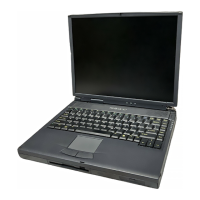
2. Turn the computer upside down.
3. Remove the two Phillips screws that secure the metal CPU/Memory compartment cover
panel and remove the cover panel.
4. Gently, push down on the two release tabs that secure the memory board in the socket.
5. The memory board will spring up to a 45° angle, remove it by holding it by the edges and
gently pulling it out of the socket.
6. Insert the new memory board into the socket at a 45° angle. The memory board is
designed to insert only in the correct orientation. If it won’t go into the socket, turn it
over and try again.
7. Push the board firmly into the socket, then press down until the spring latches hold the
board securely in place.
8. Replace the cover panel and secure it with the screws.
9. Turn on the computer. The system will automatically detect the additional memory and
prompt you to press ‘F2’ to run the Setup program. When the program comes up, just
press ‘Esc’ and then ‘F4’ and the new memory configuration will be recorded.
The system will automatically reconfigure itself for the additional memory. If you check in the
Setup program, you should see that the extended memory total listed on Page 1 has increased.
Memory & Suspend-to-Disk
If you use the Suspend-to-Disk feature, whenever you add memory, you must increase the size of
the dedicated disk partition to be the same size as your new system memory total. Please refer to
Appendix B for instructions on using the PHDisk utility to change the disk partition.f
Figure 22: Installing a Memory Upgrade



 To Next Page