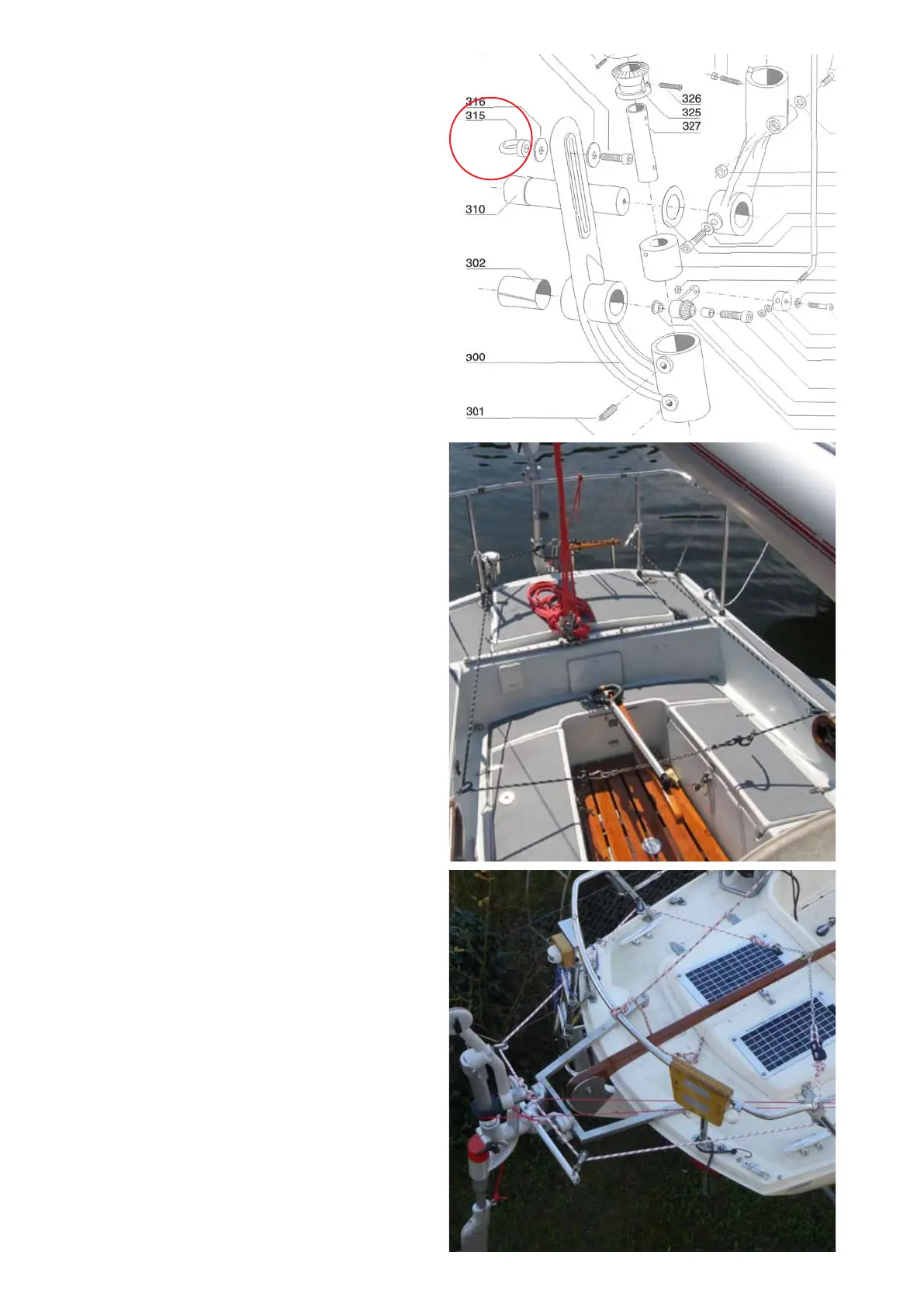
1.6.2 THE BASICS
• Keepthesteeringlinesasshortaspossible.
• Usethesmallestpossiblenumberofblocks.
• Usenon-stretchlines.
• Makesuretheangleformedbythelinesbetween
the system and the back of the boat (seen from
above) is no greater than 30 degrees.
• Checkthetensionofthesteeringlines.
• Watchtomakesurethatlinetravelisnotbeing
wasted between the pendulum arm and the main
rudder.
• Checkthatthemainrudderbearingsrunsmoothly.
• Checkwheelsteeringsystemsforplayand
stiffness.
1.6.3 WINDPILOT SYSTEM REQUIREMENTS
• Ring315onthependulumarmmustbeatdeck
level.
• Thiskeepsthesteeringlinesshort.
• Therearenounnecessaryblocksonthesteering
lines.
• Therearenoblocksfittedtothesystemitself.
• Thependulumruddershaftislongenoughto
provide plenty of leverage for the pendulum rudder.
• Thebevelgearlinkageisworkingproperlyto
provide automatic yaw damping.
• Thesystemissensitiveinlightairsbutpowerfulin
stronger wind conditions.
CAUTION
• Takecarewhensettingupthesteeringlines
between the WINDPILOT and the main rudder.
Poor force transmission will seriously impair
steering quality.
1.6.4 CROSSBAR
• Iftheangleformedbythelinesbetweenthesystem
and the first set of turning blocks on the back of the
boat (seen from above) is greater than 30 degrees,
performance is likely to suffer. The blocks may be
moved to the ends of a crossbar fitted adjacent
to the top of the mounting bracket to improve the
angle and resolve the problem.
1.6.5 DEDICATED BREAK POINT FOR STEERING
LINES
• Twooftheturningblocksforthesteeringlines
should be fastened to the boat only with thin cord
(e.g. 3 mm burgee halyard). If, for whatever reason,
the transmission system should be overloaded,
these lines will break and save the rest of the
setup.
1.6.6 SHOULD I SPLICE THE STEERING LINES?
• No,itisbetterjusttouseknotsasyoucanthen
end-for-end the lines easily to spread the wear.



 To Next Page