6 7
COOKING USING YOUR PRESSURE COOKER
General
Y
our pressure cooker cooks food under pressure,
i
.e. at temperature above 100°C.
This reduces cooking times by up to 70 %, a
significant energy saving. Cooking in steam largely
preserves food's flavour, taste and vitamins.
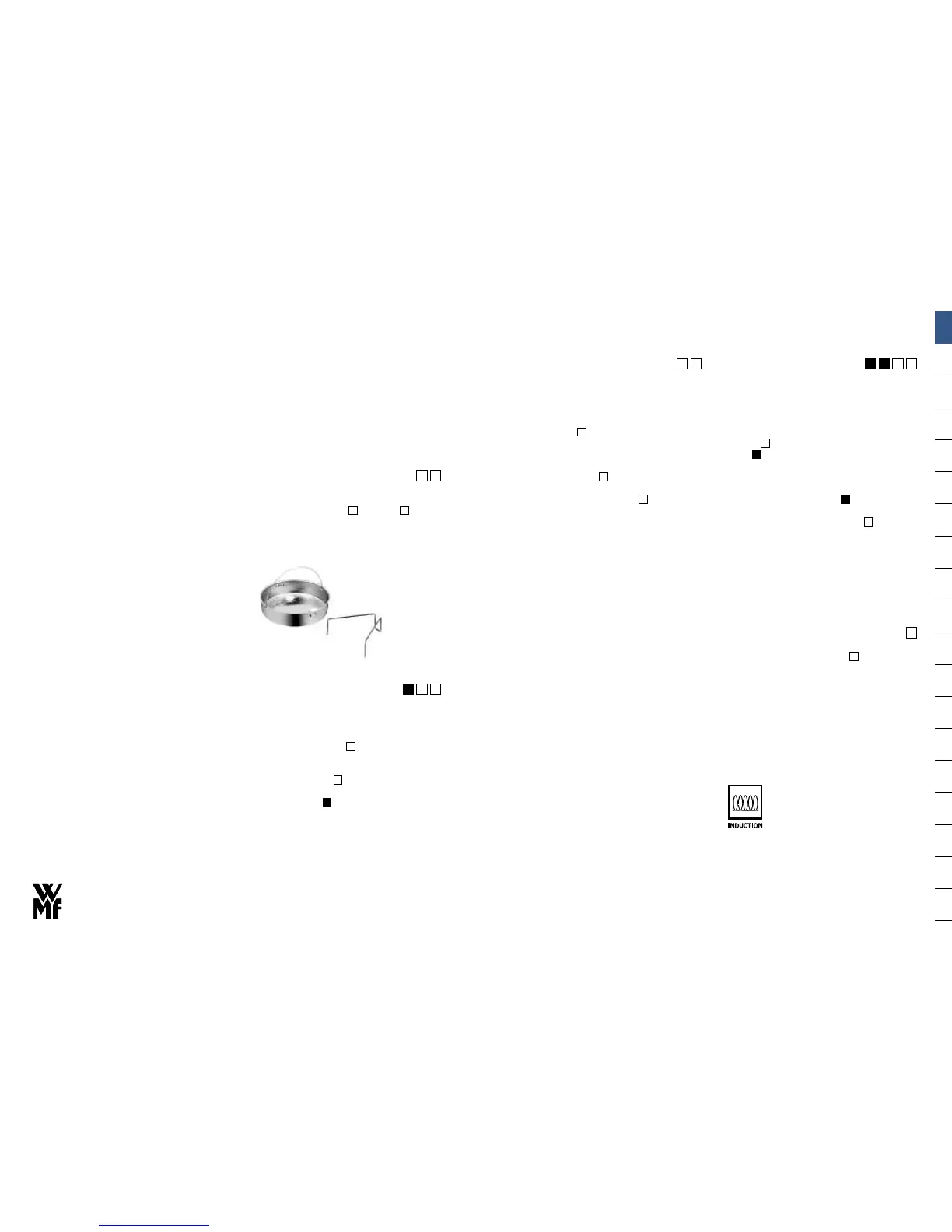
Cooking with inserts
Depending on the size of your pressure cooker,
you can cook with inserts or a trivet .
Inserts and trivets are available as accessories
from your WMF dealer (see 'Accessories and spare
parts').
Heating up
After filling and closing your pressure cooker,
place it on the hob at the maximum heat setting.
During the heating phase, air will escape via the
automatic heating device , which also acts as a
safety valve, until the valve audibly closes and
pressure can build up.
The cooking indicator will rise, and the yellow
pressure ring, together with the two orange rings,
will become visible .
Turn down the heat in time, ensuring that it is
reduced sufficiently. The orange ring
recommended in the recipe must be just visible.
J
1
9
91J
1312
1312
Cooking times
T
he cooking time only starts once the ring
r
ecommended in the recipe is fully visible. Take
care to ensure that the ring position remains
stable. Regulate the heat accordingly. If the
cooking indicator falls below the required
orange ring, you will have to turn up the heat
slightly.
This will slightly prolong the cooking time.
If the cooking indicator rises above the second
orange ring, excess pressure will result. This will
escape audibly via the main valve on the lid
handle.
Remove the pot from the hob, wait until the
cooking indicator has fallen to the second orange
ring, and turn the heat back on.
Pressure cooking facilitates shorter cooking times,
because the steam pressure in the pot results in
higher temperatures.
First ring: approx. 110°C
(operating pressure 45 kPa, regulating
pressure 90 kPa)
for delicate foods such as fish or compote
Second ring: approx. 119°C
(operating pressure 95 kPa, regulating
pressure 130 kPa, max. 150 kPa)
for all other foods
Energy-conscious users will want to turn off the
heat even before the end of the cooking time,
since the heat stored in the pot will suffice to
finish the cooking process.
Cooking times may vary for the same foodstuffs,
depending on the quantity, form and make-up of
the food.
3
1
1
31
Opening the pot
A
t the end of the cooking time remove the
p
ressure cooker from the hob.
On principle, the lid should only be opened and
removed from the pot once the pot is
depressurised. This means that the cooking
indicator must have fully disappeared into the
handle . The residual pressure lock ensures that
the pot can only be opened once fully
depressurised, i.e. once even the yellow pressure
ring is no longer visible.
If the yellow ring is still visible , this means that
the residual pressure lock has reacted. To release
it, quickly move the sliding indicator to the
ZU/LOCKED position.
If no steam escapes, shake the pot briefly. This
will release any pockets of steam from the food.
Such bubbles may form especially when cooking
liquid or viscous foods, and they can spit out when
removing the lid. Now turn the lid handle to the
right as described, and open the pot.
Information on induction hobs
The TransTherm
®
universal base is suitable for
all hob types, including induction hobs. A humming
noise may develop at high heat setting when
cooking on induction hobs. This noise has
technical causes and does not indicate that either
your hob or your pressure cooker is defective. The
pot size must correspond to the size of the
cooking zone. Otherwise – especially in the case
of small diameters – the cooking zone (magnetic
zone) may not respond to the pot base.
11
11
K
7
I
1
71KI
DE
GB
ES
DK
FI
FR
GRIT
NL
NO
PL
PT
RUSE
SK
SICZ
TR
HU
HR
BG



 To Next Page