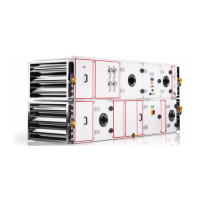
Shutdown / Fire /
End-of-lifedisposal
Seasonalshutdown:
Operate heat-wheel heat exchanger periodically to clean off the surface.
Short-termshutdown:
Run down the system to minimum output by means of the control system.
Set the dampers to recirculating air mode and close the outside air damper to prevent
cooling and the risk of frost.
Switch off recirculation pumps and close the control valves.
Drain internal components that could be damaged by frost, for example the heat
exchanger.
Use compressed air to blow out heat exchanger and connecting lines installed on site
until they are fully drained.
Allow the fan to run on until all surfaces are completely dry.
Drain all siphons.
Switch off the main isolator and lock the system.
Long-termshutdown:
Adopt the same procedure as for a short-term shutdown.
In addition, relieve the tension on fan vee-belts if installed, or remove the vee-belts to
prevent damage to the shaft bearings.
Restarting:
Visually inspect and check for signs of damage.
Follow the commissioning routine (as described in the "Commissioning" section).
Shutdown
Disposalandrecycling:
When it has reached the end of its useful life the system must be disassembled by
suitablytrainedandqualiedpersonnel.
Isolate the system from the power supply before commencing disassembly work.
Trained,qualiedelectriciansmustremovethepowercables.
Fully drain all components containing media (heating coil, cooling coil, etc.). Dispose
of such media (e.g. water containing antifreeze, refrigerant etc.) professionally in
accordance with local regulations.
The system can then be disassembled into its component parts.
Metal and plastic parts must be sorted and disposed of in the correct, environmentally
responsible manner. (weight reduction)
Be aware that load-bearing metal and plastic components may have aged and thus no
longer reach the original structural load limit.
Attention should be paid to this in particular with weatherproof appliances due to the
constant weathering and UV radiation.
If load-bearing metal and plastic components have aged, they must be transported
using safe, modern Wolf lifting equipment.
Metal and plastic components should be sorted and disposed of separately according
to the local regulations. Electrical and electronic components must be disposed of as
electrical waste.
Suitable protective clothing, protective gloves and respirators must be worn when
handlingcomponentsthatarecontaminatedwithdust(e.g.lters,mineralwoolproducts,
etc.).
Filters and mineral wool products must be disposed of in an environmentally friendly
manner according to the local regulations.
Fire
Theequipmentassuchdoesnotpresentadirectrehazard.
Externalinuencescouldcausethesealsinstalledinsmallnumbersintheequipment
to burn.
Disconnectthesystemfromthepowersupplyintheeventofare.
Personsinvolvedinreghtingmustwearsuitablebreathingapparatus.
The usual extinguishers such as water, extinguishing foam or extinguishing powder
canbeusedforreghting.
Flammable seals are installed only in small quantities. In the event of a re only
correspondingly small quantities of pollutants can be produced.


 To Next Page
 Loading...