The provided document is an "Operations Manual" for the NBFL (New Bus for London) vehicle, manufactured by Wrightbus. The manual is intended to provide drivers with information to operate their vehicles safely and efficiently, and also includes details for maintenance and emergency repairs.
Function Description:
The NBFL is a 4-cylinder turbo-charged diesel engine hybrid bus designed for public transport. The diesel engine charges the hybrid batteries, which in turn power a direct-drive electric motor into the axle. The vehicle features an air-operated braking system with an electrically driven compressor, an electronically controlled air suspension system with a kneeling function, and a 24-volt multiplex electrical system that uses a 600-volt DC/DC converter to charge the 24-volt battery from the 600-volt battery. Power steering is electrically driven. The vehicle's emission control system utilizes a reagent (Adblue/Urea) to meet Euro 5 engine emission legislation.
Important Technical Specifications:
- Engine: Efficient 4-cylinder turbo-charged diesel engine.
- Power System: Hybrid electric, with batteries powering a direct-drive electric motor.
- Electrical System: 24-volt multiplex, with a 600-volt DC/DC converter.
- Suspension: Independent wishbone front suspension with air springs and hydraulic dampers; drop-centre rear axle with radius rods, air springs, and hydraulic dampers.
- Braking System: Air-operated, with Service One and Service Two reservoirs for front and rear brakes, and a park reservoir for spring-actuated, air-released rear brakes.
- Emissions: Euro 5 compliant, requiring Adblue/Urea.
- Ground Clearance: Can be increased by 70mm using the Ferry Lift Switch.
- Wheel Torque (Steel Wheels): 600Nm ±15Nm, applied in three stages (1st Stage - 300Nm ±7.5Nm, 2nd Stage - 500Nm ±12.5Nm, 3rd Stage - 600Nm ±15Nm).
- Recommended Tyres:
- Front: Michelin 315/60 R22.5 X ENERGY XF TL 154/148L
- Rear: Michelin 275/70R22.5 XZA 2 ENERGY TL 148/145 M
- Recommended Tyre Pressure:
- Front: 9.0 Bar
- Rear: 8.75 Bar
- Engine Oil (Euro 5): 11L, 15W-40 Grade (To Cummins CES20076, 77 or 78. ACEA E5 and API CI-4).
- Engine Coolant: 55L, TEC PGXL (Propylene glycol) (TMC RP329 - grade). To CES 14603.
- Battery Circuit Coolant: 11L, TEC PGXL (Propylene glycol).
- Hybrid Circuit Coolant: 40L, BASF G48 coolant (50/50 mixture with de-ionized water).
- Steering Fluid: 5L, TEXAMATIC 7045 E, GM Dexron III Equivalent spec.
- Rear Axle Oil: 30L, 80W - 90 Chevron Texaco Multigear SAE 80W - 90. (According to ZF List of Lubricants TE-ML 12).
- Air Compressor Lubricating Oil: 1.3 Ltrs, Fluid Force 4000.
Usage Features:
- Driver's Seat Adjustment: Levers for height (front and rear), wire loop for fore and aft position, knurled knobs for seat back rake and lumbar support.
- Controls Layout: Includes switch panel, drive selector, park brake control, accelerator and brake pedals, hidden switches, multifunction switch, drivers information screen, and warning lights.
- Upper Console: Features switches for rear fog lights, reverse bleeper override, interior lights (master, N/S, O/S), cab light, and battery protection system reset.
- Right Hand Dash: Includes camera toggle, hazard light, ramp switch (electronic, with manual retraction option), drive start, drive ignition start, and ferry lift switch.
- Steering Wheel Stalk (L/H): Controls wipers, horn, headlights, and indicators.
- Drive Selector: Positions D (Drive), N (Neutral), and R (Reverse). Neutral should only be selected under 5 km/hr and when stationary. Reverse requires the vehicle to be stationary and brake pedal operated.
- Right Hand Side Console: Parking brake, Cab Checker Unit (for diagnostics and camera checks), Genius (Journey Data Management System for driver ID and start inhibit), Panic Alarm, Emergency Power Switch (cuts engine, fuel, isolates batteries, releases doors, activates internal lights for evacuation), Crew Switch (for rear door lock/unlock), Rear/Mid/Front Door Close, Door Open (opens all doors, rear platform door can be disabled), Kneeling Switch (lowers vehicle to lowest position), Battery Isolator Switch (disconnects electrical system), Foot Switch (activates microphone for radio system).
- Lower Left Hand Side Console: Assault Screen Unlock (unlocks electromagnet for near-side assault screen), Hidden Start Switch (must be pressed and held with engine start switch), OnBoard Diagnostics socket.
- Door Buttons: Emergency door release buttons are located on the exterior for front, mid, and rear doors. Interior switches above each door allow opening/closing when the vehicle is below 5kph.
- Ramp Request Switch: Located at the mid-door, illuminates a light in the driver's cab when pressed.
- Rear Crew Controls: Allows crew to open/close rear doors, with interlocks and warning buzzers.
- DMUX Screen: Displays warning indicators (Stop, Caution, Information), visual representation of the vehicle, engine rpm, door status, and diagnostic menus (MUX, DICO, Engine, Battery Management System, EBS, Compressor, Power Steering).
- Starting and Driving: Normal starting procedure involves parking brake, neutral, master switch on, ignition on, hidden start switch, and engine start switch. Rear starting procedure also available. Shutting down requires turning off ignition and then battery master switch.
- Braking: Regenerative braking integrated with service brakes, acting on rear wheels. ABS system may disengage regenerative braking on slippery surfaces.
- Speed Control Humps: Maximum recommended speed of 10mph.
Maintenance Features:
- Daily Checks: Includes level checks (engine oil, engine coolant, washer bottle), visual checks (exterior lights, fluid leaks, tyres, wheel nut pointers, panels, interior condition, escape hatch, interior lights, fire extinguisher), and physical checks (doors, ramp, saloon bells, wheelchair buzzer, warning lights, cab controls).
- Service Schedule: Detailed 4-week rota over 5 years for chassis and body inspection and service actions, including air cleaner, air conditioning, front axle, front suspension, rear axle, rear suspension, foundation brakes, pneumatic braking system, cooling system, electrical, engine and ancillaries, SCR, fuel system, drive shaft, steering gear, air suspension, wheels and tyres, body, and hybrid systems.
- Engine Oil Level: Dipstick and filler located behind a hinged door on the rear offside. 2.8 litres between low and high marks.
- Fuel System: Diesel filling point on offside front, Adblue filling point on offside rear. Water separator drain cock for fuel system maintenance.
- Screen Wash: Filling point behind offside front lower hinge panel. Autoglym all-season quick clear screen wash recommended.
- Battery Door Panel: Access panel for batteries, located on the side of the vehicle. Struts should be lubricated every 28 days.
- Cleaning:
- Exterior Paintwork: Use neutral soaps/cleaners, avoid abrasive cleaners/polishes/solvents. Wash with lukewarm water and soft brush or automatic washer.
- ABS: Sponge clean with soap and warm water. Avoid Acetone.
- Body Interior: Regular vacuuming and cleaning for moquette/leather, panelling, and fittings.
- Flooring: Regular upkeep with suitable products, daily sweeping/damp mopping, periodic scrub cleaning. Detergent composition guidelines provided. Rinsing with hot/cold water. Avoid metallised emulsion for polishing.
- Treadmaster Flooring: Detailed maintenance programme including Treadmaster Cleaner, Floor Polish Stripper, and Sealer.
- Corrosion Inspection: Check underside and bodywork for dirt/road salts, damaged surfaces, bare metal.
- Structural Inspection: Check underside for loose fixings, cracks, weld fractures. Check joints, body structure intersections, seats, pedestals, mountings.
- Part Attachments: Check security of pipes, cables, mudflaps, flooring, stepwells, handrails.
- Heating System: Check pipe joints for coolant leaks, ensure gate valves work, clean air filters.
- Electrical: Check operation of lights, switches, warning lights, indicators, stop lights, horn. Check battery charging and instrument function.
- Cooling Systems: Check coolant level when cold. Expansion tank fillers on O/S rear corner. Battery coolant circuit has expansion tank under stairs. Do not mix coolants between circuits.
- Emergency Repairs:
- Jacking Points/Prop Heights: Specific jacking points identified, with warnings against jacking on unsupported frame parts.
- Wheels and Tyres: Procedure for correct fitment, re-torqueing (after 25-50 miles), and tightening sequence. Recommendations for dynamically balanced wheels and inspection of all parts before fitment.
- Battery Boost Socket: Located below driver's seat.
- High Voltage Lock Off and Isolation Procedure: Detailed safety critical procedure for isolating high voltage, including switching off ignition, battery master switch, 24V DC battery isolator, waiting 5 minutes for capacitor discharge, disconnecting HV power connector, and verifying voltage levels.
- Towing: Bus can only be towed from the front using a rigid tow bar. Requires disconnecting propshaft at rear axle. Manual release of spring brakes may be necessary if air supply is unavailable.
- Emergency Equipment: Fire extinguisher (located near mid-door, requires breaking glass), emergency windows (located throughout, break glass tool with yellow safety tag), emergency exit panels (upper deck, push white areas and pull to remove).

 Need help?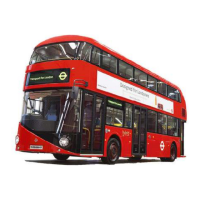

 To Next Page
 General