5 Operation
5.1 The current levels for alarm lights
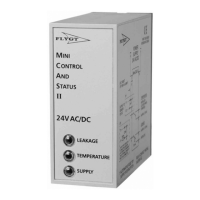
When the current level is between 3–22 mA, it is only the SUPPLY LED that is light.
Current level (mA) Type of alarm
> 22 Leakage alarm
< 3 Overtemperature alarm
5.2 LED indications
Symptom Cause Remedy
The leakage indicator LED is lit. There is a leakage in the pump. Service the pump. For information,
see Check which sensor tripped the
leakage alarm (page 11).
There is an earth fault in the sensor
circuit wiring.
See Check for an earth fault in the
sensor circuit (page 11) .
The temperature indicator LED is lit. A thermal contact is open. Service the pump.
The CLS is connected with the wrong
polarity in series with the
temperature switches.
Change polarity on the sensor output
of the relay.
The sensor output voltage is low. There is an earth fault in the sensor
circuit wiring.
See Check for an earth fault in the
sensor circuit (page 11).
The relay has a fault. Replace the relay.
The leakage indicator is nuisance
tripping.
The drive unit has CLS and VFD, and is
not protected by a filter.
Install a filter in the drive units
junction box, see Filter kits (page
16)
The drive unit has a CLS and no VFD,
but the fault is due to interference
from other drive units.
Install a filter on the sensor output of
the relay.
5.3 Reset the alarms after a fault indication
After a leakage fault, the relay resets automatically.
After an overtemperature fault, the relay requires a manual reset.
Select one of the following steps to reset the relay:
– Push the external push-button that is connected to pin 6 and pin 7.
When using the 24 V relay, pin 6 and pin 2 also resets.
– Interrupt the power supply for a short while.
5 Operation
10 MiniCAS II Installation, Operation, and Maintenance Manual


 To Next Page
 Loading...