
 Need help?
Do you have a question about the Xylem Rule A53S and is the answer not in the manual?
Describes the automatic 2-1/2 minute test cycle and how the pump checks for water and operates.
Covers fatal injury warnings, personal safety, property damage, child safety, and usage limitations.
Details electrical shock risks, grounding, GFCI requirements, and power disconnection for service.
Explains intermittent operation, testing, flow rate optimization, and system recommendations for basements.
Covers mounting, strainer attachment, and proper discharge hose installation to prevent air pockets.
Addresses common problems like pump not running, clogged strainers, and issues with water discharge.
Provides step-by-step instructions for removing debris and cleaning the pump's plastic and metal strainers.
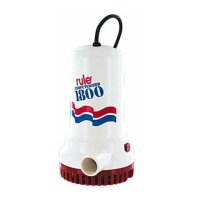
This document describes the Rule Submersible Utility Pump, a device designed for various water removal tasks. The manual covers the A53S, A53S-24 (automatic models), and A53D (non-automatic model) pumps, providing essential information for safe installation, operation, and maintenance.
The Rule Submersible Utility Pump is primarily designed for intermittent and seasonal water removal. The automatic models (A53S and A53S-24) feature a unique 2.5-minute test cycle. During this cycle, the pump runs for approximately one second to check for resistance or drag against the impeller. If water is detected, the pump continues to operate until all water is removed, then shuts off and returns to its 2.5-minute test cycle. Unplugging and replugging the pump does not reset this cycle. The non-automatic A53D model, however, is activated by plugging it into a GFCI-protected 110VAC electrical outlet.
These pumps are intended for use with fresh and salt water only. They are not designed for use in or on top of swimming pools, open bodies of water, or with hazardous liquids or flammable gases. Using the pump as a pool cover pump will void the warranty. The pump's motor includes a sensor or automatic thermal overload protection, which may cause it to operate unexpectedly if triggered.
The pump's design allows for flexibility in discharge hose connections. Users can employ a 1-1/8" I.D. hose, a 1" pipe with the included elbow pipe adapter, or a standard garden hose with the included garden hose adapter. Once the discharge hose is connected, the pump can be lowered into the sump by holding its housing, never by the power cord or hose. It is crucial to eliminate all air/water pockets by ensuring the discharge hose runs level or continuously downward, without any loops or "sags" that could trap water.
For basement sump or basin applications, it is recommended to install a high-water alarm system and a battery back-up pump system, especially for finished basements or areas prone to property damage from flooding. It is important to note that the manufacturer's warranty covers only the pump itself and does not extend to labor or incidental damage such as flooding.
The pump's operation is straightforward, but adherence to safety guidelines is paramount. Before any installation or servicing, the electrical power to the pump must be disconnected. The pump is supplied with a 3-prong grounding plug and must be connected only to a grounding-type receptacle protected by a ground-fault circuit interrupter (GFCI) to reduce the risk of electric shock. If verification of GFCI protection is uncertain, a qualified electrician should be consulted. Extension cords should not be used to connect the unit to an electrical supply; a properly located outlet is required. All electrical work must be performed by a qualified technician in accordance with local, electrical, and safety codes (NES and OSHA). The power cord should not be buried and must be visibly located to minimize damage from lawn mowers, hedge trimmers, or other equipment. The pump should not be used if the cord or the product is damaged. Users should never plug the pump into an outlet while standing in water or on a damp surface, and children should not be permitted to use the product.
Restricting the flow by using a smaller pipe or hose size, such as a garden hose, will not damage the pump but will reduce the flow rate. To achieve maximum flow, the shortest length of the largest diameter hose available should be used.
For sump/utility use, the strainer should be attached to a wood base. If mounting the pump onto concrete, a piece of wood should first be fastened to the concrete, and then the strainer attached to the wood.
Regular testing of the pump before the rainy season begins is recommended to ensure proper operation.
Maintaining the pump's strainers clean and free of debris is critical for optimal performance. The manual recommends regularly removing any debris that may accumulate in and around both the plastic strainer and, if applicable, the internal stainless steel strainer located under the plastic base strainer.
Cleaning Procedure:
If the impeller becomes jammed due to ice, no immediate action is necessary; the pump will resume normal operation once the ice thaws. While the pump will continue its 2.5-minute water check cycle even when frozen, it is recommended, though not strictly necessary, to disconnect the pump during extended periods of freezing to prevent unnecessary wear. If the impeller jams due to debris, the debris should be removed as soon as possible to restore automatic pumping mode.
The manual also provides a troubleshooting guide for common issues:
Proper attachment of the pump to the strainer is essential before powering the unit to prevent damage to the pump, the surrounding environment, property, and injury to persons.
 General
| Open Flow | 53 GPM |
|---|---|
| Outlet Size | 1.5 inches |
| Flow Rate | 53 GPM |
| Maximum Head | 9 ft (2.7 m) |
| Inlet/Outlet Size | 1.5 inches |



 To Next Page