EasyManua.ls Logo

Yamaha DX21 - BASIC CIRCUIT OPERATIONS

Yamaha DX21
29 pages
Print Icon
To Next Page IconTo Next Page
To Previous Page IconTo Previous Page
Loading...
DX21
DX21
ā– 
BASIC
CIRCUIT
OPERATIONS
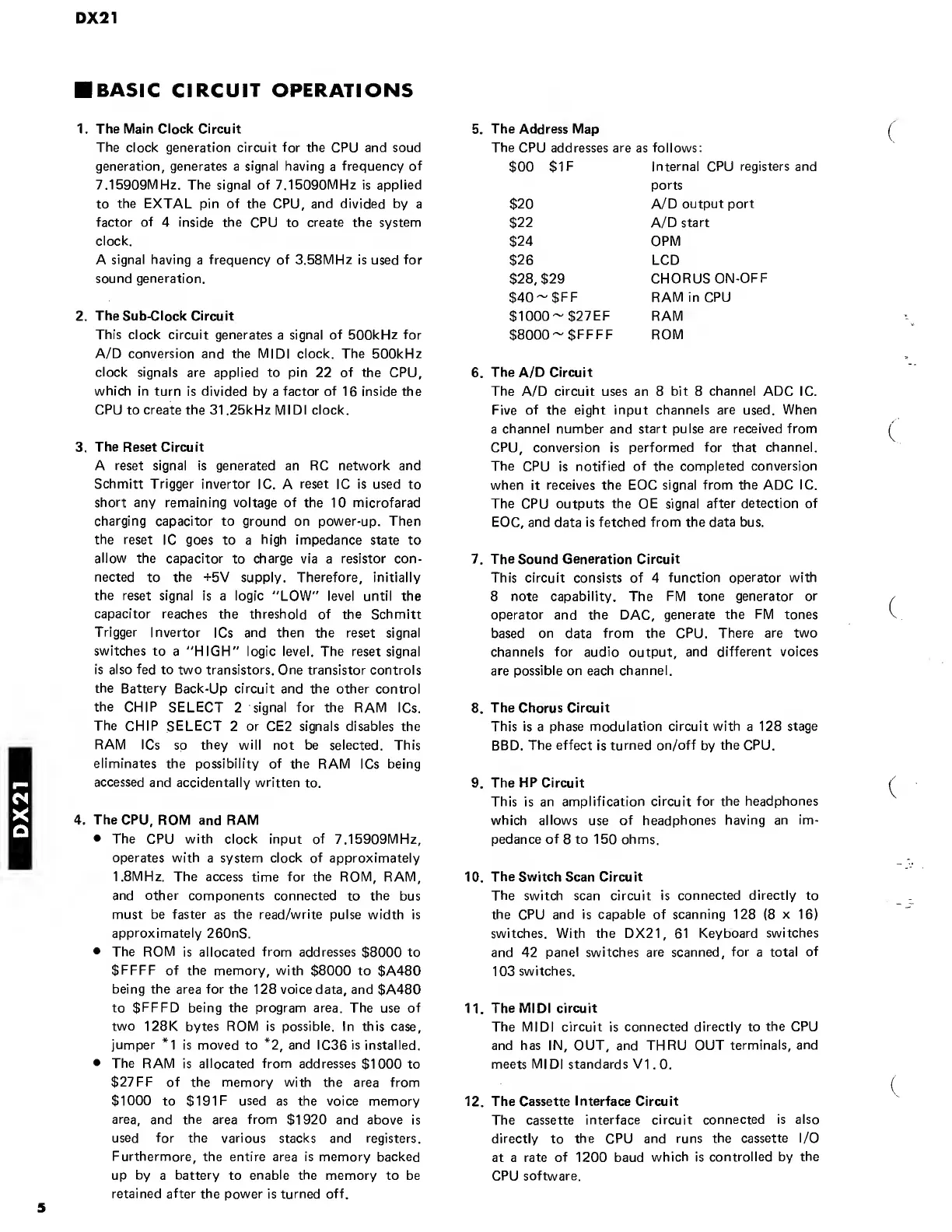
1.
The
Main
Clock
Circuit
The
clock
generation
circuit
for
the
CPU
and
soud
generation,
generates
a
signal
having
a
frequency
of
7.15909MHz.
The
signal
of
7.15090MHz
is
applied
to
the
EXTAL
pin
of
the
CPU,
and
divided
by
a
factor
of
4
inside
the
CPU
to
create
the
system
clock.
A
signal
having
a
frequency
of
3.58MHz
is
used
for
sound
generation.
2.
The
Sub-Clock
Circuit
This
clock
circuit
generates
a
signal
of
500kHz
for
A/D
conversion
and
the
MIDI
clock.
The
500kHz
clock
signals
are
applied
to
pin
22
of
the
CPU,
which
in
turn
is
divided
by
a
factor
of
16
inside
the
CPU
to
create
the
31.25kHz
MIDI
clock.
3.
The
Reset
Circuit
A
reset
signal
is
generated
an
RC
network
and
Schmitt
Trigger
invertor
1C.
A
reset
1C
is
used
to
short
any
remaining
voltage
of
the
10
microfarad
charging
capacitor
to
ground
on
power-up.
Then
the
reset
1C
goes
to
a
high
impedance
state
to
allow
the
capacitor
to
charge
via
a
resistor
con¬
nected
to
the
+5V
supply.
Therefore,
initially
the
reset
signal
is
a
logic
"LOW"
level
until
the
capacitor
reaches
the
threshold
of
the
Schmitt
Trigger
Invertor
ICs
and
then
the
reset
signal
switches
to
a
"HIGH"
logic
level.
The
reset
signal
is
also
fed
to
two
transistors.
One
transistor
controls
the
Battery
Back-Up
circuit
and
the
other
control
the
CHIP
SELECT
2
signal
for
the
RAM
ICs.
The
CHIP
SELECT
2
or
CE2
signals
disables
the
RAM
ICs
so
they
will
not
be
selected.
This
eliminates
the
possibility
of
the
RAM
ICs
being
accessed
and
accidentally
written
to.
4.
The
CPU,
ROM
and
RAM
•
The
CPU
with
clock
input
of
7.15909MHz,
operates
with
a
system
clock
of
approximately
1.8MHz.
The
access
time
for
the
ROM,
RAM,
and
other
components
connected
to
the
bus
must
be
faster
as
the
read/write
pulse
width
is
approximately
260nS.
•
The
ROM
is
allocated
from
addresses
$8000
to
$FFFF
of
the
memory,
with
$8000
to
$A480
being
the
area
for
the
128
voice
data,
and
$A480
to
$FFFD
being
the
program
area.
The
use
of
two
128K
bytes
ROM
is
possible.
In
this
case,
jumper
*1
is
moved
to
*2,
and
IC36
is
installed.
•
The
RAM
is
allocated
from
addresses
$1000
to
$27
FF
of
the
memory
with
the
area
from
$1000
to
$
191F
used
as
the
voice
memory
area,
and
the
area
from
$1920
and
above
is
used
for
the
various
stacks
and
registers.
Furthermore,
the
entire
area
is
memory
backed
up
by
a
battery
to
enable
the
memory
to
be
retained
after
the
power
is
turned
off.
5.
The
Address
Map
The
CPU
addresses
are
as
follows:
$00
$1F
Internal
CPU
registers
and
ports
$20
A/D
output
port
$22
A/D
start
$24
OPM
$26
LCD
$28,$29
CHORU5
ON-OFF
$40
~
$FF
RAM
in
CPU
$1000
~$27EF
RAM
$8000~$FFFF
ROM
6.
The
A/D
Circuit
The
A/D
circuit
uses
an
8
bit
8
channel
ADC
1C.
Five
of
the
eight
input
channels
are
used.
When
a
channel
number
and
start
pulse
are
received
from
CPU,
conversion
is
performed
for
that
channel.
The
CPU
is
notified
of
the
completed
conversion
when
it
receives
the
EOC
signal
from
the
ADC
1C.
The
CPU
outputs
the
OE
signal
after
detection
of
EOC,
and
data
is
fetched
from
the
data
bus.
7.
The
Sound
Generation
Circuit
This
circuit
consists
of
4
function
operator
with
8
note
capability.
The
FM
tone
generator
or
operator
and
the
DAC,
generate
the
FM
tones
based
on
data
from
the
CPU.
There
are
two
channels
for
audio
output,
and
different
voices
are
possible
on
each
channel.
8.
The
Chorus
Circuit
This
is
a
phase
modulation
circuit
with
a
128
stage
BBD.
The
effect
is
turned
on/off
by
the
CPU.
9.
The
HP
Circuit
This
is
an
amplification
circuit
for
the
headphones
which
allows
use
of
headphones
having
an
im¬
pedance
of
8
to
150
ohms.
10.
The
Switch
Scan
Circuit
The
switch
scan
circuit
is
connected
directly
to
the
CPU
and
is
capable
of
scanning
128
(8
x
16)
switches.
With
the
DX21,
61
Keyboard
switches
and
42
panel
switches
are
scanned,
for
a
total
of
103
switches.
11.
The
MIDI
circuit
The
MIDI
circuit
is
connected
directly
to
the
CPU
and
has
IN,
OUT,
and
THRU
OUT
terminals,
and
meets
MIDI
standards
VI.
0.
12.
The
Cassette
Interface
Circuit
The
cassette
interface
circuit
connected
is
also
directly
to
the
CPU
and
runs
the
cassette
I/O
at
a
rate
of
1200
baud
which
is
controlled
by
the
CPU
software.
5

Other manuals for Yamaha DX21

Related product manuals