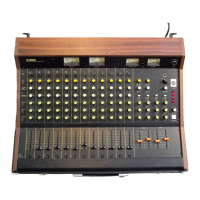
Need help?
Do you have a question about the Yamaha EMX2150 and is the answer not in the manual?
Keep the unit away from high temperatures, humidity, and dust to prevent mechanical damage.
Handle the unit with care to prevent damage from strong physical impacts.
Product contains no user-serviceable parts; refer all maintenance to qualified service personnel.
Always turn the power OFF before connecting or disconnecting cables to prevent unit damage.
Plug and unplug cables by gripping the connector, not the cord, to avoid damage.
Use a soft, dry cloth for cleaning; never use solvents like benzine or thinner.
Ensure the power source voltage matches the unit's specified voltage for safe operation.
Details on input channel controls including PAD, GAIN, CLIP indicator, and 3-band equalizer.
Overview of master controls: VU meters, graphic equalizers, AUX controls, DSP, faders, and PHONES jack.
Description of HI-Z and LO-Z input connectors for various source equipment.
Details on CH INSERT IN/OUT jacks for external signal processing equipment.
Information on AUX SEND and AUX RETURN jacks for external effects and monitoring.
Details on LINE OUT, GEQ OUT, SPEAKER OUT, FOOT SW jacks, and side panel POWER/PHANTOM switches.
Guidance on connecting various audio sources using LO-Z XLR and HI-Z phone jack inputs.
Procedure for accurately matching input sensitivity of each channel with its source signal.
Advice on setting channel and master faders for optimum noise, distortion, and control margin.
How to use HIGH, MIDDLE, and LOW equalization controls for tonal separation and feedback control.
Explanation of the built-in DSP effects, programs, and parameter editing for sound modification.
Uses of graphic equalizers for acoustic correction and feedback control in listening areas.
Guidelines for connecting speaker systems to the mixer's outputs, including impedance restrictions.
Illustration and explanation of a basic sound reinforcement system setup using the EMX2200.
Configuration for live performance with on-stage monitor speakers and external effects.
Power output ratings for EMX2150, EMX2200, and EMX2300 into different speaker impedances.
THD specifications for power amp output and channel input to line out.
Frequency response characteristics of the mixer's speaker outputs.
Hum and noise levels for various outputs and input configurations.
Voltage gain specifications for different input and output paths.
Crosstalk specifications between adjacent channels and input to output.
Range of the input channel gain control and operation of the pad switch.
Details on the range and type of the 3-band input channel equalization controls.
Specifications for the 9-band graphic equalizers, including frequency bands and boost/cut range.
List of available DSP effects, their program numbers, and programmable parameters.
Information on the illuminated VU meters and clip indicators.
Specification for the +48V phantom power applied to balanced inputs.
Voltage and power consumption requirements for different regions and models.
Physical dimensions for EMX2150, EMX2200, and EMX2300 mixers.
Weight specifications for EMX2150, EMX2200, and EMX2300 mixers.
Diagram illustrating signal paths, levels, and component interconnections within the mixer.

 To Next Page
 General