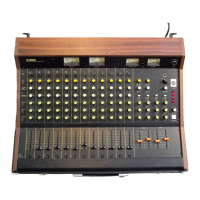
Need help?
Do you have a question about the Yamaha M916 and is the answer not in the manual?
Details on the mixer's frequency response range and total harmonic distortion levels.
Specifications related to the mixer's noise floor and signal isolation performance.
Information on maximum voltage gain and channel equalization capabilities.
Details on the High Pass Filter and input/output signal configurations.
Summary of mixer input and output signal characteristics.
Details on VU meters, peak indicators, and power consumption.
Information regarding the mixer's physical size, depth, height, and weight.
Detailed specifications for all input connections and levels.
Detailed specifications for all output connections and levels.
Adjusting input signal sensitivity and selecting input sources.
Using the channel fader and EQ for signal processing.
Applying HPF and adjusting stereo pan for input channels.
Managing foldback and echo signal routing and levels.
In-depth use of EQ and Pan controls for channel processing.
Controlling main program and foldback bus levels.
Managing overall echo bus send levels.
Adjusting effects return levels and stereo panning.
Choosing audio sources to monitor via the headphone output.
Setting the volume for the headphone output.
Assigning talkback to busses and setting input level.
Using the push-to-talk switch for talkback communication.
Understanding VU meter ballistics and peak LED warnings.
Selecting which signal sources are displayed on each meter.
AC power, fuse, power, and phantom power switch details.
PGM and Matrix output connections and specifications.
Various audio input jacks including Echo, FB, Sub, Effects, and Channel inputs.
Using EQ Out/Fader In jacks for signal processing insertion.
Best practices for cable connections to prevent noise.
Increasing output stage gain via internal jumper modification.
Modifying effects and matrix aux input sensitivity.
Changing echo and foldback send point logic.
Using the mixer for live sound reinforcement scenarios.
Creating multiple monitor mixes for live performances.
Integrating the mixer into studio recording setups.
Proper procedures for cleaning the mixer's exterior.
Guidance on spare parts and fuse replacement.
Safety warnings for accessing internal parts.
 General
| Channels | 16 |
|---|---|
| Inputs | 16 |
| Microphone Inputs | 8 |
| EQ Bands per Channel | 3 |
| Aux Sends | 2 |
| Phantom Power | Yes |
| Weight | 7.5 kg |
| Type | Analog |
| Line Inputs | 8 |

 To Next Page