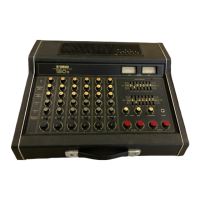
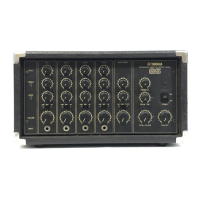
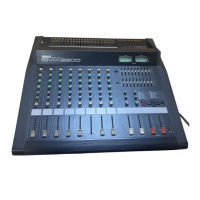
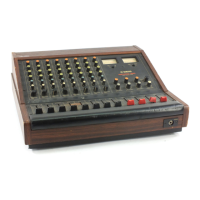
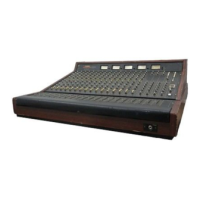
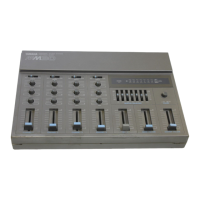
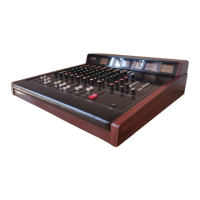
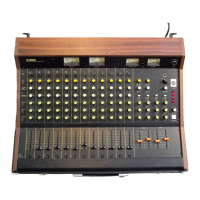
The Yamaha EM-100/80 Ensemble Mixers are audio units designed for mixing various sound sources, offering a range of features for both live performance and recording applications. The EM-100 is a 6-channel mixer, while the EM-80 is a 4-channel mixer, with both models sharing many core functionalities and specifications.
Function Description:
These mixers serve as a central hub for combining multiple audio inputs, including microphones, electric instruments (guitars, basses, combo organs), and line-level sources (tape decks, record players). They provide individual channel controls for volume, tone (treble and bass), and balance, allowing users to fine-tune the sound of each input. A built-in reverb effect can be blended into each channel, and the units also support external echo units via dedicated Echo Jacks. Master controls include overall volume, reverb/echo intensity, and separate volume controls for auxiliary inputs and monitor outputs. The EM-100 model additionally features VU meters for visual monitoring of the output level.
Important Technical Specifications:
- Channels: EM-100 has 6 input channels, EM-80 has 4 input channels.
- Output Power: Both models deliver 30 Wrms x 2.
- Dimensions (W x H x D):
- EM-100: 42.9 x 14.4 x 37.6 cm (17 x 5 x 14 ¾")
- EM-80: 34.5 x 14.4 x 37.6 cm (13 ½ x 5 x 14 ¾")
- Weight:
- EM-100: 8.5 kg (18.7 lbs.)
- EM-80: 8.0 kg (17.6 lbs.)
- Power Consumption: 130W (for both EM-100/80).
- Input Terminals (Nominal Input Level & Impedance):
- LINE: -19 dBm (0.09V) for EM-100, -21.5 dBm (0.065V) for EM-80; 50k Ω.
- INST.: -24.5 dBm (0.05V) for EM-100, -27 dBm (0.035V) for EM-80; 50k Ω.
- MIC.: -45 dBm (4mV) for EM-100, -47.5 dBm (3mV) for EM-80; 10k Ω.
- AUX.: -15 dBm (0.14V) for both; 50k Ω.
- FROM ECHO: -27 dBm (0.035V) for both; 50k Ω.
- Output Terminals (Nominal Output Level & Impedance):
- REC. OUT: -11 dBm (0.22V) for EM-100, -13.5 dBm (0.16V) for EM-80; 50k Ω.
- MONITOR OUT: +9 dBm (2.2V) for both; 5k Ω.
- TO ECHO: -13 dBm (0.17V) for EM-100, -15.5 dBm (0.13V) for EM-80; 50k Ω.
- Fittings: Includes Input Jacks (6 for EM-100, 4 for EM-80), Aux. In Jacks (L, R), Speaker Jacks (L, R), Monitor Out Jacks (L, R), Rec. Out Jacks (L, R), To Echo Jack, From Echo Jack, Level Meters (L, R, EM-100 only), Headphone Jack, and Pilot Lamp.
- Voltage Settings: 110, 130, 220, 240V (150, 260V settings not connected). U.S., Canadian, European, and Australian models are pre-set.
Usage Features:
- Input Selectors: Each channel features a three-setting input selector: "LINE" for audio units (tape decks, record players), "INST." for electric instruments (guitar, bass, combo organ), and "MIC" for microphones (voice, wind instruments, acoustic guitar).
- Balance Controls: Individual balance controls per channel allow users to distribute the input signal between the left and right output channels. Turning the knob fully left sends the signal to the left channel only, while the center position provides an even balance.
- Reverb/Echo Controls: A continuous control on each channel allows blending the built-in reverb effect. Connecting an external echo unit to the Echo Jacks converts the reverb effect to echo. A Master Reverb/Echo Control adjusts the overall intensity.
- Tone Controls: Each channel has independent Treble and Bass tone controls to adjust the high and low frequencies. Turning these knobs clockwise accentuates the respective tones.
- Volume Controls: Each channel has its own Volume knob to adjust the input level. A Master Volume Control manages the combined volume of all channels for the Speaker and Phones outputs.
- Aux. Volume Control: This knob adjusts the volume of the signal from the Aux. jacks, independently of other volume controls, including the Master Volume, for Speaker and Phones outputs.
- Monitor Volume Control: Controls the combined volume of all channel signals directed to the Monitor Out output.
- Rec. Out Jacks: These jacks are used for recording to a tape deck or recorder. They also function as signal input terminals when connecting another EM unit for extra channels.
- Echo Jacks: Dedicated jacks for connecting an external echo unit (To Echo for output, From Echo for return).
- Speaker Jacks: Designed for YES speakers, but compatible with other 8Ω speakers, provided their maximum allowable input is not too low.
- Monitor Out Jacks: Used to feed the mixed signal to a combination amplifier/speaker unit for additional power, suitable for large venues.
- Phones Jack: A stereo jack for stage or other monitoring purposes.
- Connecting Extra Channels: A second EM unit can be connected in two ways:
- (A) Sub unit Rec. Out to main unit Aux. jacks: Volume controlled by the main unit Aux. Volume knob, allowing independent volume control.
- (B) Sub unit Rec. Out to main unit Rec. Out jacks: Volume controlled by the main unit Master Volume knob.
Maintenance Features:
- Fuses: The unit includes fuses that should be replaced with the same value if they blow.
- Voltage Selector: A knob on the rear panel allows users to set the unit to their local voltage (110, 130, 220, 240V) before plugging in the power cord. This is a critical precaution to prevent damage.
- Power Switch: The power switch should be off before connecting or disconnecting any cords to ensure safety.
- Ventilation: Sufficient space around, behind, and under the unit is required for proper ventilation to prevent overheating.
- Environmental Protection: The unit should be protected from heat, humidity, dust, and shocks, and kept away from direct sunlight or other heat sources.
- Input Selector Usage: Users are advised not to switch input selectors while the amplifier is in use.
- VU Meters (EM-100 only): These meters help monitor the output level. If the needle exceeds +3 on either channel, it indicates a high signal level that will result in sound distortion, prompting the user to adjust levels to prevent clipping.

 Need help?

 To Next Page
 General