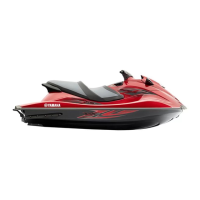
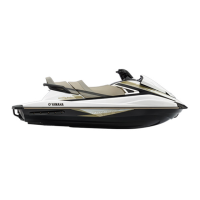
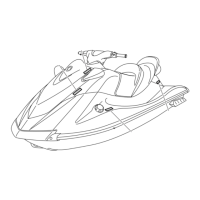
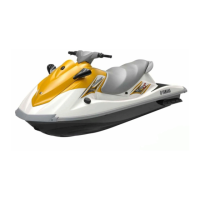
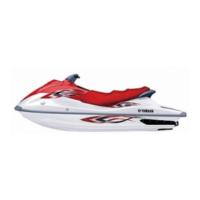
This document is an owner's/operator's manual for the 2012 Yamaha WaveRunner VXS/VXR personal watercraft. It provides comprehensive information on the watercraft's operation, maintenance, and safety.
Function Description
The Yamaha WaveRunner VXS/VXR is a personal watercraft (PWC) designed for recreational use, including water-skiing. It is propelled by a water-jet system directly connected to the engine, meaning there is no "neutral" position; it is either in "forward" or "reverse" depending on the shift lever. Steering is achieved by turning the handlebars, which changes the angle of the jet thrust nozzle. Throttle application is crucial for effective steering, especially at speeds above trolling. The watercraft is equipped with the Yamaha Engine Management System (YEMS), which includes an off-throttle steering (OTS) system. The OTS system activates at planing speeds to assist in turning by providing some thrust even when the throttle is released, allowing for sharper turns when throttle is applied while turning the handlebars. The OTS system does not function below planing speeds or when the engine is off. The watercraft is designed to carry an operator and up to two passengers, with a maximum load capacity of 240 kg (530 lb). For water-skiing, a spotter is required on board in addition to the operator and skier.
Important Technical Specifications
- Model: VX1800-L (VXS), VX1800A-L (VXR)
- Engine Type: Liquid cooled 4-stroke, DOHC, 4 cylinders
- Engine Displacement: 1812 cm³
- Bore & Stroke: 86.0 × 78.0 mm (3.39 × 3.07 in)
- Compression Ratio: 11.0:1
- Maximum Output (ISO 8665/SAE J1228): 132.4 kW @ 7600 r/min
- Lubrication System: Wet sump
- Cooling System: Water
- Starting System: Electric
- Ignition System: T.C.I.
- Spark Plug: LFR6A
- Spark Plug Gap: 0.8–0.9 mm (0.031–0.035 in)
- Battery Capacity: 12 V, 19 Ah
- Charging System: Flywheel magneto
- Propulsion System: Jet pump, axial flow, single stage
- Impeller Rotation: Counterclockwise
- Jet Thrust Nozzle Angle: 24.0° ± 24.0°
- Recommended Fuel: Regular unleaded gasoline
- Minimum Octane Rating (PON): 86
- Minimum Octane Rating (RON): 90
- Recommended Engine Oil Type SAE: SAE 10W-30, 10W-40, 20W-40, 20W-50
- Recommended Engine Oil Grade API: API SE, SF, SG, SH, SJ, SL
- Fuel Tank Total Capacity: 60 L (15.9 US gal, 13.2 Imp.gal)
- Engine Oil Quantity (with oil filter replacement): 3.1 L (3.28 US qt, 2.73 Imp.qt)
- Engine Oil Quantity (without oil filter replacement): 3.0 L (3.17 US qt, 2.64 Imp.qt)
- Engine Oil Total Quantity: 4.3 L (4.55 US qt, 3.78 Imp.qt)
- Maximum Fuel Consumption: 48.6 L/h (12.8 US gal/h, 10.7 Imp.gal/h)
- Cruising Range at Full Throttle: 1.24 hour
- Trolling Speed: 1300 ± 100 r/min
- Engine Idling Speed: 1300 ± 100 r/min
- Length: VXS 3220 mm (126.8 in), VXR 3270 mm (128.7 in)
- Width: 1170 mm (46.1 in)
- Height: 1160 mm (45.7 in)
- Dry Weight: VXS 327 kg (721 lb), VXR 330 kg (728 lb)
- Maximum People on Board: 3 persons
- Maximum Load Capacity: 240 kg (530 lb)
- Design Category: C (for winds up to Beaufort force 6 and significant wave heights up to 2 m)
Usage Features
- Remote Control Transmitter: Used to select Yamaha Security System (lock/unlock) and Low RPM Mode settings. The transmitter is not fully waterproof and should not be submerged.
- Yamaha Security System: Prevents unauthorized use by locking the engine.
- Low RPM Mode: Limits maximum engine speed to approximately 70% of normal, useful for beginners or restricted areas.
- Engine Stop Switch: Red button to immediately stop the engine.
- Engine Shut-off Switch: Automatically stops the engine if the operator falls off, by removing a clip attached to a lanyard worn by the operator.
- Start Switch: Green button to start the engine.
- Throttle Lever: Increases engine speed when squeezed.
- Steering System: Jet thrust steering, requiring throttle for effective turning.
- Reverse System: Allows for low-speed maneuvering in reverse. Should only be shifted while engine is idling or off. Not to be used for slowing down or stopping.
- Multifunction Information Center: Displays operating conditions such as tachometer, speedometer, hour meter/voltmeter, fuel level, and various warning indicators (check engine, engine overheat, oil pressure, fuel level). Speedometer units can be switched between km/h and mph.
- Storage Compartments: Bow storage compartment (50.0 L capacity, 5.0 kg load limit) and glove compartment (7.0 L capacity, 1.5 kg load limit). These are not waterproof.
- Fire Extinguisher Holder and Cover: Located in the bow storage compartment.
- Reboarding Step (VXR): Assists in reboarding from the water.
- Water-skiing: The watercraft can be used for water-skiing, requiring an operator, a rearward-facing spotter, and the skier. A cleat is provided for attaching the ski rope.
- Engine Break-in: A specific procedure for the first 1 hour 35 minutes of operation to ensure proper engine component wear.
- Fueling: Refuel in a well-ventilated area away from flames or sparks. Do not overfill the fuel tank.
- Bilge Water Draining: Procedures for draining water from the engine compartment on land and in water.
- Cooling Water Pilot Outlet: Discharges cooling water from the engine.
- Water Separator: Collects water that may enter the fuel tank breather hose.
Maintenance Features
- Periodic Maintenance Chart: Provides guidelines for regular checks and lubrication, recommended to be performed by a Yamaha dealer.
- Engine Oil and Oil Filter: Regular checks and replacement of engine oil and oil filter are crucial.
- Battery Care: Instructions for checking electrolyte level, cleaning terminals, applying grease, and proper storage.
- Flushing Cooling Water Passages: Essential post-operation care to prevent corrosion.
- Cleaning: Procedures for cleaning the watercraft, including the engine compartment, hull, deck, and jet pump.
- Lubrication: Specific points for lubricating cables (throttle, steering, shift) with marine grease and rust inhibitor.
- Rustproofing: Spraying metallic parts with a rust inhibitor and having internal engine components rustproofed by a dealer.
- Long-term Storage: Comprehensive steps for preparing the watercraft for extended storage, including fuel stabilization, cleaning, and battery removal/storage.
- Tool Kit: Included with the watercraft for basic maintenance.
- Fuse Replacement: Instructions for replacing blown fuses in the electrical box.

 Need help?

 To Next Page
 General