
 Need help?
Do you have a question about the Yamaha X-MAX 400 ABS 2018 and is the answer not in the manual?
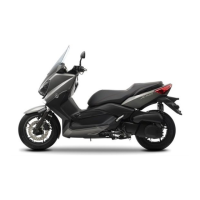
This document is the owner's manual for the Yamaha X-MAX 400 ABS motorcycle, model YP400RA. It provides comprehensive information on the operation, inspection, and maintenance of the scooter, emphasizing safety and proper riding techniques.
The Yamaha X-MAX 400 ABS is a single-track vehicle designed for on-road use, not suitable for off-road conditions. It is powered by a liquid-cooled, 4-stroke, DOHC single-cylinder engine with a displacement of 395 cm³. The bore and stroke are 83.0 × 73.0 mm (3.27 × 2.87 in), and the compression ratio is 10.6:1. The starting system is electric, and it uses a wet sump lubrication system. The recommended engine oil is YAMALUBE 10W-40 or SAE 10W-30 type SE motor oil, with an API service SG type or higher and JASO standard MA grade. The oil quantity for an oil change is 1.50 L (1.59 US qt, 1.32 Imp.qt), and with oil filter removal, it is 1.70 L (1.80 US qt, 1.50 Imp.qt).
The fuel system is fuel-injected, with a throttle body ID mark B741 00. It is designed to use premium unleaded gasoline (Gasohol [E10] acceptable) with a research octane number of 95 or higher. The fuel tank capacity is 13 L (3.4 US gal, 2.9 Imp.gal), and the fuel reserve amount is 2.4 L (0.63 US gal, 0.53 Imp.gal). The vehicle is equipped with catalytic converters in the exhaust system and a canister to prevent fuel vapor discharge into the atmosphere.
The electrical system operates at 12 V, with a TCI ignition system and an AC magneto charging system. The battery is a GTZ8V model, 12 V, 7.0 Ah (10 HR). All lighting, including headlights, brake/tail light, front and rear turn signal lights, auxiliary lights, license plate light, and meter lighting, are LED type. The turn signal lights are 10.0 W × 2, and the license plate light is 5.0 W × 1. Fuses include a 30.0 A main fuse, 10.0 A main fuse 2, 2.0 A terminal fuse 1 (for auxiliary DC jack), 10.0 A signaling system fuse, 7.5 A signaling system fuse 2, 10.0 A radiator fan motor fuse, 7.5 A backup fuse, 7.5 A turn signal light and hazard fuse, 7.5 A ABS control unit fuse, 30.0 A ABS motor fuse, 15.0 A ABS solenoid fuse, and 2.0 A answer back fuse.
The chassis features an underbone frame. The caster angle is 26.5°, and the trail is 95 mm (3.7 in). The front suspension is a telescopic fork with a coil spring and hydraulic damper, offering 110 mm (4.3 in) of wheel travel. The rear suspension is a unit swing type with a coil spring and hydraulic damper, providing 107 mm (4.2 in) of wheel travel. The shock absorber assemblies have spring preload adjusting rings, allowing for adjustment to suit rider preference and load.
Braking is handled by a hydraulic dual disc brake at the front and a hydraulic single disc brake at the rear, both using DOT 4 specified brake fluid. The vehicle is equipped with an Anti-lock Brake System (ABS) that acts on both front and rear brakes independently. The clutch is a dry, centrifugal, shoe type. The drivetrain uses a V-belt automatic transmission, with a primary reduction ratio of 1.000 and a secondary reduction ratio of 6.643 (31/14 x 42/14).
The tires are tubeless: front 120/70-15 M/C 56S and rear 150/70-13 M/C 64S, both MICHELIN/CITY GRIP. The front wheel rim size is 15 x MT3.50, and the rear is 13 x MT4.00. Recommended cold tire air pressure for one person is 220 kPa (2.20 kgf/cm², 32 psi) for the front and 250 kPa (2.50 kgf/cm², 36 psi) for the rear. For two persons, the pressures are the same. The minimum tire tread depth (front and rear) is 1.6 mm (0.06 in). The maximum load capacity (total weight of rider, passenger, cargo, and accessories) is 184 kg (406 lb).
Key usage features include a Smart Keyless System, SKEA7E-01 (Smart Unit) and SKEA7E-02 (Hand Unit), which allows vehicle operation without a mechanical key and includes an answer-back function. The smart key operating range is about 80 cm (31.5 in) from the antenna. The main switch controls vehicle power, steering lock, seat opening, fuel tank cap lid, and storage compartment A. The vehicle also has a sidestand with an ignition circuit cut-off system to prevent starting when the sidestand is down or if brakes are not applied. A rear brake lock lever prevents the rear wheel from moving when stopped.
The instrument panel includes a speedometer, tachometer (red zone at 8200 r/min and above), multi-function display, and various indicator and warning lights (turn signal, high beam, ABS, engine trouble, traction control system, smart key system). The multi-function display shows fuel meter, information display (air temperature, battery voltage, traction control system status, average/instantaneous fuel consumption, average speed, warning messages), coolant temperature meter, clock, and tripmeter displays (odometer, tripmeter, time tripmeter, fuel reserve tripmeter, oil change tripmeter, V-belt replacement tripmeter). The "TRIP/INFO" switch on the handlebar is used to navigate and adjust these settings.
The vehicle is equipped with a Traction Control System (TCS) that helps maintain traction on slippery surfaces by regulating engine power. The TCS can be turned off via the "INFO" switch. An auxiliary DC jack (12-V, 1 A max) is located in storage compartment A for accessories. The windshield height can be adjusted to one of two positions. Storage compartments include front storage compartments (A and B) and a rear storage compartment under the seat. Load limits are 1 kg (2.2 lb) for compartment A, 0.5 kg (1.1 lb) for compartment B, and 5 kg (11 lb) for the rear storage compartment.
Maintenance features include periodic checks and adjustments for fuel line, spark plug, valve clearance, fuel injection, exhaust system, evaporative emission control system, air induction system, air filter elements, V-belt case air filter element, brakes (front and rear), brake hoses, brake fluid, rear brake lock cable, wheels, tires, wheel bearings, steering bearings, chassis fasteners, brake lever pivot shafts, sidestand, sidestand switch, front fork, shock absorber assemblies, engine oil, engine oil filter element, final transmission oil, cooling system, V-belt, and brake switches. The owner's tool kit is located under the seat. The manual provides troubleshooting charts for starting problems, poor engine performance, and engine overheating. An emergency mode allows vehicle operation without the smart key if it is lost or discharged, using the smart key system identification number.
 General
| Brand | Yamaha |
|---|---|
| Model | X-MAX 400 ABS 2018 |
| Category | Motorcycle |
| Language | English |



 To Next Page