Need help?
Do you have a question about the YARDMAX YG1650 and is the answer not in the manual?
Essential guidelines for safe operation and handling of the lawn mower.
Advice on operator safety, keeping bystanders clear, and avoiding hazards.
Specific safety considerations related to the lawn mower's engine.
Critical safety instructions for handling gasoline and refueling.
Rules for safe operation, including starting, stopping, and mowing techniques.
Guidelines for safely operating the mower on slopes and inclines.
Precautions for preparing and maintaining a safe mowing environment.
Step-by-step guide on safely starting and stopping the lawn mower engine.
Essential engine maintenance, including oil level checks and oil changes.
Instructions for inspecting, sharpening, and replacing the cutting blade.
Solutions for common problems like engine failure or poor cutting.
This document is an operator's manual for a YARDMAX walk-behind lawn mower, model YG1650. It provides comprehensive instructions for assembly, operation, and maintenance, emphasizing safety throughout. The manual aims to ensure users can operate the machine effectively and safely, promoting longevity and optimal performance.
The lawn mower is designed for residential homeowners, primarily for cutting grass on well-maintained lawns. It is not intended for cutting brush or agricultural uses. The design focuses on ease of use, portability, and convenience, promising a clean and spotless cut. The manual highlights the YARDMAX commitment to "MAX Performance, MAX Value, MAX Support," backed by manufacturing expertise, enhanced design, quality metal parts, a robust warranty, and budget-friendly pricing.
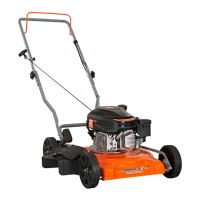
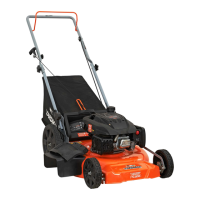
The YARDMAX walk-behind lawn mower is a gasoline-powered machine designed to cut grass. It features a recoil starting system and offers multiple cutting options: bagging, mulching, and side discharge. The engine start/stop control is integrated into the upper handle, requiring the operator to depress and squeeze it against the handle to run the unit and release it to stop the engine and blade. This control acts as a safety device, preventing accidental operation. The mower is equipped with a cutting height adjustment lever, allowing users to select from seven different positions to suit their lawn's requirements, with a medium position recommended for most lawns.
For grass collection, the mower includes a grass catcher that attaches to the rear discharge door. When the grass catcher is used, clippings are collected in the bag. Alternatively, the mower can be configured for mulching, where grass clippings are finely cut and recirculated back onto the lawn. This mode is activated by removing the side discharge chute, which allows the mulch cover to close. For effective mulching, it's advised not to cut wet grass or grass exceeding four inches in height. The side discharge mode allows clippings to be discharged to the side through a deflector, which is installed by lifting the mulch cover and sliding the deflector hooks under the hinge pin.
Before operation, users must read and understand the entire manual, paying close attention to all cautions and warnings. The machine is shipped without gasoline or oil in the engine, so users must service the engine with both as instructed in the Engine Operator's Manual. Fueling should always be done outdoors in a well-ventilated area, with the engine off and cooled, to prevent ignition of flammable vapors. The fuel tank should not be overfilled, leaving space for expansion. Similarly, engine oil must be added to the correct level, checking the dipstick daily to avoid overfilling or underfilling, which can damage the engine.
When starting the engine, the primer bulb is used for cold starts (one to three presses), followed by a brisk pull of the recoil starter grip. For hot starts, only the recoil starter grip is needed. Operators should stand behind the mower and pull the starter rope at a 30-degree angle. The manual warns about rapid retraction (kickback) of the starter cord, which can cause injury.
Basic cutting procedure involves using a sharp blade for best results and avoiding cutting more than 1/3 of the grass length, especially during dry periods. For very long grass, it's recommended to cut twice, first at a higher setting. Mowing patterns should vary to prevent stripes, and operating across slopes (not up and down) is advised for safety. The manual stresses maintaining control on slopes and avoiding operation on slopes greater than 15 degrees. It also advises against operating on wet grass, which can cause slipping and falls.
The manual provides a detailed maintenance schedule, outlining tasks and intervals for ensuring the mower's safe and efficient operation. Before any maintenance, the engine must be stopped, allowed to cool, the spark plug wire disconnected and grounded, and the Electric Start Push Key (if equipped) removed to prevent accidental starting.
Key maintenance tasks include:
For storage, the manual advises emptying the fuel tank by running the engine dry or adding a fuel stabilizer for longer storage (over 30 days). The spark plug should be removed, a tablespoon of clean engine oil poured into the cylinder, and the starter rope pulled several times to distribute the oil, preventing cylinder corrosion. The product should be stored in a dry, frost-proof, and lockable area, away from children and corrosive materials. The handle can be folded for compact storage, but care must be taken to avoid damaging cables. A protective cover is recommended, but not plastic, which can trap condensation.
 General
| Starting System | Recoil |
|---|---|
| Cutting Width | 21 inches |
| Cutting Height Adjustment | Single lever |
| Cutting Height Positions | 6 |
| Mulch Capable | Yes |
| Side Discharge | Yes |
| Rear Bag | Yes |
| Wheel Size (Rear) | 11 inches |
| Mulching Capability | Yes |
| Self-Propelled | No |
| Starter Type | Recoil |
| Engine Type | Briggs & Stratton |
| Drive Type | Push |
| Wheel Size (Front) | 7 inches |

 To Next Page