6
Initial Setup
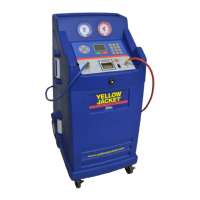
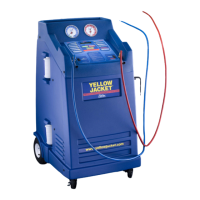
To ensure quick, successful integration of the 37880
into your shop, please follow these set-up procedures
before the first use of the unit.
Step 1: FILL VACUUM PUMP WITH OIL
1.
Remove thumbscrews located under
the vacuum
pump shelf.
2.
Rotate the front of the vacuum pump
out to expose
the oil fill port.
3.
Remove the fill cap located on top of
the vacuum
pump.
4.
Using a funnel, insert oil to the oil level line usin
g
the provided YELLOW J
ACKET vacuum pump oil.
5.
Replace the oil fill cap.
6.
Rotate the vacuum pump back into
its original
position and
replace the
thumbscrews.
Step 2: FILL SOU
RCE TANK WITH REFRIGERANT
(also see page 11)
1.
Disconnect blue tank ho
se from tank.
2.
Open blue tank valve and allow nitr
ogen in tank to
vent.
3.
Reconnect blue tank ho
se.
4.
Attach the tank refill ad
apter (Part No. 19153) to the
R-134a virgin cylinder. WARNI
NG: DO NOT OVER-
TIGHTEN THE TANK REFILL ADAPTER.
5.
Plug unit into
a grounded 110V outlet.
6.
Turn on the main power switch.
7.
Select TANK REFIL from the main menu
8.
Follow the us
er prompts to complete the tank refill
process.
9.
When the display reads “SUPPLY TANK EMPT
Y”
disconnect blue
hose.
10.
Remove the tank refill adapter from empty R-13
4a
virgin cylinder and place it in the tool tray located on
top of the unit.
The Recovery Option should be used to fully recovery and
recycle all refrigerant from an air conditioning system. For
instance, if the system needs to be opened to atmosphere
to replace a part, all refrigerant must be removed before
opening the system.
RECOVER Operational Steps
1. Verify the automobile air conditioning system is
off.
2. Select RECOVER for recovery operations. The
LCD should read “CONNECT SERVICE HOSES
TO VEHICLE ENTER TO CONTINUE.”
NOTE: If desired, the gauges of the 37880 SERIES
can now be used to aid investigation of an A/C system
problem. Ensure the automobile A/C system is turned
off prior to selecting a mode on the machine.
3. Connect the high and low side auto service hoses
to the respective high and low side service ports
on the automobile A/C system. Open the service
hose valves.
4. Press START to begin recovery operations.
WARNING: DO NOT RECOVER CONTAMINATED
REFRIGERANT WITH THIS UNIT. RECOVERING
CONTAMINATED REFRIGERANT WILL VOID ALL
WARRANTIES AND MAY CAUSE DAMAGE TO OTHER
AUTOMOBILES SERVICED IN THE FUTURE.
During the recovery operation, refrigerant is removed from
both the high and low side of the automobile air condition-
ing system. The LCD will display the amount of refrigerant
being recovered and the status line will read
“RECOVERING REFRIGERANT.”
Note: If “RECOVERY HOLD” Option is selected The
unit will stop at 6” of mercury and hold for five min as re-
quired by EPA Per SAE J2211. If the pressure rises to 0
psi the compressor will restart and the unit will pull down
to the required 6” of mercury and hold for two minutes.
The unit will repeat this process until the system pressure
remains stable at vacuum for two minutes or until it fails
this process five times. If the process fails five times the
status line will read “LEAK CHECK FAILED.” This may
mean that the automobile A/C system has a gross leak
and it will not hold a vacuum.
If this occurs take the appropriate steps to locate the leak
and properly repair it.
If the “RECOVERY HOLD” option is not selected the unit
will shut off at the required level of vacuum and the opera-
tor must insure that the EPA standard (SAE J2211) is met.
After the system turns off, the unit will beep to alert the
technician the job is complete. The oil removed from the
auto will drain into the oil drain bottle on the side of the
unit. Because a small amount of gas will be released as
the oil drains, a small hissing sound may come from the
bottle.
Always inspect hoses, o-rings, and fittings for damage be-
fore using equipment. Replace worn or damaged compo-
nents. Failure to insure that hoses, o-rings and fittings are
in working order can increase a build-up of NCG’s in the
recovered refrigerant.
RECOVER



 To Next Page