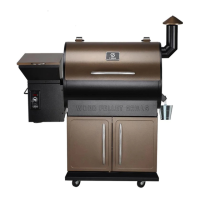
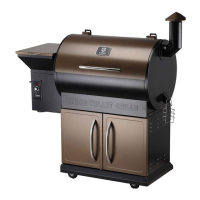
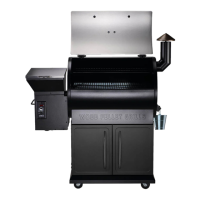
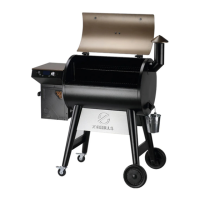
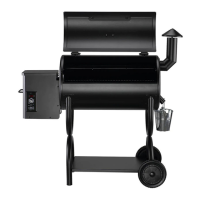
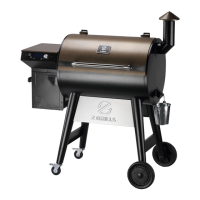
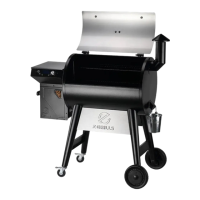
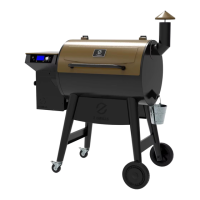
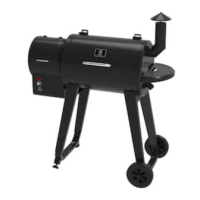
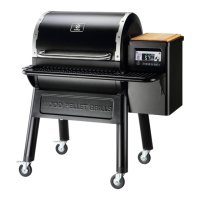
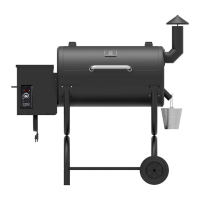
This document describes the Z GRILLS Wood Pellet Grill, models ZPG-700D3 and ZPG-700D4E, an outdoor cooking appliance designed for use with wood pellets. The grill's primary function is to cook food using indirect heat generated by burning wood pellets, providing a distinct smoky flavor.
Function Description
The Z GRILLS Wood Pellet Grill operates by feeding wood pellets from a hopper into a firepot via an auger. A hot rod ignites the pellets, and a fan circulates heat and smoke throughout the grill chamber. A digital thermostat control allows users to set and maintain desired cooking temperatures. The grill is designed for outdoor use only and should not be operated in any enclosed area. It is crucial to use only wood pellets specifically designed for wood pellet grills and to avoid pellets labeled as having additives. The grill's design incorporates a grease drain pan and a grease bucket to collect drippings, minimizing the risk of grease fires.
Usage Features
The grill features a comprehensive assembly process, starting with the body frame, followed by the hopper, chamber, and various internal components like the heat baffle, grease drain pan, porcelain grills, and warming rack. The hopper includes a pellet cleanout door, allowing users to easily empty unused pellets or switch between different smoking flavors.
Initial firing instructions are critical for first-time use and whenever the grill runs out of pellets. This process involves removing internal components, checking the auger and firepot for obstructions, plugging in the power cord, and setting the temperature dial to "SMOKE." Users should confirm the auger is turning, the fan is blowing air, and the hot rod is heating up. After a shutdown cycle, the hopper is filled with pellets, and the grill is run at "HIGH" to allow pellets to travel through the tube. Once pellets are dropping, another shutdown cycle is performed. Finally, the grill is set to "SMOKE" to achieve full flame, followed by another shutdown cycle. Once cool, components are reinstalled, and the grill is preheated at "HIGH" for 45 minutes to burn off any foreign matter before cooking. It is essential to always start the grill on the "SMOKE" setting with the lid open.
Subsequent start-up procedures are provided for instances where the grill fails to light or the fire goes out during cooking. These steps emphasize turning off and unplugging the grill, allowing it to cool, and removing all food, internal components, unburned pellets, and ash from the firepot. After plugging it back in, the grill is turned on, and pellets should fall into the firepot, with the hot rod heating up. If flames appear, components are reinstalled, and the grill is set to "SMOKE" with the lid open before adjusting to the desired cooking temperature.
Operating tips highlight factors influencing grill temperature, such as external conditions (temperature, humidity, wind, pellet quality). Sheltering the grill from wind can improve temperature output and heat retention. Frequent lid opening is discouraged as it increases cooking time. Preheating the grill for 10 minutes before adding food is recommended for faster heating. Users are warned never to move the grill while in use or to put water into the pellet hopper or firepot. A critical safety warning advises against adding pellets directly to the firepot, as this is dangerous. If pellets run out, the grill should be allowed to cool, and the initial firing instructions followed.
The digital thermostat control wiring diagram illustrates the connections for the power cord, hot rod, draft inducer fan, auger drive motor, and RTD sensor. The control panel features settings for "SMOKE," "Shut Down Cycle," and various temperature ranges (180°F to 375°F and "High"). It also includes ports for two meat probes (PROBE1 and PROBE2), allowing users to monitor internal food temperatures. The P1 temperature on the control panel displays the reading from PROBE1, and P2 from PROBE2.
Maintenance Features
Regular maintenance is crucial for the Z GRILLS grill. Before any maintenance or cleaning, the grill must be turned off, unplugged, and completely cold.
Grease management is a key aspect of maintenance. Grease accumulates on the flue lining, grease drain tube, V-shaped grease drain, and grease drain pan. These areas should be regularly checked and cleaned to prevent grease fires. It is easier to remove accumulated grease when the grill is still warm (not hot), but heat-resistant gloves are recommended to prevent burns. Users can scrape grease accumulation from the V-shaped grease drain and grease drain tube using a stiff, nonmetallic tool, pushing it into the grease bucket. Remaining residue can be wiped with paper towels or rags. Wrapping the grease drain pan with heavy-duty aluminum foil before use is suggested for easier cleaning. If a grease fire occurs, the temperature dial should be turned to "SHUT DOWN CYCLE," and the lid kept open until the fire is out. Once cool, all grease accumulation should be cleaned.
The flue pipe (smoke stack) also requires cleaning. The chimney cap assembly should be removed, and the flue pipe cleaned with warm soapy water. Creosote and grease accumulation inside the vertical and horizontal sections of the flue pipe can be scraped with a stiff, nonmetallic tool. Water or other liquid cleaners should not be sprayed inside the grill.
Outside surfaces can be cleaned with warm soapy water, avoiding oven cleaner, abrasive cleansers, or abrasive cleaning pads. Using a Z GRILLS cover is highly recommended for protection, and a high-quality car wax can be used to protect the grill's finish.
Internal components, such as the porcelain-coated grill grates, should be cleaned with a long-handled cleaning brush after each use. The inner RTD temperature probe should also be cleaned after each use.
Ash removal is necessary periodically. Excessive ash in the firepot can cause the fire to go out, especially in the "SMOKE" setting. A shop vacuum is recommended for removing ash. A strict warning states that the grill fire must be out, the unit off, unplugged, and cold before attempting to clean ash.
Troubleshooting information is provided for common issues like the grill not working, fire going out, or difficulties starting. Solutions include checking power connections, replacing fuses, inspecting the hot rod, and ensuring wires and connectors are secure. For issues related to the auger drive motor, checking the small fan motor blade is suggested. If the fan does not turn on, the motor may need replacement. Error codes (LEr for low temperature, HEr for high temperature, Er 1 for probe connection, and Er 2 for temperature dial security) are also explained, with corresponding solutions. A critical warning advises against turning off the main switch while the fan is still running during the "SHUT DOWN CYCLE," as this interruption could lead to a fire in the hopper chamber. The grill will automatically shut off when the cycle is complete.


 To Next Page
 General