
 Need help?
Do you have a question about the Zanussi ZFU25200WA and is the answer not in the manual?
Safety measures for children and vulnerable individuals regarding appliance use and disposal.
General safety precautions for operating the appliance, including ventilation and appliance usage.
Guidance on freezing fresh food, including preparation and process duration.
Instructions for storing frozen food, including initial setup and drawer usage.
How to activate and use the Fast Freeze function.
Explanation of the alarm light indicating temperature rise and its behavior.
Methods for thawing frozen food.
Instructions on how to remove and reinsert freezer baskets and shelves.
Regular cleaning procedures for the appliance interior and exterior.
Explanation that the freezer is 'no frost' and how it works.
Guidelines for placing the appliance based on climate class and ambient temperature.
Advice on where to place the appliance for optimal air circulation and heat avoidance.
Important notes for electrical connection during installation.
Instructions for installing rear spacers for proper ventilation.
How to ensure the appliance is level using adjustable feet.
Overview of the appliance's main components and features.
Description of normal operational sounds and their causes.
Tips for optimizing energy consumption.
Advice for maximizing the freezing process efficiency.
Tips for optimal storage of frozen food.
This document is a user manual for a Zanussi freezer, model ZFU25200WA. It provides comprehensive instructions for safe operation, daily use, maintenance, and installation of the appliance.
The Zanussi ZFU25200WA is a freezer designed for household use, intended for keeping foodstuffs and beverages. It features a freezer compartment suitable for freezing fresh food and storing frozen and deep-frozen food for extended periods. The appliance operates as a "no frost" type, meaning there is no buildup of frost on the internal walls or on the food due to continuous circulation of cold air driven by an automatically controlled fan.
The freezer includes a control panel with an alarm light, fast freeze indicator, fast freeze switch, pilot light, and a temperature regulator. The temperature is automatically regulated, and users can adjust it to achieve desired coldness levels. The appliance also features a "Fast Freeze" function to rapidly freeze fresh food, which should be activated 24 hours before placing food in the freezer. An "Excessive Temperature Alarm" alerts users to abnormal temperature rises, such as during a power cut.
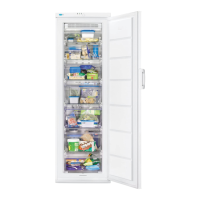
The internal layout includes freezer baskets, flaps, and maxibox baskets for organized storage. Some baskets have limit stops to prevent accidental removal, requiring a specific tilting motion for insertion and removal.
Switching On and Off: To switch on, insert the plug and turn the temperature regulator clockwise to a medium setting. The pilot light and alarm light will illuminate. To switch off, turn the temperature regulator to the "0" position.
Temperature Regulation: The temperature regulator allows users to adjust the coldness. Turning it towards lower settings provides minimum coldness, while higher settings provide maximum coldness. The intermediate position is generally recommended. The optimal setting depends on room temperature, frequency of door openings, and the quantity of food stored.
Freezing Fresh Food: The freezer compartment is designed for freezing fresh food. To use the "Fast Freeze" function, activate it 24 hours before placing food in the top compartment. The maximum amount of food that can be frozen in 24 hours is specified on the rating plate. The freezing process takes 24 hours, during which no additional food should be added. After 24 hours, the "Fast Freeze" function should be deactivated.
Storage of Frozen Food: For optimal storage, allow the appliance to run for at least 2 hours before storing products, especially after initial startup or a period of disuse. Freezer drawers facilitate easy access to food packages. For large quantities, all drawers except the bottom one can be removed to ensure good air circulation. Food can protrude up to 15 mm from the door on all shelves.
Thawing: Frozen food can be thawed in the refrigerator compartment or at room temperature. Small pieces can be cooked directly from frozen, though this will increase cooking time. In case of accidental defrosting (e.g., power failure exceeding the "rising time" value), defrosted food must be consumed quickly or cooked and then re-frozen after cooling.
Energy Saving Hints: To save energy, avoid frequent or prolonged door openings. If the ambient temperature is high, and the temperature regulator is set to a low temperature with a fully loaded appliance, the compressor may run continuously, causing frost buildup. In such cases, set the regulator to warmer settings to allow automatic defrosting and reduce electricity consumption.
Freezing Hints: For best freezing results, only freeze high-quality, fresh, and thoroughly cleaned foodstuffs. Prepare food in small portions for rapid freezing and easier thawing of required quantities. Wrap food in aluminum foil or polythene, ensuring airtight packages. Avoid direct contact between fresh, unfrozen food and already frozen food to prevent temperature rise in the latter. Lean foods store better and longer than fatty ones, and salt reduces storage life. Water ices consumed directly from the freezer can cause frost burns. It is advisable to mark the freezing date on each pack to track storage time.
Storage of Frozen Food Hints: Ensure commercially frozen foodstuffs are adequately stored by the retailer and transferred to the freezer as quickly as possible. Do not open the door frequently or leave it open longer than necessary. Once defrosted, food deteriorates rapidly and should not be re-frozen. Adhere to the storage period indicated by the food manufacturer.
Cleaning the Interior: Before first use, wash the interior and all accessories with lukewarm water and neutral soap, then dry thoroughly. Avoid detergents or abrasive powders, as they can damage the finish and leave strong odors.
Periodic Cleaning: The appliance should be cleaned regularly. Clean the inside and accessories with lukewarm water and neutral soap. Regularly check and wipe door seals to ensure they are clean and free from debris. Rinse and dry thoroughly. Do not pull, move, or damage pipes/cables inside the cabinet. Never use detergents, abrasive powders, highly perfumed cleaning products, or wax polishes on the interior.
Cleaning the Condenser: Clean the condenser (black grill) and compressor at the back of the appliance with a brush to improve performance and save electricity. Take care not to damage the cooling system.
Cleaning the Outer Casing: Many kitchen surface cleaners contain chemicals that can damage the plastics of the appliance. The outer casing should only be cleaned with warm water and a little washing-up liquid. After cleaning, reconnect the appliance to the mains supply.
Defrosting the Freezer: As a "no frost" type, manual defrosting is not required.
Removal of Freezing Baskets and Glass Shelves: Some freezing baskets have limit stops. To remove, pull the basket towards you, then tilt its front upwards at the end point. To re-insert, slightly lift the front to guide it past the end points, then push it back into position. Glass shelves are secured by locking pins; use a screwdriver to loosen the pins, pull them out, and then pull the shelf outwards.
Door Reversibility: The door opening direction can be changed. This operation requires careful handling, ideally with another person. Steps include removing the plug, tilting the appliance, removing the plinth and cap, unscrewing and repositioning hinges and pins, refitting the door, and then re-inserting cover pins and handle on the opposite side. A final check ensures all screws are tightened. After door reversal, it is advisable to wait at least four hours before connecting the appliance to allow oil to flow back into the compressor.
Troubleshooting: The manual provides a troubleshooting guide for common issues such as the appliance not operating, pilot light flashing, alarm light flashing, compressor operating continually, and incorrect freezer temperatures. It also addresses issues like excessive frost. Solutions often involve checking power connections, adjusting temperature settings, ensuring the door is closed properly, or contacting a qualified electrician.
Safety Precautions: Always unplug the appliance before carrying out any maintenance. The appliance contains hydrocarbons in its cooling unit, so maintenance and recharging must be performed by authorized technicians.
 General
| Annual energy consumption | 304 kWh |
|---|---|
| Noise level | 40 dB |
| Freezing capacity | - kg/24h |
| Fast freeze function | Yes |
| Freezer net capacity | - L |
| Freezer gross capacity | 250 L |
| Door hinge | - |
| Product type | Upright freezer |
| Product color | White |
| Appliance placement | Freestanding |
 Weight and Dimensions
| Width | - mm |
|---|---|
| Weight | 71100 g |




 To Next Page