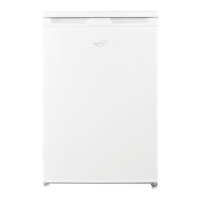
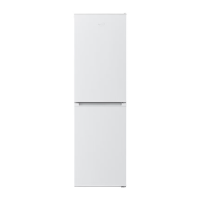
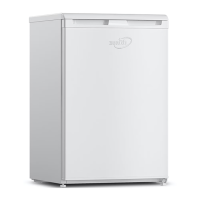
This document is an instruction manual for the Zenith refrigerator models ZLS3481W and ZLS4481W. It provides comprehensive information on safety, installation, operation, maintenance, and warranty.
Function Description:
The Zenith ZLS3481W and ZLS4481W are refrigerating appliances designed for household use, specifically for the short-term storage of fresh food and drinks. They are not intended for commercial use or for storing sensitive products requiring controlled temperatures like vaccines or medical supplies. The refrigerator operates by maintaining an internal temperature, which can be regulated using a thermostat knob. It features automatic defrosting, with thawing water flowing into a collection container at the rear of the device.
Important Technical Specifications:
- Refrigerant Gas: The product may comprise a cooling system using R600a gas. Users are warned to avoid damaging the cooling system and its pipes due to the flammability of this gas. The type of gas used is indicated on a label on the inner left side of the product.
- Electrical Connection: The appliance requires connection to a grounded socket protected by an appropriate capacity fuse. The connection must comply with national regulations, and the power cable plug must be easily accessible after installation. Extension cables and multiway plugs are not to be used.
- Operating Temperature: The average temperature inside the fridge should be around +5°C. The operating temperature is regulated by a thermostat knob with settings from 1 (lowest cooling/warmest) to 5 (highest cooling/coldest), or Min to Max. The appliance can be stopped by turning the thermostat knob to "O" position (if equipped).
- Lighting: The product is equipped with a lighting source of "G" energy class. If the product has LED type lighting, replacement should be done by authorized service. The lamps are designed to withstand extreme physical conditions (below -20°C) and are not suitable for household room illumination.
- Installation Clearances: For efficient operation, there must be appropriate air ventilation around the refrigerator. If placed in a wall recess, there should be at least 5 cm distance with the ceiling and at least 5 cm with the wall. If the floor is carpeted, the product must be elevated 2.5 cm from the floor. When installing two refrigerators side by side, there should be at least 2 cm distance between them.
- Ambient Temperature: The ambient temperature of the room where the refrigerator is installed should be at least 5°C.
- Door Reversibility: The doors of the appliance can be reversed, with detailed instructions provided for the process, including the removal and re-positioning of hinges and feet.
Usage Features:
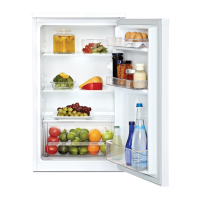
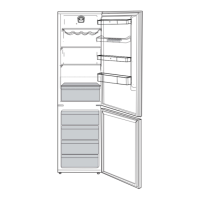
- Interior Compartments: The refrigerator includes movable shelves, allowing for adjustable distances between them. A vegetable drawer is provided for storing vegetables and fruits for extended periods. Bottle shelves are available for bottles, jars, and tins.
- Food Storage Guidelines:
- Milk products should be stored in their intended compartment.
- Raw meat is best kept in a polyethylene bag on the bottom shelf (crisper cover).
- Hot foods and beverages should be allowed to cool to room temperature before placing them in the refrigerator.
- Concentrated alcohol should be stored upright and tightly closed.
- Explosive substances or containers with flammable propellant gases (e.g., canned cream, spray cans) should not be stored in the device due to explosion risk.
- Liquids in bottles and cans should not be placed in the freezer compartment (if applicable) as they may burst.
- Liquids should be placed in an upright position after tightly closing the lid.
- Raw meat and poultry should be kept below cooked food and dairy products.
- Food should be stored for the shortest possible time, adhering to 'Best Before' and 'Use By' dates.
- Unusable leaves on vegetables should be removed, and soil wiped off.
- Lettuce, cabbage, parsley, and cauliflower should be left on the stem.
- Cheese should be wrapped in greaseproof paper and then in a polythene bag, with as much air excluded as possible. For best results, it should be taken out of the fridge an hour before eating.
- Raw meat and poultry should be wrapped loosely in polythene or aluminum foil to prevent drying.
- Fish and offal should be wrapped in polythene bags.
- Food with strong odors or that can dry out should be wrapped in polythene bags, aluminum foil, or placed in an airtight container.
- Bread should be wrapped well to keep it fresh.
- White wines, beer, lager, and mineral water should be chilled before serving.
- Bananas and melons should not be stored in the fridge, though melons can be chilled for short periods if wrapped to avoid flavoring other food.
- The door should not be left open for long periods to avoid increased running costs.
- Initial Operation: When operating for the first time, the refrigerator should be run empty for the initial six hours, and the door should not be opened frequently.
Maintenance Features:
- Regular Cleaning: The refrigerator should be cleaned at regular intervals to extend its service life.
- Cleaning Agents:
- Never use gasoline, benzene, or similar substances for cleaning.
- Avoid sharp and abrasive tools, soap, household cleaners, detergent, and wax polish.
- For non-No Frost products, water drops and frosting on the rear wall of the fridge compartment should not be cleaned with oil or similar agents.
- Only use slightly damp microfiber cloths for the outer surface.
- A solution of one teaspoon of bi-carbonate in half a liter of water can be used to wipe the interior, followed by drying.
- Ensure no water enters the lamp housing or other electrical items.
- Never use cleaning agents or water containing chlorine on outer surfaces and chromium-coated parts, as chlorine causes corrosion.
- Door Shelves: Door shelves can be removed by pulling them up for cleaning and reinstalled by sliding them from top to bottom.
- Door Gaskets: Door gaskets should be checked regularly and cleaned if necessary.
- Avoiding Bad Odors:
- Keep the refrigerator clean, as food residuals and stains can cause odors. Clean with bi-carbonate dissolved in water every few months.
- Store food in closed containers to prevent microorganisms from spreading.
- Do not keep spoiled food or food past its best before date.
- Protecting Plastic Surfaces: Avoid placing liquid oils or oil-cooked meals in unsealed containers, as they can damage plastic surfaces. Spilled oil should be cleaned and rinsed immediately with warm water.
- Defrosting: The refrigerator defrosts automatically. Thawing water flows into a drain channel and collection container. Any water droplets that freeze after defrosting should be removed with a cloth soaked in warm water, avoiding hard or sharp objects. The flow of thawed water should be checked periodically for blockages.
- Extended Storage: If the refrigerator will not be used for a long period, it should be unplugged, emptied of food, cleaned, and the door left ajar to prevent mold.

 Need help?
 General

 To Next Page