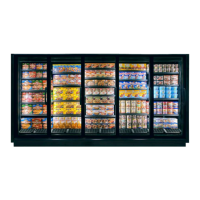
RVZC30 (and BB/T/TBB/WA), RVZP30 (and BB/T/TBB/WA), RVC24
4
0407
INTRODUCTION
The information contained in this manual pertains to the Evolution
display freezers which include:
RVZC30 RVZC24 RVZP30
RVZC30BB RVZCWA RVZP30BB
RVZC30T RVZCWB RVZP30T
RVZC30TBB RVZP30TBB
(The 30" 1-door case is based on the 24" door platform; for the 1-
door case, please use the coil assembly drawings, defrost and
electrical specifications listed for 24" door cases.) Specification
sheets for each of these cases is supplied separately and are avail-
able at www.zero-zone.com. All of these cases are used for mer-
chandising ice, frozen food, or ice cream.
Zero Zone has made every effort to produce refrigeration equip-
ment of the highest quality using state-of-the-art components. The
cases are built with the thickest insulation in the industry and a high
efficiency evaporator coil. Potential case features include:
• Brushless D.C. electronic motors or
PSC or shaded pole fan motors
• T-8 fluorescent lamps
• LED lighting or fiber optic lighting
• Standard-energy, low-energy or no-energy doors
These display cases were designed and tested using the following
industry standards:
• ASHRAE Standard 72-2005 – Method of Testing Commercial
Refrigerators and Freezers (ANSI Approved)
• ARI 1200- Performance Rating of Commercial Refrigerated Dis-
play Merchandisers and Storage Cabinets (ANSI Approved)
• UL 471- Commercial Refrigerators and Freezers (ANSI Ap-
proved) (equipment certified by ETL)
• NSF 7- Commercial Refrigerators and Freezers (ANSI Approved)
(equipment certified by NSF)
ASHRAE 72-2005 specifies the test conditions for the equipment.
It includes the ambient conditions of 75° F dry bulb and 55% RH. It
also specifies the door opening requirements for the performance
test. Doors are opened six times in one hour for 6 seconds. The
door opening test period is for 8 hours during one 24-hour perfor-
mance test. As an example a 5-door case will have 240 door open-
ings during one 24-hour test.
Consult the factory if your store exceeds these test conditions.
DELIVERY INSPECTION
These display cases were carefully factory-tested, inspected and
properly packed to ensure delivery in the best possible condition.
The equipment should be uncrated and checked for damage im-
mediately upon delivery. DAMAGE MUST BE NOTED AT TIME
OF DELIVERY AND ALL CLAIMS FOR DAMAGES MUST BE
FILED WITH THE TRANSPORTATION COMPANY - NOT WITH
ZERO ZONE. The carrier will supply necessary report and claim
forms.
PACKAGING
Each case in a line up is labeled to identify the line up and joint.
The label uses a number and letter designation. The number indi-
cates the lineup. The letter indicates the case joint. Case joints
begin with the letter A at the left most joint in the lineup, when look-
ing at the front of the line up. The joint for two cases has the same
number-letter designation (Figure 1). Back to Back cases have a
unique designation. The left most joint in the lineup when looking
at the front of the case is labeled 1-A. The joint on the back of the
case is 1-A1 (Figure 1).
Insulated dividers are factory installed to separate low and medium
temperature cases. They are also used to join different case mod-
els. Factory installed “Plexi” glass dividers separate refrigeration
circuits.
The first case in the line up (with it’s right side labeled A) has a
packet attached to the door handle that contains the manual, spe-
cial instructions for installing ordered options, and touch up paint if
the cases are custom painted Every other case in the line up has a
packet attached to the door that contains the specific information
for that case. The packing slip is taped to each case’s right hand
door.
Bumpers and kick plates are shipped on top of the case. Shelves
for the case are tie wrapped and blocked into the individual cases.
Other accessories like, drain traps, drain pans, condensate evapo-
rating pans, and hat channels are shipped in the case that require
the parts.
Materials for joining cases include caulk, joining bolts, splices and
T or J strips. These parts are supplied in cases that have a left-
side insulated divider or no left end. The parts are bagged and
taped to the coil covers. The T and J strips are tied to the shelves.
LOCATION
These cases must not be installed in the direct rays of the sun or
near a source of radiant heat.
Be certain that the floor under the installation is of sufficient strength
to prevent sagging. Out of level conditions will result in reduced
performance.
Wall cases (cases set with a back to a wall) and cases set back to
back, should be positioned to allow a minimum 2 - 4 inch space
behind the back of the unit(s). This will allow necessary air to circu-
late behind the display case(s). Higher humidity stores with mini-
mal air circulation require a 4” gap.


 To Next Page