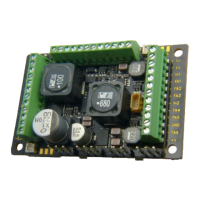
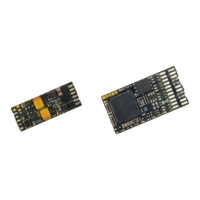
Page 10 Function-Decoders MX681, MX685, MX686, MX687, MX688
3.8 The NMRA-DCC function mapping
CVs #33 to #46 are reserved for the function mapping of the first address. It links a specific function
key to a specific function output. It is also possible to control several function outputs with one func-
tion key. Each function key is represented by a single CV in the in the table below. The individual bits
of a CV represent individual function outputs.
Due to the fact that function decoders have a maximum of 8 function outputs (headlights, FA1-FA6),
the "superfluous" bits (see table below) are shifted to the left (according to NMRA rules), so that "low"
function outputs (FA0v / r, FA1) can also be controlled by "high" function keys (F3 and higher).
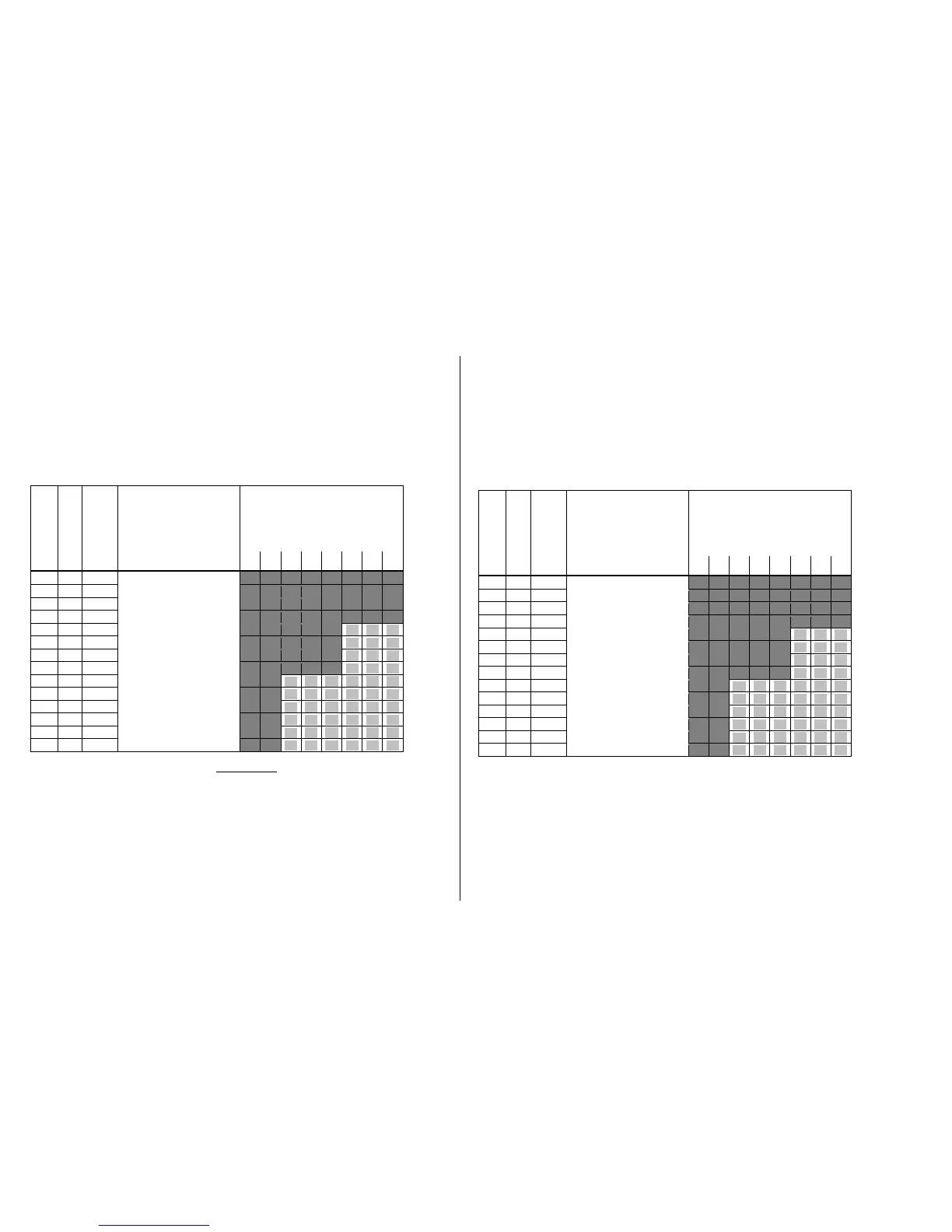
Below: NMRA standard bits (dark gray boxes) and “right shifted” bits (shaded gray):
The black dots in the table above indicate the default settings at the time of delivery, where each func-
tion key corresponds to the same numbered function output. Therefore, the following values were writ-
ten to these CV’s by default:
CV #33 = 1
CV #34 = 2
CV #35 = 4
CV #36 = 8
CV #37 = 2
CV #38 = 4
CV #39 = 8
CV #40 = 16
and so on
The Function mapping for the Second address is defined (in the same way as for the first
address) with
CVs #69 to #82
The commands of the first and the second address are read separately, and stored according to the
respective "function mapping" and the desired function output states.
After power-on (system boot-up, longer track power interruption etc.), the decoder is first waiting for a
SECOND ADDRESS command (provided the second address is not 0) and the outputs are set based on
this secondary address command. (First-address commands are executed only if changes in the function
output states between successive first-address commands occur.) During continued operation the "prin-
ciple of the most recent change" between first and second address commands applies.
Identical to the first address: NMRA standard bits (dark gray) and “right shifted” bits (shaded gray):
Tip: Directional taillights with the help of special effect CV’s:
With the NMRA function mapping only F0 can be directional and was intended for the headlights, so
they automatically switch between “front” and “rear” when the driving direction is changed. All other
functions are controlled direction-independent.
The special effect CVs #125 - 132, #159 and #160 (see chapter “Special function output effects”),
each assigned to a function output (up to FO8), make it possible to have more direction dependent
functions. To utilize only the directional capabilities of these CVs use only the directional Bits 0 and/or
1 without setting the actual effect-bits.


 To Next Page