Need help?
Do you have a question about the Zoom MRS-1266 and is the answer not in the manual?
Outlines critical safety guidelines, warnings, and precautions for hazard-free operation.
Provides essential advice on electrical interference, cleaning, backup, and copyrights.
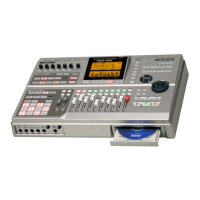
Introduces the ZOOM MRS-1266 Multitrak Recording Studio and its key features.
Describes the recorder section's tracks, V-takes, and recording capabilities.
Explains the rhythm section's patterns, songs, and synchronization features.
Details the mixer's channels, parameters, and automated operation.
Explains the insert and send/return effects available on the unit.
Identifies and labels the controls and sections on the top panel of the MRS-1266.
Identifies the connectors and switches located on the rear panel of the unit.
Identifies the connectors and controls situated on the front panel of the unit.
Illustrates rear panel connections for instruments, audio, and MIDI devices.
Illustrates front panel connections for instruments, expression pedals, and foot switches.
Provides steps for powering on the unit.
Guides on how to load and select the demo song.
Instructions for playing the loaded demo song.
Details the correct procedure for powering off the device.
Guides the user through the initial process of creating a new project.
Explains how to create a rhythm song using patterns, chords, and tempo information.
Guides on recording the initial audio track with a rhythm backing.
Details how to record additional parts over existing tracks using the overdubbing function.
Explains the process of mixing recorded tracks and rhythm into a final song.
Explains the concept and usage of virtual tracks (V-takes) for recording multiple takes.
Describes how to navigate to specific points within a song using time or measure units.
Details the punch-in/out feature for re-recording specific sections of a track.
Explains the mixdown process to record tracks as a stereo mix onto the master track.
Details the bounce function for mixing multiple tracks onto one or two tracks.
Explains editing audio data by directly rewriting waveform data using various commands.
Guides on copying a specific section of audio data to another track or V-take.
Covers editing audio data on a V-take basis, including copy, move, and erase functions.
Describes the mixer that processes input signals from jacks, adjusting sensitivity, pan, and send levels.
Details the mixer that processes playback signals from tracks and the rhythm section for stereo mixing.
Explains how to adjust the effect depth by setting the send level for chorus/delay and reverb.
Guides on adjusting the stereo position (pan) or balance of signals from input mixer or tracks.
Details saving and recalling mixer and effect settings as 'scenes' for quick recall.
Guides on creating custom rhythm patterns using real-time or step input methods.
Details methods for inputting rhythm pattern data, including step and FAST input.
Explains how to add chord and root information to rhythm songs to affect bass phrases.
Explains how to select positions, patches, and edit insert effects.
Guides on editing effect parameters and types to customize insert effect patches.
Explains how to select and edit patches for reverb and chorus/delay effects.
Explains how to write project master tracks to a CD-R/RW disc for audio playback.
Provides steps for writing a single project's master track to an audio CD.
Details the procedure for finalizing a CD-R/RW disc to ensure compatibility with ordinary CD players.
Outlines common operations like loading, saving, copying, and erasing projects.
Explains how to back up projects to CD-R/RW discs and restore them.
Guides on configuring MIDI channel assignments, timing clocks, and other MIDI functions.
Introduces the SMF player function for importing and playing Standard MIDI Files.
Guides on using the built-in chromatic tuner for instrument tuning.
Explains how to enable SCMS to prevent digital copying.
Introduces procedures for testing, repairing, and formatting the internal hard disk.
Guides on testing and repairing the hard disk for data integrity issues.
Details the process of formatting the hard disk, including data loss warnings.
Provides detailed technical specifications for the MRS-1266 unit.
Offers solutions for common operational problems encountered with the MRS-1266.
Lists and describes available effect types and their parameters for insert and send/return effects.
Provides a comprehensive list of rhythm patterns available on the unit.
Lists available drum kits and bass programs with their corresponding MIDI program numbers.
Provides a chart mapping MIDI note numbers to specific drum sounds on the pads.
Lists all available instrument sounds for the drum pads.
Lists all available phrases and their corresponding categories.
Details the MIDI implementation, including recognized and transmitted messages.
Provides a summary chart of the MRS-1266's MIDI capabilities and message handling.
 General
| Brand | Zoom |
|---|---|
| Model | MRS-1266 |
| Category | Recording Equipment |
| Language | English |

 To Next Page