Need help?
Do you have a question about the Zoom MRS-8 and is the answer not in the manual?
Explains warnings and cautions to prevent accidents.
Details precautions for electrical interference, cleaning, backup, and copyrights.
Records and plays back audio signals.
Uses internal drum/bass sound source to play rhythms.
Mixes signals from recorder and drum/bass source into a stereo signal.
Processes input, recorder playback, or drum/bass signals for sound characteristics.
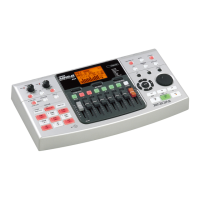
Identifies controls and indicators on the front panel of the MRS-8.
Describes the display section of the MRS-8, including indicators and keys.
Details the control section with keys, dial, and cursor keys for operating the MRS-8.
Explains the fader section with individual faders for tracks and master control.
Covers the transport controls like PLAY, REC, STOP, REW, FF for controlling playback and recording.
Shows and labels the connectors and switches on the rear panel of the MRS-8.
Instructions for inserting an SD card into the MRS-8 for storage media.
Steps for inserting IEC R6 (size AA) batteries to power the MRS-8.
Covers creating a new project and selecting a guide rhythm for recording.
Details how to adjust input sensitivity for the MRS-8's input connectors and built-in mic.
Guides on selecting and applying insert effects for guitar/bass recording.
Explains how to select a track and record the input sound with insert effect applied.
Shows how to record further tracks while listening to a recorded track.
Explains adjusting track levels, panning, and EQ for creating a stereo mix.
Explains how to use the mastering effect immediately before the MASTER fader for final mix processing.
Guides on recording the final stereo mix onto the master track of the MRS-8.
Explains virtual tracks (V-takes) for each track, allowing multiple recordings on one track.
How to specify and move to a specific point in a song using time or measure units.
Explains how to set index marks at any position in a song for easy navigation.
How to set start (A) and end (B) points to repeat a specific section of a song.
Details manual and auto punch-in/out for re-recording specific parts of a track.
Explains recording audio and drum/bass tracks as a stereo mix onto the master track.
Mixing sounds from multiple tracks onto one or two tracks for recording.
Bouncing drum/bass track onto any track while playing other tracks.
Adjusting the length and volume of the pre-count heard before recording.
Explains editing audio data within a specified range on a track.
How to copy a specified range of audio data from one track/V-take to another.
Procedure to move a specified range of audio data from one track/V-take to another.
How to erase audio data within a specified range, returning it to mute condition.
Adjusting start/end points by erasing data outside a specified range.
How to apply fade-in or fade-out to audio data over a specified range.
How to reverse the order of a specified range of audio data.
Editing audio data in V-take units like erase, copy, move, exchange, import.
Explains the functions and operation of the built-in mixer of the MRS-8.
How to select input sources and send them to audio tracks for recording.
Adjusting track parameters like level, panning, EQ, and effect send for each track.
How to link adjacent mono tracks (1/2 or 3/4) to create stereo tracks.
Explains the functions and operation of the built-in rhythm section.
Describes the drum kits (27 sounds) and bass programs (5 types) available in the rhythm section.
Information on accompaniment patterns with drum/bass data, up to 99 measures each.
Sequence of rhythm patterns with programmed chord/tempo info for an entire song.
How to select and play one of the over 500 available rhythm patterns.
How to create your own rhythm patterns using real-time or step input.
How to edit the automatically assigned name for a rhythm pattern.
How to copy or erase existing rhythm patterns.
How to create a rhythm song by sequencing patterns with chord/tempo information.
Importing rhythm patterns/songs or specific patterns from another project saved on SD card.
Adjusting rhythm section settings like pad sensitivity, metronome volume, and pre-count.
Explains the two types of effects: insert and send/return.
Describes insert effects, their positions in the signal path, and processing methods.
Explains send/return effects connected to the mixer's send/return loop for reverb, chorus, etc.
How to select insert effect position, patch, and edit patches.
How to change where the insert effect is applied in the signal path.
How to select an algorithm and patch for the insert effect.
How to edit effect types and parameters for the currently selected patch.
How to store edited patches or interchange patch positions.
How to apply insert effect to monitor signal only, recording unprocessed input signal.
How to select and edit patches for the send/return effect.
Importing patches from another project for insert or send/return effects.
Explains that song data is managed in units called projects, containing all settings.
How to perform operations like loading, saving, copying, and erasing projects.
Load a previously saved project from the SD card.
Create a new project on the SD card.
How to select and load a saved project from the SD card.
Duplicates a project saved on the SD card.
Erases a saved project from the SD card.
How to edit the name of the currently loaded project.
Disables project saving and editing by enabling write protection.
Explains MIDI as a standard for exchanging musical data between devices.
Lists functions like sending play info, sync info, and control change messages via MIDI.
How to make MIDI-related settings for the MRS-8.
Specifying MIDI channels for sending drum kit and bass program playing information.
Setting whether MIDI synchronization message Timing Clock will be transmitted.
Specifying whether Song Position Pointer messages indicating current position will be transmitted.
Specifying whether Start/Stop/Continue messages indicating transport status will be transmitted.
Specifying whether MIDI Time Code (MTC) messages for synchronization will be transmitted.
Lining up master tracks from multiple projects to play them continuously.
Registering projects in a playlist to specify their playback order for sequence play.
Selecting and playing a playlist for continuous project playback.
How to use the tuner to detect pitch and tune instruments.
How to use various tuning types besides chromatic, like guitar and bass standard tunings.
Changing the level meter to show post-fader or pre-fader signal levels.
Adjusting display contrast and turning the backlight on or off.
Procedure for safely removing or inserting an SD card while the MRS-8 is on.
How to format an SD card in the MRS-8, erasing all data.
Displaying remaining SD card capacity and current project size.
Solutions for issues like no sound, weak sound, distorted playback, or fader problems.
Solutions for issues like inability to record, no input signal, or distorted recorded sound.
Troubleshooting for insert and send/return effects not working correctly.
Solutions for issues with rhythm pattern playback, pad tapping, and song creation.
Troubleshooting for MIDI synchronization issues with external devices.
Solutions for issues like creating/saving projects, and SD card recognition.
Lists the technical specifications of the MRS-8, including recorder, mixer, effect, and rhythm functions.
Details parameters for various effect modules and algorithms.
Lists available rhythm patterns, their variations, and measures.
Lists drum kits and bass programs available, with their corresponding numbers.
Table mapping instruments to MIDI note numbers across different pad banks.
Describes the file structure on the SD card, including PROJxxx folder and specific files.
Explains MIDI messages recognized and transmitted by the MRS-8.
A chart detailing MIDI functions, transmitted/recognized messages, and modes.
 General
| Brand | Zoom |
|---|---|
| Model | MRS-8 |
| Category | Recording Equipment |
| Language | English |

 To Next Page