Loopdrive – User and installation manual
Quiescent mode, system OK
LOOP SHORT side A (active)
LOOP SHORT side A (memory)
LOOP SHORT side B (active)
LOOP SHORT side B (memory)
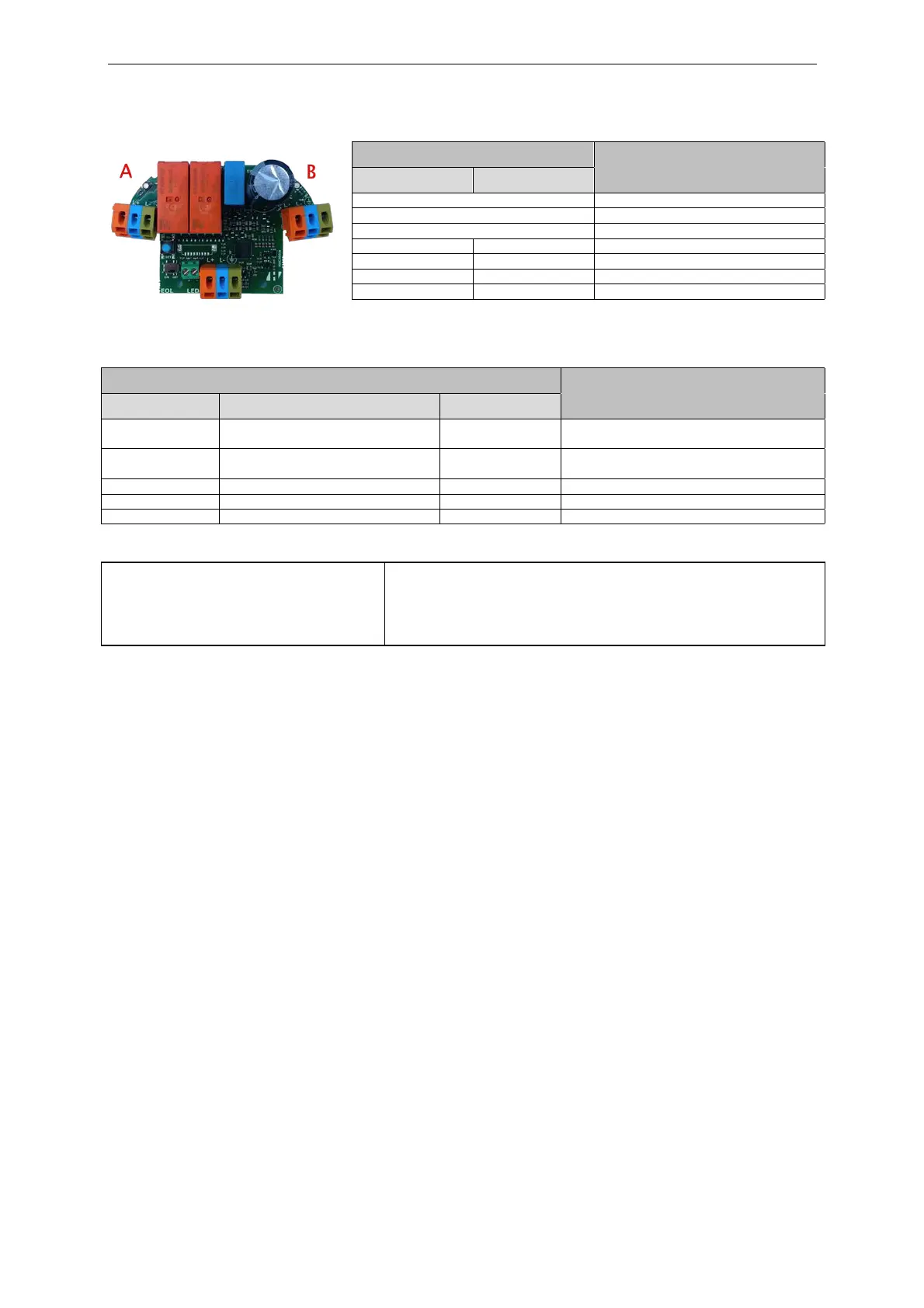
Table 2. FIM indications -basic
Table 3. FIM indications - advanced
LOOP SHORT side A (active)
LOOP SHORT side B (memory)
LOOP SHORT side A (memory)
LOOP SHORT side B (active)
T-branch SHORT or OPEN (memory)
Blinking speed:
fast = 4 blinks/s
slow = 1 blink/s
very slow = 1 blink/4s
Fault status:
active - fault is currently detected
memory - fault was detected in the past and fixed
NOTE:
FIM is not capable of indicating EARTH faults and LOOP OPEN faults.
1.4. Fault contact
Loopdrive provides fault contact output per loudspeaker line for integration with any Voice Alarm System via
programmable control inputs. Every loudspeaker line can have separate contact closure, or – depending on the
system design – multiple loudspeaker lines can share common fault contact.
The contact is normally open during quiescent mode of the system. During quiescent mode:
a. Loopdrive system is powered and running, monitoring entire loudspeaker line,
b. Power amplifier is connected,
c. Loop is closed and fully working, every T-Branch is fully operational,
d. No faults detected.
Any other state, including service mode, amplifier disconnection or even power failure of Loopdrive, will immediately
close the contact, reporting failure to the main system.


 To Next Page